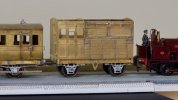
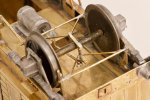
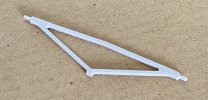
The Heybridge Railway, 1889 to 1913

RichardG

Western Thunderer
Very nice.

To be seen at Albury this year?

Graham thank you for your kind words, they really do help.

Yes I do hope to bring myself, Lady Marion (the loco one*) and the horse box. Her Ladyship is battery-powered so the ensemble won't actually need any track :). I will bring along a box of my GER wagons so people can see them. A bit of a mixed bunch, that's the wagons and the people who come along as well.

DSC_9454.jpeg
 
Last edited:

RichardG

Western Thunderer
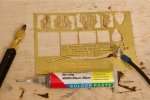
DSC_9459.jpegA nice thing about this kit is the provision of two layers of brass for each brake hanger and brake block. So the parts will look reasonably substantial.

The solder paste is 'JPT183'. It works well without any additional flux; and for small parts like these the 2 volt setting on the RSU is fine. The return lead bolted onto the work seems easier and more positive than using the magnets on the steel plate, but I guess this is a matter of taste. Anyway, my RSU didn't come with a steel plate.

DSC_9461.jpeg
What is not so nice is, the brake blocks end up around 1.3 mm from the wheels. So there will be a hiatus in the build while I sort something out. I am thinking of 0.8 mm square brass to make overscale brake pads with a better gap.
 

spikey faz

Western Thunderer
View attachment 238012
What is not so nice is, the brake blocks end up around 1.3 mm from the wheels. So there will be a hiatus in the build while I sort something out. I am thinking of 0.8 mm square brass to make overscale brake pads with a better gap.
Hi Richard

If the kit brake blocks are already a reasonable scale representation of the prototype blocks, would it not be better to cut off the push-rod and move it towards the wheel by 1.3mm. I realise this would entail repositioning the vertical support as well, but seems a shame to have to make overscale brake blocks instead.

But irrespective of how you sort out the brakes, it's a really nice build. :thumbs:

Mike
 

RichardG

Western Thunderer
. . . would it not be better to cut off the push-rod and move it towards the wheel by 1.3mm . . .

Mike I like the idea, and certainly two wrongs don’t make a right.

On the other hand this is my first attempt at an item of express passenger stock. There are eight brake blocks in all, each with its own linkage.

DSC_9462.jpeg

So if I move the brake hangers closer to the wheels, I will have to remake every linkage.

Of course I don’t know yet whether the linkages will actually fit, but everything except the roof has been spot-on until now.

It’s all a bit of a step up from my previous wagon builds, which mostly have one or two brake shoes or even none at all!
 

RichardG

Western Thunderer
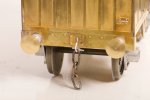
Three days ago I was in a proper pickle because I broke one of the buffer stocks whilst drilling it out. So I wrote to David Hill ( @Genghis ) the proprietor of Gladiator Models asking for a replacement. Two spare castings arrived yesterday and I fixed one onto the model today. So that's barely three days in all, and a first class service from Gladiator.

DSC_9469.jpeg
Staying with the buffers, the next task was to drill through each shank to take a length of piano wire. I found this straightforward with a pillar drill, even if it was all a bit difficult to see. Witness the second from right.

DSC_9473.jpeg
The giant chain was for test running at NEEGOG yesterday. The acid test here is to propel a wagon at maximum speed. In this case, the model not only stayed on the track but seemed to ride rather well too, which is a bonus.
 

RichardG

Western Thunderer
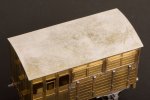
A good friend (who, incidentally, I met through WT) suggested gluing a lens cleaning tissue onto the roof to represent canvas. What could be simpler? Well, I took me four goes but eventually I achieved a result without rips and air bubbles.

DSC_9482 (1).jpeg
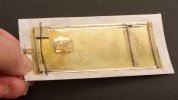
For the final attempt, I unfolded the tissue and let it dry out. Spread PVA glue over the bare roof, and applied the tissue. I teased out as many of the creases and air bubbles as I could, and then misted the paper with ironing water. I think any water would do, the main thing is the tissue then shrank as it dried out.

DSC_9480.jpeg
While the tissue was still wet, I tucked the edges underneath.

Along the way I realised, there is no need to iron out the folds in the tissue, in fact this makes things more difficult. The tissue must be dried out before starting, otherwise the alcohol stops the PVA making a bond. If things go wrong, PVA washes off brass with soapy water. And despite my fears, the model is not scented with Purple Freesia and Bergamot :)
 
Last edited:

RichardG

Western Thunderer
Looks very much like an original Unimat one.

DSC_9486.jpeg
The Proxxon TBM220 drill press has been mentioned a few times on WT and mine is being very useful. Unfortunately the same firm's machine vice is showing signs of wear already. So I have bought myself a milling vice from Unimat (above), this is made out of tool steel instead of cast aluminium. Buy cheap buy twice they say! The Unimat part number is 164090.

This is just the right size. Thanks to @simond for pointing me in the right direction.
 

RichardG

Western Thunderer
View attachment 238012What is not so nice is, the brake blocks end up around 1.3 mm from the wheels. So there will be a hiatus in the build while I sort something out. I am thinking of 0.8 mm square brass to make overscale brake pads with a better gap.

These horse boxes were built with handbrakes only (1878) and later rebuilt with clasp brakes (1888). Much as I would like to model only the handbrakes, I really have got to tackle the clasp brakes. I have spent a week mulling this over, and finally made a start.
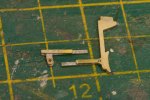
DSC_9490.jpeg
The large spacing for the brake shoes is always going to look wrong. I opened up the push rods for the handbrakes so I could make them longer.
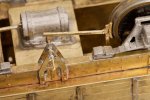
DSC_9514.jpeg
Then I rebuilt the push rods in position on the model, and filled the two gaps with small pieces of fret.
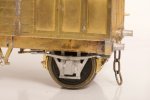
DSC_9507.jpeg
The kit provides tabs and slots to locate the remaining six brake hangers, but the tabs (or if you prefer, the slots) are in the wrong place. So I filed down every tab, and added the rest of the hangers. So all eight hangers are a presentable distance from the wheels.

DSC_9495.jpeg
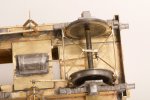
The instructions suggest assembling the mechanisms for the clasp brakes in position on the model. This seems incredibly difficult so I assembled the first one on the bench. The long link is free to move on all three pivots (despite appearances!), so the assembly articulates.
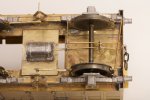
DSC_9500.jpeg
Needless to say, having put the brake hangers in sensible positions, the two pairs of links are too long.
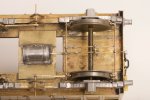
DSC_9503.jpeg
I have wriggled my way out of this by cutting the two longer links and then overlapping the cut parts.
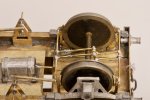
DSC_9504.jpeg
Here is a different view of the same assembly.

I wonder, is there a better solution? I feel, if I try to butt-join the cut pieces of link and laminate a reinforcement on the inside, I will make things worse. And, this bodgery isn't going to show from normal viewing angles. But fresh ideas might help me when I do the second set of clasp brakes. Right now, everything including me is well overdue for a bath :D
 

RichardG

Western Thunderer
Incidentally, I have had to build this arrangement of links and rods to comprehend how it works. During assembly, it seemed the design was simplified, there is no fulcrum for the long link with three pivots. Finally, it has dawned on me that the axle of the wheel is the fulcrum. It is sturdy and it is in the right place.
 
Last edited:

simond

Western Thunderer
The kit brake design does seem a little “impressionist”.

I would expect that the crossbars would bend (or at least flex considerably) when the brakes were applied, and I’m surprised they are not triangulated - or made from flat bar with some width. Or, I guess that the rocking lever and links were not outboard close to the shoes, but that merely moves the problem back to the brake cylinder.

The other thing that appears curious is there is no support for the rocking lever, which would therefore droop, and might well cause the brakes to drag. I think a hanger link pivoted on the said link, and attached to a trunnion on the chassis would be expected on the prototype.

That said, if it gives a satisfactory impression, and doesn’t stop your model rolling, nor catch on the track, I guess it meets the basic kit needs.
 

simond

Western Thunderer
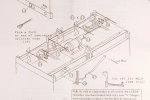
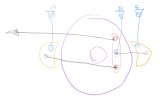
i hope this helps. The links A & C react the brake forces to the chassis. They also locate the shoes vertically and horizontally. The red rocking lever splits the brake pull (black arrow) between the shoes. The blue link B stops the rocking lever hanging on the pull rods, I think this is missing from your model.

IMG_2785.jpeg

the GW. and I suspect many other lines, used triangular spreaders to get the brake force from the equaliser levers (more or less on the vehicle centre line) outboard to the brake shoes. The brake force is of the order of tons, so would bend a simple crossbar. A flat bar - edgewise, was also used. The other thing that the crossbars had to do was stop the shoes spreading - they would tend to be pushed outboard by the coning of the wheels.

IMG_2786.jpeg
Hope these rather crude & scruffy sketches are useful
Simon
 

RichardG

Western Thunderer
Simon, your sketches are a great help. I suppose, the hanger 'B' is missing because the kit has no floor! To correct my earlier post - the wheel axle cannot be the fulcrum; the assembly would be resting on the axle all the time. The arrangment as presented in the kit cannot work. It's amazing how a wrong kit design can mislead the novice.

You have inspired me to look at a GER horsebox in my stash of unbuilt kits. This is a D&S kit.


D&S GER brake rigging.jpg
Extract from D&S instructions

From now on I had better call "the long link with three pivots" the reversing swing link. I mean, these instructions have been drawn up by someone who understands what they are on about.

The LT&SR horse box I am building would have had a vacuum brake not also had a Westinghouse brake . . . but and, I suspect, the mechanical design would be closer to that of the D&S design.

( Edited for technical correctness. I have no idea where my reference to vacuum brake came from. )
 
Last edited:

simond

Western Thunderer
Ah, much better! (And much nicer sketches than my doodles, but at least we’re depicting the same concepts!).

I am surprised that the vehicle modelled in the D&S instructions has a push rod for the brakes at one end - pushrods are inherently liable to flexing out of straight (“Euler buckling”), and were certainly unusual in most applications, as the rod had to be much bigger, heavier, to withstand it, than a pull rod supporting the same force.

I'm sure the mechanical designs would have been equivalent, if not identical.

and the triangular yokes, of course. If you don’t have the materials in the kit, I made some for my O13 milk brake.

some impressionistic brakes here, and a couple of photos in the post below.

atb
Simon
 
Last edited:

RichardG

Western Thunderer
I am learning fresh lessons, quite a lot all in one go. I cannot hope to learn about railway practice by building this sort of kit. I must not allow badly-fitting parts to cloud my view of the big picture. Kits which claim to "need only wheels to complete" may need a great deal more. Kits produced twenty or thirty years go may well have had no updating since their first introduction.

DSC_9516.jpeg
It is quite depressing to go to so much effort to build something so fundamentally wrong. I would rather have no brake rigging at all. Here is a final photo of my effort before I dismantle it.

Looking closely at the D&S kit, I see they provide the drawing of the brake rigging, but not the parts to build it! Perhaps, they see it as an optional extra which many modellers can do without.

Onwards and upwards, I'll see if I can build something better, or do without.
 

Ian@StEnochs

Western Thunderer
I am surprised that the vehicle modelled in the D&S instructions has a push rod for the brakes at one end - pushrods are inherently liable to flexing out of straight (“Euler buckling”), and were certainly unusual in most applications, as the rod had to be much bigger, heavier, to withstand it, than a pull rod supporting the same force.

atb
Simon

I agree about brake push rods being flexible and having to carry quite a force yet Andrew Barclay used them on a lot of their Four coupled pugs. Being Barclay of course they are heavily built with a section 5”x3” . I haven’t seen a bent one!
 

RichardG

Western Thunderer
The kit brake design does seem a little “impressionist”.

I do like "impressionist". It is a kind word, more gentle than "fictional" or "non-prototypical".

I have had a go at a more indicative representation.

DSC_9522.jpeg
The brass wire may well be underscale but this was vastly easier to do than building the arrangement provided in the kit.

DSC_9535.jpeg
I think this will look passable when the model is standing on the track. Still no hanger for the reversing swing link, I cannot reach into the space.
 

magmouse

Western Thunderer
Following a discussion with some other WTers about the (lack of) availability of etched brake yokes, I had a go at printing some:

IMG_5917.jpeg

Printed with a standard PLA filament, they are surprisingly robust - the thicknesses are slightly over scale, but not much. It occurs to me that it would be possible to print all the parts apart from the pull rods, and get something pretty presentable.

Nick.
 

Ian@StEnochs

Western Thunderer
Following a discussion with some other WTers about the (lack of) availability of etched brake yokes, I had a go at printing some:

View attachment 238519

Printed with a standard PLA filament, they are surprisingly robust - the thicknesses are slightly over scale, but not much. It occurs to me that it would be possible to print all the parts apart from the pull rods, and get something pretty presentable.

Nick.

Nick,

May I ask what printer & filament you used to print those please. Looks very smooth and could almost be an injection moulding.

Ian
 

magmouse

Western Thunderer
Nick,

May I ask what printer & filament you used to print those please. Looks very smooth and could almost be an injection moulding.

Ian
Ian - yes, of course. It’s a Bambu A1 Mini, with a 0.2mm nozzle and smooth build plate. The filament is ‘bog standard’ PLA.

I set the printer to do ‘ironing’, which together with the smooth plate gave nice, smooth surfaces top and bottom. You are looking at the bottom - the side against the build plate - in the photo. Otherwise the settings were the default ones for the filament and nozzle. I might have increased the number of top or bottom layers, or the wall thickness, to make sure there was no fill in the middle - i.e. it’s completely solid.

Like you, I was pleased with the quality of the outcome, especially as it involved relatively little effort!

Nick,
 
Top