
You are using an out of date browser. It may not display this or other websites correctly.
You should upgrade or use an alternative browser.
You should upgrade or use an alternative browser.
Chas's workbench
- Thread starter Chas Levin
- Start date


Chas Levin
Western Thunderer
Almost as if fate - or at any rate, the BBC Christmas schedulers - have stepped in, I post below pictures of the two Revell CIWL coach kits I've been building, while I watch the classic 1974 'Murder On The Orient Express' on TV! They're finished now, other than some tweaking of the lights and the fixing of the roofs - currently just sat on top - using neodymium magnets, but those jobs won't change the outside appearance:

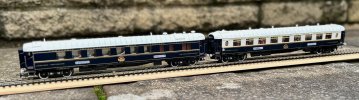


Altogether a very enjoyable project and I think they've turned out a lot better than I thought they might, given they're 40+ year old plastic kits. The batch building thing went well too (I know calling building just two a 'batch' is pushing it!) and I'll do that again.
I hope everyone has a nice, relaxing time between Christmas and New Year
Altogether a very enjoyable project and I think they've turned out a lot better than I thought they might, given they're 40+ year old plastic kits. The batch building thing went well too (I know calling building just two a 'batch' is pushing it!) and I'll do that again.
I hope everyone has a nice, relaxing time between Christmas and New Year

oldravendale
Western Thunderer
Absolutely beautiful, Chas.
Chas Levin
Western Thunderer
Exquisite work, well done!
Absolutely beautiful, Chas.
Thanks Gents!
They also run very well too, which tbh I wasn't expecting: I thought they'd be the kind of coaches that sit in a siding, adding 'local colour'. There's some lead over the bogies and the wheels are Hornby, running in brass top hats, but the rest is original Revell.

paulc
Western Thunderer
They are great , well done Chas .Almost as if fate - or at any rate, the BBC Christmas schedulers - have stepped in, I post below pictures of the two Revell CIWL coach kits I've been building, while I watch the classic 1974 'Murder On The Orient Express' on TV! They're finished now, other than some tweaking of the lights and the fixing of the roofs - currently just sat on top - using neodymium magnets, but those jobs won't change the outside appearance:
View attachment 254003View attachment 254004View attachment 254005View attachment 254006View attachment 254007
Altogether a very enjoyable project and I think they've turned out a lot better than I thought they might, given they're 40+ year old plastic kits. The batch building thing went well too (I know calling building just two a 'batch' is pushing it!) and I'll do that again.
I hope everyone has a nice, relaxing time between Christmas and New Year
Chas Levin
Western Thunderer
Thanks Paul!They are great , well done Chas .

Yorkshire Dave
Western Thunderer
An excellent job on the 40yr+ Wagon Lits kits. Just shows how good the original tooling and moulding was.
Chas Levin
Western Thunderer
Thanks Dave and yes, entirely agree how good these kits are! I wish they'd done some other CIWL but as far as I know it was just these two.An excellent job on the 40yr+ Wagon Lits kits. Just shows how good the original tooling and moulding was.
Chas Levin
Western Thunderer
Happy New Year to everyone - let's hope 2026 is a terrific year for us all!
Chas Levin
Western Thunderer
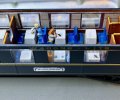
Still fiddling with neodymium magnets for the CIWL coach roofs (note to self: plan & install these before finishing the rest of the coach next time!!) but I've also printed off some miniature plates of food on tickers for the tables, because I noticed that the tables look very empty though the windows, I guess because they're so bright and white:



Meanwhile, I'd planned a Christmas project of pure nostalgia, a build of the classic Airfix Lancaster kit. I built a large amount of WWII Airfix kits in my youth (as did so many of us) and occasionally build one these days, generally as cargo for a Warflat or Warwell, but in this case, it's just for fun. Unfortunately family illness disrupted our Christmas arrangements, so I'm running a little late - here are the main units after priming:

I'm trying out Halfords Plastic Clear Pre-Primer, because with an end result that's largely going to be black and built of black plastic, it seemed to be creating extra work to use grey or red primer (and while I'm sure they had black primer last time I was in Halfords, I couldn't see any this time).
Meanwhile, I'd planned a Christmas project of pure nostalgia, a build of the classic Airfix Lancaster kit. I built a large amount of WWII Airfix kits in my youth (as did so many of us) and occasionally build one these days, generally as cargo for a Warflat or Warwell, but in this case, it's just for fun. Unfortunately family illness disrupted our Christmas arrangements, so I'm running a little late - here are the main units after priming:
I'm trying out Halfords Plastic Clear Pre-Primer, because with an end result that's largely going to be black and built of black plastic, it seemed to be creating extra work to use grey or red primer (and while I'm sure they had black primer last time I was in Halfords, I couldn't see any this time).
Chas Levin
Western Thunderer
The Lancaster's another vintage kit, similar age I think to the Revell CIWL coaches, but I've been fairly lucky in terms of lack of damage... with one tiny exception: there's a small protruding pin under th piece that fits on top of the front turret to help hold the turrent in place and provide an upper pivot, and that had snapped off, so I had to replace it with a piece of 1.2mm brass tube:
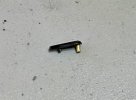

You can see where it fits here, at the front, top:
And a final photo of one of the Revell CIWL coaches with the lighting on...

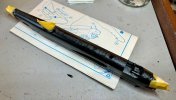
You can see where it fits here, at the front, top:
And a final photo of one of the Revell CIWL coaches with the lighting on...
Chas Levin
Western Thunderer
Thank you! I started off preferring the blue and white Pullman, but now I think the simpler all-blue one looks classier.
Chas Levin
Western Thunderer
After some serious masking, Tamiya AS-22 RAF Dark Earch has been applied...
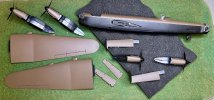
I know it probably looks like I've spent too much time and trouble on the masking, but I intensely dislike spoiling work I've already done and having to go back and re-do things. It happens, of course, but after a few instances of sprayed paint finding its way into less than fully masked areas I now go to some trouble. It did pretty well, just a small shadow of brown on one side of one propeller blade and a flaked brown edge on an engine cowling where I removed the masking too soon, quite good going givin the number of different areas.
Ian Rathbone in his 'Painting and Lining' book recommends removing masking tape as quickly as possible after spraying to allow the still soft paint edge to settle, rather than it possibly drying into a raised edge if the tape's removed later and that's what I do. It works very well almost all the time but occasionally the paint edge dries along the tape sooner than further into the painted area and adheres to the tape, so that when it's removed it pulls tiny amounts of paint with it and leaves a flaked edge. I've re-done that edge sionce taking this photo: one thing about Tamiya aerosols is that re-sprayed areas blend in to earlier coats absolutely perfectly.
I know it probably looks like I've spent too much time and trouble on the masking, but I intensely dislike spoiling work I've already done and having to go back and re-do things. It happens, of course, but after a few instances of sprayed paint finding its way into less than fully masked areas I now go to some trouble. It did pretty well, just a small shadow of brown on one side of one propeller blade and a flaked brown edge on an engine cowling where I removed the masking too soon, quite good going givin the number of different areas.
Ian Rathbone in his 'Painting and Lining' book recommends removing masking tape as quickly as possible after spraying to allow the still soft paint edge to settle, rather than it possibly drying into a raised edge if the tape's removed later and that's what I do. It works very well almost all the time but occasionally the paint edge dries along the tape sooner than further into the painted area and adheres to the tape, so that when it's removed it pulls tiny amounts of paint with it and leaves a flaked edge. I've re-done that edge sionce taking this photo: one thing about Tamiya aerosols is that re-sprayed areas blend in to earlier coats absolutely perfectly.
Graeme King
Active Member
Having spent some time earlier today cutting numerous pieces of masking tape to allow me to spray a top-coat of green onto my latest loco and tender bodies without having to then put even more black paint over the already-painted black areas, I can well understand your logic Chas.
My sense of joy was not then what it might have been when I opened my carefully re-sealed and stored, part-used tin of Phoenix Precision Doncaster Green to find a thin oily layer sitting on top of a thick hard skin with a green mixture beneath that was half jelly and half mud! I did not consider that I had the time available to waste on trying to extract, thin, stir and test apply any redeemable good bits of the mess to see whether I could save some paint that would spray, cover properly, and dry, so I reluctantly switched to an unused jar of Railmatch. I know that looks almost the same once it is applied to a sufficient depth and varnished, but I always find that by the time it is thinned enough for my airbrush its non-ideal covering power has diminished almost to the equivalent of a coat of thinners, and its dried sheen is too poor for reliable transfer adhesion...
My sense of joy was not then what it might have been when I opened my carefully re-sealed and stored, part-used tin of Phoenix Precision Doncaster Green to find a thin oily layer sitting on top of a thick hard skin with a green mixture beneath that was half jelly and half mud! I did not consider that I had the time available to waste on trying to extract, thin, stir and test apply any redeemable good bits of the mess to see whether I could save some paint that would spray, cover properly, and dry, so I reluctantly switched to an unused jar of Railmatch. I know that looks almost the same once it is applied to a sufficient depth and varnished, but I always find that by the time it is thinned enough for my airbrush its non-ideal covering power has diminished almost to the equivalent of a coat of thinners, and its dried sheen is too poor for reliable transfer adhesion...
Chas Levin
Western Thunderer
Ouch: I've been there on many occasions, as have many of us, of course. What frustrates me is the sheer unpredictability of paint tinlets. Examples bought at the same time and presumably of the same or similar age and make-up sometimes age remarkably differently, with one near-full tin that's only been opened and used once or twice solidifying as you report, while another that's half used (with therefore a larger air gap above the paint and more paint residue round the rim to onstruct the forming of a good seal) persistently remaining completely fresh and usable!Having spent some time earlier today cutting numerous pieces of masking tape to allow me to spray a top-coat of green onto my latest loco and tender bodies without having to then put even more black paint over the already-painted black areas, I can well understand your logic Chas.
My sense of joy was not then what it might have been when I opened my carefully re-sealed and stored, part-used tin of Phoenix Precision Doncaster Green to find a thin oily layer sitting on top of a thick hard skin with a green mixture beneath that was half jelly and half mud! I did not consider that I had the time available to waste on trying to extract, thin, stir and test apply any redeemable good bits of the mess to see whether I could save some paint that would spray, cover properly, and dry, so I reluctantly switched to an unused jar of Railmatch. I know that looks almost the same once it is applied to a sufficient depth and varnished, but I always find that by the time it is thinned enough for my airbrush its non-ideal covering power has diminished almost to the equivalent of a coat of thinners, and its dried sheen is too poor for reliable transfer adhesion...
And yes, Railmatch has - I assume - some sort of silicone type additive which made me stop using it. Transfers I could work with on it, but applying varnish was a nightmare, with constant pooling (I think that's the right word, where the varnish forms into separate blobs and rivulets...
I'm following you build and it's even more frustrating of course when it's something a bit out of the ordinary!
Chas Levin
Western Thunderer
I've kept the Lancaster wings and fuselage separate for adding the camouflage green on top of the brown. I'm not sure if that's how people usually tackle aircraft markings, but it allows easier painting:
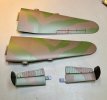
I didn't spot that tiny green splodge in the middle of the starboard wing until I took these photos (poor attention to detail) so that'll have to be over-sprayed in brown. I'm also not entirely happy with the shape of the green in the middle of the port wing, but I'll probably learn to live with it - it'll be partially covered by the red and blue roundel anyway.
Keeping the parts separate through the camouflage layout does cause some extra layout planning: you can do all four wings pretty much freehand, but then you have to position them alongside the fuselage in order to plan where the second colour - in this case green - will go on the fuselage in order to align correctly:

The eagle-eyed will have spotted that the rear gun turret has three of the four gun barrels missing: two were missing from the kit as bought - which in a 1979 kit was quite good going I thought, as everything else was complete - and I stupidly snapped off one a couple of days ago! Not a problem: I'd intended replacing the two missing barrels with blackened brass wire, so I'll now replace all four, once the kit's nearer completion and there's less chance of further damage.
Some more of my habitually over-done masking and the fuselage is now brown and green too:
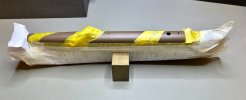

The forward small circular window was another casualty unfortunately, saved for re-installation, which will be awkward...
I didn't spot that tiny green splodge in the middle of the starboard wing until I took these photos (poor attention to detail) so that'll have to be over-sprayed in brown. I'm also not entirely happy with the shape of the green in the middle of the port wing, but I'll probably learn to live with it - it'll be partially covered by the red and blue roundel anyway.
Keeping the parts separate through the camouflage layout does cause some extra layout planning: you can do all four wings pretty much freehand, but then you have to position them alongside the fuselage in order to plan where the second colour - in this case green - will go on the fuselage in order to align correctly:
The eagle-eyed will have spotted that the rear gun turret has three of the four gun barrels missing: two were missing from the kit as bought - which in a 1979 kit was quite good going I thought, as everything else was complete - and I stupidly snapped off one a couple of days ago! Not a problem: I'd intended replacing the two missing barrels with blackened brass wire, so I'll now replace all four, once the kit's nearer completion and there's less chance of further damage.
Some more of my habitually over-done masking and the fuselage is now brown and green too:
The forward small circular window was another casualty unfortunately, saved for re-installation, which will be awkward...
Chas Levin
Western Thunderer
Some work's been done on the Lancaster, in between non-modelling things that have pushed their way in!
I'd intended using the wheels that come with the kit but clumsily broke the trailing wheel (definitely something to put in place as late in the build as possible!) so in looking for a replacement (having decided not to go with making a replacement mounting for it) I succumbed to the temptation of a resin wheel set from CMK Kits and I have to say they look excellent (cocktail sticks & blutak are for rattle-can priming):
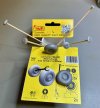

There's something about that main wheel, with the superb representation of weighted bulging, that looks so realistic, and oddly attractive...
I'd intended using the wheels that come with the kit but clumsily broke the trailing wheel (definitely something to put in place as late in the build as possible!) so in looking for a replacement (having decided not to go with making a replacement mounting for it) I succumbed to the temptation of a resin wheel set from CMK Kits and I have to say they look excellent (cocktail sticks & blutak are for rattle-can priming):
There's something about that main wheel, with the superb representation of weighted bulging, that looks so realistic, and oddly attractive...
Chas Levin
Western Thunderer
And while I'm on the subject of third party detailing kits and their dual use for both detailing and for replacing breakages, I can also recommend Master Models, based in Poland but like CMK readily available through UK based Ebay sellers. I'd managed to catch the rear turret guns and break a couple so, these brass ones from Master Models will replace them - you see them here after applying of Birchwood Casey Brass Black, as they arrive in shiny new looking brass:
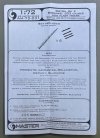

Still a few spots to blacken, I can now see in that photo!
When I last built Airfix kits of WWII hardware in the 1970s, as far as I know no-one made resin, brass or plastic detailing kits, or if they did it was of course pre-internet so far fewer people would have known about them. I suspect though that it's modern advances in small scale manufacture, 3D printing etc that's allowed for the profusion of such things.
When I re-entered the modelling world in about 2012 with railways, those kits were mainly small manufacturers and they sat alongside railway detailing kits on the same trade stands at shows so I took it for granted that such things were quite usual in railway modelling, but it's only recently I've discovered the enormous amount of military stuff being made. It's only ever going to be an occasional diversion for me - usually a riad vehicle conversion to provide a load for a railway flat wagon - but it's good to know these things are out there.
I also suspect though that the number of military modellers around the world is considerably larger than railway modellers and in fact this stuff is probably being produced in quantities that dwarf the likes of the now sadly defunct Markits, Branchlines, Gibson and the rest...
Still a few spots to blacken, I can now see in that photo!
When I last built Airfix kits of WWII hardware in the 1970s, as far as I know no-one made resin, brass or plastic detailing kits, or if they did it was of course pre-internet so far fewer people would have known about them. I suspect though that it's modern advances in small scale manufacture, 3D printing etc that's allowed for the profusion of such things.
When I re-entered the modelling world in about 2012 with railways, those kits were mainly small manufacturers and they sat alongside railway detailing kits on the same trade stands at shows so I took it for granted that such things were quite usual in railway modelling, but it's only recently I've discovered the enormous amount of military stuff being made. It's only ever going to be an occasional diversion for me - usually a riad vehicle conversion to provide a load for a railway flat wagon - but it's good to know these things are out there.
I also suspect though that the number of military modellers around the world is considerably larger than railway modellers and in fact this stuff is probably being produced in quantities that dwarf the likes of the now sadly defunct Markits, Branchlines, Gibson and the rest...