Rivermead Central

John R Smith

Western Thunderer
I had originally intended to have the platform 1 (main) station building on this curve and have platform 1 extending several feet around the curve. That is no longer my intention because of the clearance issues with long locomotives on a 3’ 6” radius curve requiring the platform to be absurdly far from the track.

Martin

Curved platforms are not just a problem in coarse scale. Even in fine scale, with a minimum of say 6' radius, we can be in trouble with GWR 70' carriage stock or big diesels - which works out at just over 19 inches long in O Gauge. Once again, we are trying to squeeze a quart into a pint pot. On the full size railway any curve of 15 chains or less on running lines required a check rail and a very serious speed limit, that being a curve of 23 feet radius in our scale. So to have a chance of prototypical curves we need a room at least 46 feet across! Ho hum . . .

John
 

40057

Western Thunderer
The sleeper-built fence last shown in post #938 now has its horizontal rails attached. These were made of 1 mm X 3 mm walnut strip, then glued and pinned in place:

47FF40B2-8AC5-4F17-80CA-CA5EF087CB35.jpeg

The rails will be painted black.

The right-angle metal bracket for holding the fence upright is also fastened in place. The bracket will be covered by a length of strip wood painted grey to match the base-boards.

Martin
 

40057

Western Thunderer
The sleeper-built fence is now ready to be installed on the layout:

CFF2E75A-FC71-40D1-BAE8-2A819D0E8FEA.jpeg

Apologies for the poor quality photo taken in artificial light.

The countersunk hole is for the wood screw that will hold the fence in place. Fastening the fence down will be another stretch working at arm’s length — probably the most difficult location still to do.

Martin
 

John R Smith

Western Thunderer
Martin

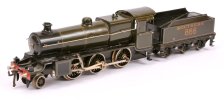
I thought that you might like an update on the Bassett-Lowk Southern 2-6-0 Mogul that I purchased a while back. Well, you did warn me, and I took no notice, and so I have managed to lumber myself with an assortment of problems rather than a useful item of motive power.

It did turn out to be quite attractive in a somewhat rugged fashion -

Bassett-Lowke 2-6-0 02.jpg
This version, as you can see, has the fixed headlamps and the very plain tender, so I have assumed it to be early in the production run. The cosmetic condition is excellent because the engine has been refinished by Chris Littledale of the Brighton Museum -

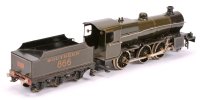
Bassett-Lowke 2-6-0 06.jpg

The tender, as far as I can see, has not been refinished, perhaps because the transfers were not available. However, it is in very nice condition, and Chris has managed to match the colours very well.

Bassett-Lowke 2-6-0 03.jpg

These engines have the Bing six-coupled mechanism, with the winder arbor on the right hand side of the engine. You did indeed warn me, and the first problem quickly reared its ugly head - clearances. The cylinders and valve gear are all just directly borrowed from the live steam version of the Mogul, and the strange Greenly-Walschearts valve gear is very wide. So my platforms are in danger of serious damage. Worse still, it is not just the valve gear which is wide - the steps on the engine and tender are also ridiculous, at about 75mm (for comparison, the widest bits on a B-L Compound are about 63mm). So on the first clearance trials, my ground signals were all swept aside.

I have to say that the engine is very well made, built to withstand the heaviest use. For example, the cab steps on the engine have a massive reinforcement soldered in behind.

Bassett-Lowke 2-6-0 01.jpg
The pony truck and tender wheels are cast iron, as expected. But the driving wheels are nickel-plated cast brass, centre nutted, quite contrary to the catalogue description. Have you come across this on B-L engines before?

I was impressed by the clockwork motor -

Bassett-Lowke 2-6-0 05.jpg
The standard of the mechanism build is first class - the mainspring is massive, the intermediate gear pinions are machine cut from thick brass, and the final drive pinion is machined in solid steel from the axle blank. So there seems to be very little wear in the mech.

There are two problems. First, the spring is very strong, and the winding ratchet is not geared, so winding is very hard work. I have arthritis in my hands, so this is not too good. As a temporary fix (bodge) I have bolted an extension to the wings of my winding key, which helps a lot.

Much more serious, is that despite hours of fettling, oiling, and checking the motion for stiff points, I cannot get the engine to run properly. It is all very strange and frustrating - in forward gear it is noisy, stiff and hesitant and runs very slowly. But in reverse it runs perfectly - smooth and quiet and very quick. As it stands, it is hopeless.

I expect that you may have some experience with these Bing motors - Do you have any suggestions? My Bing Precursor is older, and runs like a dream!

John

 
Last edited:

40057

Western Thunderer
Martin

I thought that you might like an update on the Bassett-Lowk Southern 2-6-0 Mogul that I purchased a while back. Well, you did warn me, and I took no notice, and so I have managed to lumber myself with an assortment of problems rather than a useful item of motive power.

It did turn out to be quite attractive in a somewhat rugged fashion -

View attachment 263985
This version, as you can see, has the fixed headlamps and the very plain tender, so I have assumed it to be early in the production run. The cosmetic condition is excellent because the engine has been refinished by Chris Littledale of the Brighton Museum -

View attachment 263986

The tender, as far as I can see, has not been refinished, perhaps because the transfers were not available. However, it is in very nice condition, and Chris has managed to match the colours very well.

View attachment 263987

These engines have the Bing six-coupled mechanism, with the winder arbor on the right hand side of the engine. You did indeed warn me, and the first problem quickly reared its ugly head - clearances. The cylinders and valve gear are all just directly borrowed from the live steam version of the Mogul, and the strange Greenly-Walschearts valve gear is very wide. So my platforms are in danger of serious damage. Worse still, it is not just the valve gear which is wide - the steps on the engine and tender are also ridiculous, at about 75mm (for comparison, the widest bits on a B-L Compound are about 63mm). So on the first clearance trials, my ground signals were all swept aside.

I have to say that the engine is very well made, built to withstand the heaviest use. For example, the cab steps on the engine have a massive reinforcement soldered in behind.

View attachment 263988
The pony truck and tender wheels are cast iron, as expected. But the driving wheels are nickel-plated cast brass, centre nutted, quite contrary to the catalogue description. Have you come across this on B-L engines before?

I was impressed by the clockwork motor -

View attachment 263989
The standard of the mechanism build is first class - the mainspring is massive, the intermediate gear pinions are machine cut from thick brass, and the final drive pinion is machined in solid steel from the axle blank. So there seems to be very little wear in the mech.

There are two problems. First, the spring is very strong, and the winding ratchet is not geared, so winding is very hard work. I have arthritis in my hands, so this is not too good. As a temporary fix (bodge) I have bolted an extension to the wings of my winding key, which helps a lot.

Much more serious, is that despite hours of fettling, oiling, and checking the motion for stiff points, I cannot get the engine to run properly. It is all very strange and frustrating - in forward gear it is noisy, stiff and hesitant and runs very slowly. But in reverse it runs perfectly - smooth and quiet and very quick. As it stands, it is hopeless.

I expect that you may have some experience with these Bing motors - Do you have any suggestions? My Bing Precursor is older, and runs like a dream!

John
Hi John

Sorry to hear the mogul needs attention.

To respond to your various comments and queries. Yes, rugged, very strongly built and over-scale dimensions. There were some definite ‘phases’ in Bassett-Lowke production. The first 0 gauge catalogued model made at Northampton was the Precursor tank c.1921. It was very, very similar to its Bing-made predecessor. Indeed, possibly a direct copy of the Bing model — but I think it more likely that Northampton used the same Greenly drawing originally prepared for Bing. But the locomotive models that came after the Precursor tank have a very distinct style, unlike earlier or later production. I think it unlikely Greenly had any input to these (they would probably have been better models if Greenly had designed them). I’m referring to the Northampton version of Caledonian Railway no.142, the moguls and the two 0-6-0s (4F and J39). All have a similar character: over-size, massively built with very limited coarse detailing. With the Duke of York in 1927 and the following lithographed models — Compound, Royal Scot, Flying Scotsman — the designs became much more refined and accurately scaled.

I am not particularly surprised by the brass wheels. Bing seem to have often used brass for driving wheels in the mid-1920s. I have a friend who has an 0 gauge clockwork LMS Prince of Wales (1924) and it has brass wheels. The third production batch of the live-steam Gauge 1 Claughtons (1925) also have brass wheels on the examples I have seen (which presumably means the Gauge 1 Southern King Arthur models likewise have brass driving wheels). On your mogul, of course, only the driving wheels will have come from Bing. The pony truck and tender wheels would be made in Northampton along with the body.

The Bing motor in your mogul I think is the same motor as in the Prince of Wales models mentioned above. Except for use in the moguls, frame extensions were added at the back of the motor to accommodate the wider spacing between the middle and rear driving wheels. It’s the same mech in the two Northampton-made 0-6-0s. I don’t know of this motor being used in any other models for the UK market.

Your mogul is certainly an early one because the later models were fitted with the large Northampton-made 6-coupled mechanism with speed control.

Without examining the model, it is very difficult to know what to suggest as the cause of the problem when running forwards. There is one gear wheel that is only used in forward direction, so is this damaged or loose? Are the driving wheels firmly fixed on the axles? If one of them can move slightly in one direction only (so the quartering is out), that might cause the behaviour you describe. Is the pivoted plate that effects reversing travelling right to its limit when putting the engine in forward gear?

Martin
 
Last edited:

John R Smith

Western Thunderer
Without examining the model, it is very difficult to know what to suggest as the cause of the problem when running forwards. There is one gear wheel that is only used in forward direction, so is this damaged or loose? Are the driving wheels firmly fixed on the axles? If one of them can move slightly in one direction only (so the quartering is out), that might cause the behaviour you describe. Is the pivoted plate that effects reversing travelling right to its limit when putting the engine in forward gear?

Martin

Thank you very much for all your comments and suggestions. I am going to have another look at the mechanism to try to isolate the poor running issues. I have another B-L project on my kitchen workbench at the moment (of which more another time).

One thing that did occur to me if the Mogul was in proper running order, is that it would be a splendid garden railway engine. Clearance issues would probably be less, and it is so rugged and heavily built that it would just deal imperiously with leaves on the track or the odd shower of rain!

John
 

40057

Western Thunderer
Martin

Thank you very much for all your comments and suggestions. I am going to have another look at the mechanism to try to isolate the poor running issues. I have another B-L project on my kitchen workbench at the moment (of which more another time).

One thing that did occur to me if the Mogul was in proper running order, is that it would be a splendid garden railway engine. Clearance issues would probably be less, and it is so rugged and heavily built that it would just deal imperiously with leaves on the track or the odd shower of rain!

John
Good luck with finding the problem!

It can be extraordinarily difficult to identify where the fault lies in a clockwork mechanism/locomotive — essentially because it is not normally possible to test subsections separately. Fortunately, of course, clockwork mechanisms generally don’t go wrong. And if they do, it will tend to be a broken ratchet or spring and those problems are obvious.

A garden railway? Your solution to extending Kingswell Street via a hole in the wall?

Martin
 

40057

Western Thunderer
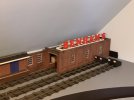
My short length of sleeper-built fence is now fastened in place on the layout adjoining the Benham’s factory building:

7F387762-8BA2-4511-A580-787BB52A79FE.jpeg

This should be (I hope!) the last really hard to reach location where I need to fasten down the ‘wall covering’. Whilst there are three other corners to the layout, the base-board there is either narrower or has no track laid on it, so working in the back corner should be less awkward.

A small milestone: the first wall covering on the north wall.

I had to spend some time removing gossamer from the Benham’s roof sign. It had gone un-noticed until working in that back corner. Spiders are a menace on a layout like mine which cannot be covered or put in a cupboard. They leave gossamer on everything. And since they are not house-trained, other things too. But there is no way I can prevent them walking all over the layout.

Martin
 

40057

Western Thunderer
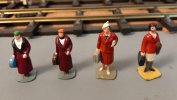
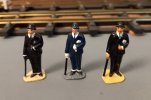
I am always on the look out for passenger figures to populate Rivermead Central. I don’t have many and manufacturers seem to have concentrated on railway staff for their model people. So I was pleased to get these Dinky Toy (Meccano Ltd) passengers this week:

F2DBD538-A98E-4FE8-A7F1-01F27B656054.jpeg

Whilst most items in the Dinky and Hornby ranges are too toy-like to use on Rivermead Central, the passenger and staff figures are a very definite exception. I expect most of the people on my layout to be Meccano Ltd products.

The above figures were made in the late 1930s. They are the smaller size Dinky figures which replaced the somewhat larger earlier versions. But, being pre-WW2, they are very nicely painted.

This photo (seen previously in post #488) shows the difference in size and the painting of the post-WW2 productions:

76E3CA07-7BF4-40D8-945D-6175651829FC.jpeg

On the left is Frank, my ‘scale object’, an early large size porter (see post #398). The lady and child are the post-WW2 version of the late ‘30s lady and child in the previous photo. I think the casting is identical, but much more crudely painted after the War.

I was particularly pleased to get the male passenger in the first photo as a large majority of the passengers I do have are women. I am not sure if he is travelling first-class or third-class. Blue-collar, clearly. But with a bowler hat.

Martin
 

40057

Western Thunderer
Prompted by yesterday’s post, I thought I had better do a bit of research into Meccano Ltd’s Dinky/Hornby 0-gauge-size figures — and especially passengers. I am not knowledgeable about Hornby, know even less about Dinky Toys, and don’t have any of the firm’s catalogues. However, a bit of time searching online quickly established Meccano Ltd’s range of 0 gauge size figures comprised:
Set no.1 — Station Staff
Set no.2 — Farmyard Animals
Set no.3 — Railway Passengers
Set no.4 — Engineering Staff
Set no.5 — Train and Hotel Staff
Set no.6 — Shepherd + Dog + Sheep
There were five or six models in each set. As far as I can see, the figures were only sold in the various sets listed, not individually. The human figures (but not the animals) were changed to smaller size castings c.1937. In some cases, the smaller version is very similar to its larger predecessor, just slightly smaller (e.g. the lady hiker); in other cases, the smaller figure is equivalent to but distinctly different from the earlier larger model (e.g. the ‘woman’ passenger).

The strong impression I had that the range of Dinky/Hornby figures was dominated by models of staff is confirmed. Amongst all the models, only set no.3 contains passengers. There were six individual models in set no.3, one of which was a ‘newsboy’, so not a passenger as such. The remaining five models were: woman; man; mother + child; hiker (woman), and; hiker (man).

The hikers are perfectly plausible to stand on a platform waiting to catch a train, or to be walking on some scenic part of a layout. But they are not regular, ‘normal’ passengers in the way the other Dinky passenger figures were. For Rivermead Central, I just need ‘ordinary’ passengers to stand on my station platforms. It turns out, there were really only six/eight different ordinary passenger figures in the Dinky/Hornby range; the larger and smaller castings for the woman, man and mother + child. The larger and smaller woman figures are differently dressed and were painted different colours. The larger man passenger is in a suit, the smaller one is wearing an overcoat (see previous post). The larger mother + child casting has the child (painted wearing red and yellow) on the woman’s right, the smaller version has the child (wearing green) to her left (see previous post). So there are six (eight counting the child separately) properly different, regular, passengers. And that’s all.

The smaller figures were made again after WW2 (1952–56). The castings appear to be identical to the post-1937 pre-War models. The post-War figures are much less well painted. The colours used for the woman and mother + child after WW2 are more garish versions of the pre-War colour schemes applied to these figures (see previous post). The man passenger, however, had a grey coat pre-WW2 (see previous post) and a brown one after the War. So the post-War version is noticeably different. Pre- and post-War versions could be stood close to each other on the same platform and would echo the reality of similarly-clad businessmen heading to work. Incidentally, the post-War card insert holding the figures in place in their box does clear up the social status of the man passenger (see my previous post). The description printed under the man figure in the 1950s box was ‘Business Man’.

I can’t help feeling Meccano Ltd missed a trick by, seemingly, always painting the various passenger figures in particular colours. Varying the colours of the passengers’ clothing/hair/skin would surely have led to some additional sales, especially since so few different passenger models were made. Paint schemes were varied to create different staff models. The casting used for Frank (porter — see previous post) was also used, appropriately dressed, in the engineering staff set. Painted differently again, the ‘Frank casting’ was a Pullman car attendant.

Martin
 

John R Smith

Western Thunderer
Hello Martin

That was an interesting and informative post about the Hornby/Dinky figures. Like you, I am no expert on Hornby in general, but there are certain points I would mention.

The figures are worth much more if still in their original box (and the if the box is in good condition). The most collectible of all seems to be the shepherd + dog + sheep set! The engineering set seems to be the least sought after. So now we know which ones to avoid.

Most of my figures have been purchased separately, and like you I have found it much harder to acquire passengers, rather than staff. The difference in size between the Hornby examples is very odd, but fortunately the human form does vary a lot too, so we can get away with a great deal. In my collection I have several examples which I do not think are Hornby, but I am unable to ID them. In amongst mine are two distinct types - solid cast, which are quite heavy, and hollow cast which are lighter and have a hole in the top of the head to allow gas to escape when in the centrifugal mould.

I did for a while have a boxed set of Bassett-Lowke figures, still strung onto the backing card. I have to confess that I did not like them much, and I sold them in the end for a great deal more than I paid for them (that doesn't happen very often!)

I really enjoy playing around with figures, and they can bring the layout to life, quite literally. The same goes for my finescale efforts too, and for them I use 1/43 figures from the Phoenix range (S&D Models). They are also cast white metal, like Hornby, but unpainted. No plastic/resin figures for me!

John
 

40057

Western Thunderer
Hello Martin

That was an interesting and informative post about the Hornby/Dinky figures. Like you, I am no expert on Hornby in general, but there are certain points I would mention.

The figures are worth much more if still in their original box (and the if the box is in good condition). The most collectible of all seems to be the shepherd + dog + sheep set! The engineering set seems to be the least sought after. So now we know which ones to avoid.

Most of my figures have been purchased separately, and like you I have found it much harder to acquire passengers, rather than staff. The difference in size between the Hornby examples is very odd, but fortunately the human form does vary a lot too, so we can get away with a great deal. In my collection I have several examples which I do not think are Hornby, but I am unable to ID them. In amongst mine are two distinct types - solid cast, which are quite heavy, and hollow cast which are lighter and have a hole in the top of the head to allow gas to escape when in the centrifugal mould.

I did for a while have a boxed set of Bassett-Lowke figures, still strung onto the backing card. I have to confess that I did not like them much, and I sold them in the end for a great deal more than I paid for them (that doesn't happen very often!)

I really enjoy playing around with figures, and they can bring the layout to life, quite literally. The same goes for my finescale efforts too, and for them I use 1/43 figures from the Phoenix range (S&D Models). They are also cast white metal, like Hornby, but unpainted. No plastic/resin figures for me!

John
Hi John

If you want to share a photo of your mystery figures, I’ll see if I recognise any of them.

Martin
 

40057

Western Thunderer
As previously discussed, it’s passengers I need. I probably have more than enough station staff already.

And the reason for the relative shortage of passengers, I now realise, is that Meccano Ltd made far more types of ‘staff’, and not many different passengers. That is also true of the range of 0-gauge-size figures made by Britain’s.

However, along with the newly acquired passenger figures shown in post #949, I also bought an hotel porter. This is for the planned hotel which will be adjacent to Cairnie Junction station. (I have opened discussions with a producer of laser-cut buildings with a view to getting a bespoke kit made for the hotel).

The hotel porter is one of the early, large size, Dinky figures from ‘Set no.5’ (see post #950 above):

E2DC1F11-8C1D-40A1-B2DC-2874880CB3FA.jpeg

There were two of these figures in Set no.5, the other wearing a green jacket. The same casting, differently painted, was also used for a railway porter carrying luggage in the station staff set, and for a member of engineering staff in Set no.4.

A couple of points to make about this figure. First, if I turn him sideways, it can be seen the initials of the owner are on the blue case:

C1FFF404-C8A7-4B04-A3A6-99E745604F7A.jpeg

‘F. H.’ — Frank Hornby, of course. Staying at my hotel! What an honour!

However, Hornby’s vanity must have added a few seconds to the time it took to paint every one of the many thousands of hotel porters made by Meccano Ltd.

The other point I want to make here relates to restoration. I have a generally sceptical attitude towards paintwork restoration. That is especially true for figures where repainted examples, to my eyes, usually look terrible. The rapidity and confidence of the original painter (almost certainly a paintress) is virtually never reproduced in restorations. The paintwork of repaints is usually too exact and careful, yet not good enough.

I always try to find figures with very good condition original paintwork, so the issue of restoration does not arise. However, whilst generally excellent, the above hotel porter did have an unfortunate and disfiguring paint chip on his nose. I repaired that yesterday:

4D8EF2E1-545C-4893-9C7F-AE3BE1701DEE.jpeg

It doesn’t show even at this magnification and he looks much better for his ‘nose job’. I will not do any other paint repairs on this figure.

Martin
 

Fitzroy

Western Thunderer
As previously discussed, it’s passengers I need. I probably have more than enough station staff already.

And the reason for the relative shortage of passengers, I now realise, is that Meccano Ltd made far more types of ‘staff’, and not many different passengers. That is also true of the range of 0-gauge-size figures made by Britain’s.

However, along with the newly acquired passenger figures shown in post #949, I also bought an hotel porter. This is for the planned hotel which will be adjacent to Cairnie Junction station. (I have opened discussions with a producer of laser-cut buildings with a view to getting a bespoke kit made for the hotel).

The hotel porter is one of the early, large size, Dinky figures from ‘Set no.5’ (see post #950 above):

View attachment 264445

There were two of these figures in Set no.5, the other wearing a green jacket. The same casting, differently painted, was also used for a railway porter carrying luggage in the station staff set, and for a member of engineering staff in Set no.4.

A couple of points to make about this figure. First, if I turn him sideways, it can be seen the initials of the owner are on the blue case:

View attachment 264446

‘F. H.’ — Frank Hornby, of course. Staying at my hotel! What an honour!

However, Hornby’s vanity must have added a few seconds to the time it took to paint every one of the many thousands of hotel porters made by Meccano Ltd.

The other point I want to make here relates to restoration. I have a generally sceptical attitude towards paintwork restoration. That is especially true for figures where repainted examples, to my eyes, usually look terrible. The rapidity and confidence of the original painter (almost certainly a paintress) is virtually never reproduced in restorations. The paintwork of repaints is usually too exact and careful, yet not good enough.

I always try to find figures with very good condition original paintwork, so the issue of restoration does not arise. However, whilst generally excellent, the above hotel porter did have an unfortunate and disfiguring paint chip on his nose. I repaired that yesterday:

View attachment 264447

It doesn’t show even at this magnification and he looks much better for his ‘nose job’. I will not do any other paint repairs on this figure.

Martin
The same goes for loco lining- the breezy effort dashed out by a Meccano girl in the 1930's always looks so much better than something laboured over for hours by some old codger 80 or 90 years later. I wonder how long it took them to get to that level, and whether they had training/practice sessions?
 

John R Smith

Western Thunderer
Hi John

If you want to share a photo of your mystery figures, I’ll see if I recognise any of them.

Martin

Hello Martin

Well, you did invite me, so here we go (after a frenzied photographic session on a very wet afternoon here in Cornwall).

Some of these I know are Hornby / Dinky, others I have no idea -

Figures 01.jpg

This is a selection of ladies with children in tow. The two on the right are I think Hornby with child on left, but with different paint schemes. The one centre left has the infant on the right. The lady on the left is much larger, with a schoolboy on the left (I think that he is a trainspotter and is here in the hope of seeing my Royal Scot).

Figures 02.jpg

A selection of ladies carrying cases. The two on the left are very small (Hornby?), with differing paint jobs but from the same casting. The large lady with the perky hat I can't ID, nor the lady on the right. She always catches the 6.30 am to Gloucester, so for some reason has an early start at work.

Figures 03.jpg

Somehow I have ended up with three of these commuters, City gents no doubt. They are all painted slightly different from one another. Why the central gentleman should have white trouser bottoms I can't imagine . . .

Figures 04.jpg

I think that the gent on the right is the same as your figure with the bowler hat, just a different paint job. I love the lady in the middle with the little dog. The chap on the left looks like a local country gentleman farmer, probably in town for the day.

Figures 05.jpg

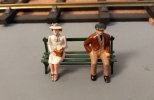
Finding seated figures seems to be really difficult, I have only come up with these two so far. The lady on the left looks very prim and proper. Did Hornby ever do seated figures?

Figures 06.jpg

Well, I just couldn't resist this. Here they all are, making Platform 1 at Kingswell Street look quite busy. I think that they must all be waiting for the 12.32 pm to Bristol - hauled by a Compound, this train usually loads quite heavily.

John
 
Last edited:

40057

Western Thunderer
Hi John

Here’s what I think you have. I’ll just call the Meccano Ltd figures ‘Hornby’.

From left to right:
1. Not an original I am sure, but appears to be a copy/based on the French Hornby maman + garçon.
2. Either a repainted original or a reproduction of the first (larger size) UK Hornby mother and child.
3. Either a repainted original or a reproduction of the smaller size UK Hornby mother and child in the 1937–40 colour scheme.
4. Either a repainted original or a reproduction of the smaller size UK Hornby mother and child in the 1952–56 colour scheme, but with more detail in the paint work.

From left to right:
1. & 2. Either repainted originals or reproductions of the smaller size UK Hornby woman passenger, in close to the 1937–40 paint scheme.
3. & 4. I don’t know, but they have the look of French Hornby figures. Might be worth searching on the Web to see if you can confirm that possibility.

These three are all repainted originals or reproductions of the larger size (pre-1937) UK Hornby male passenger. I think the middle guy is wearing spats.

From left to right:
1. Don’t know the manufacturer but I have a similar figure.
2. Looks French Dinky to me.
3. UK Hornby ‘Business Man’ in original paint, standard 1952–56 colour scheme.

John R Smith:
View attachment 264480
No idea about these two. UK Hornby did not make seated figures, but I don’t know about French Hornby.

Martin
 

40057

Western Thunderer
Thanks very much for that, Martin. I hadn't even thought about French Hornby - we need a catalogue!

John
I suspect what we really need is the 416-page book about French Hornby 0 gauge written by Chris Graebe and published in 2021.

However, in the absence of a copy to consult, I have had a look around in past auction catalogues etc on the Web.

It appears there were rather more different passengers produced by the French factory than were made in Liverpool. Latterly, plastic was used to make figures. But the French pre-WW2 metal cast figures partly echoed the British range, for example the passenger set (Dinky Toys, Série no.5, Personnages) contained a mother + son, lady with bag, man in raincoat and a newsboy — exact equivalents to figures in the British set, but all different castings. However, the other two figures in the French set were a man in plus fours with a shooting stick and a priest, not the two hikers included in the UK set. Photos online of figures apparently in their original paint suggest the French factory varied the colours used for the clothes of some passenger figures. There was at least one other French Hornby set including passengers made before WW2 and this included two children in seated pose and a bench.

Whilst they might be difficult to find, the French Hornby passengers would be excellent additions to Rivermead Central. Of course, the staff figures are obviously French, so inappropriate, but the passengers would pass as British or could be French tourists, visiting relatives, on business etc. Potentially a welcome source of different passengers.

Martin
 

40057

Western Thunderer
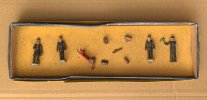
The current ‘people’ theme in the discussions on this thread reminded me of this box of station staff sitting in my ‘to do’ queue:

A9B2B71F-B331-4B57-A689-CDC16F1238E0.jpeg

EB589CF1-4DAB-4D7A-8013-81FDC5CB870C.jpeg

From the 1950s Bassett-Lowke range. On the basis of the design of the box, manufactured for Bassett-Lowke by Crescent Toys. The set is complete with the contents all still strung to the backing card. If it was in perfect condition, I would probably have kept it ‘as sold’, but it’s filthy and I can’t clean the models while they are strung to the card. So yesterday evening, I extracted and turned over the card on which the models had been mounted:

DA81D143-2698-4FF5-80C9-E4B1ED832B1E.jpeg

I’ll admit to feeling slightly guilty cutting the string. But the accumulation of sooty dust and grime on the models would ultimately damage the paint, so in the interests of preservation — they are free!

After a wash, the first chance to get some exercise in over seventy years:

9423861A-65C8-4889-B4A6-7A8C29C15DBB.jpeg

The figures are not as well painted as the pre-WW2 Britain’s or Dinky equivalents, but are better painted than the 1950s Dinky versions. Some nice touches in the set now I can see the colours properly. The four suitcases are quite detailed castings and two are finished in a mid-brown shade, two are dark brown.

These were the last traditional cast metal figures offered by Bassett-Lowke. Now washed, they are in perfect condition, as packed by the manufacturer. I’m not the first owner, but effectively I bought these figures ‘new’. I was the first to unpack them. I think I have only one other vintage item — a 1950s Bassett-Lowke goods brake van — where I was the first person to take the model out its packaging.

Martin
 

40057

Western Thunderer
Prompted by yesterday’s post, I thought I had better do a bit of research into Meccano Ltd’s Dinky/Hornby 0-gauge-size figures — and especially passengers. I am not knowledgeable about Hornby, know even less about Dinky Toys, and don’t have any of the firm’s catalogues. However, a bit of time searching online quickly established Meccano Ltd’s range of 0 gauge size figures comprised:
Set no.1 — Station Staff
Set no.2 — Farmyard Animals
Set no.3 — Railway Passengers
Set no.4 — Engineering Staff
Set no.5 — Train and Hotel Staff
Set no.6 — Shepherd + Dog + Sheep
There were five or six models in each set. As far as I can see, the figures were only sold in the various sets listed, not individually. The human figures (but not the animals) were changed to smaller size castings c.1937. In some cases, the smaller version is very similar to its larger predecessor, just slightly smaller (e.g. the lady hiker); in other cases, the smaller figure is equivalent to but distinctly different from the earlier larger model (e.g. the ‘woman’ passenger).

The strong impression I had that the range of Dinky/Hornby figures was dominated by models of staff is confirmed. Amongst all the models, only set no.3 contains passengers. There were six individual models in set no.3, one of which was a ‘newsboy’, so not a passenger as such. The remaining five models were: woman; man; mother + child; hiker (woman), and; hiker (man).

The hikers are perfectly plausible to stand on a platform waiting to catch a train, or to be walking on some scenic part of a layout. But they are not regular, ‘normal’ passengers in the way the other Dinky passenger figures were. For Rivermead Central, I just need ‘ordinary’ passengers to stand on my station platforms. It turns out, there were really only six/eight different ordinary passenger figures in the Dinky/Hornby range; the larger and smaller castings for the woman, man and mother + child. The larger and smaller woman figures are differently dressed and were painted different colours. The larger man passenger is in a suit, the smaller one is wearing an overcoat (see previous post). The larger mother + child casting has the child (painted wearing red and yellow) on the woman’s right, the smaller version has the child (wearing green) to her left (see previous post). So there are six (eight counting the child separately) properly different, regular, passengers. And that’s all.

The smaller figures were made again after WW2 (1952–56). The castings appear to be identical to the post-1937 pre-War models. The post-War figures are much less well painted. The colours used for the woman and mother + child after WW2 are more garish versions of the pre-War colour schemes applied to these figures (see previous post). The man passenger, however, had a grey coat pre-WW2 (see previous post) and a brown one after the War. So the post-War version is noticeably different. Pre- and post-War versions could be stood close to each other on the same platform and would echo the reality of similarly-clad businessmen heading to work. Incidentally, the post-War card insert holding the figures in place in their box does clear up the social status of the man passenger (see my previous post). The description printed under the man figure in the 1950s box was ‘Business Man’.

I can’t help feeling Meccano Ltd missed a trick by, seemingly, always painting the various passenger figures in particular colours. Varying the colours of the passengers’ clothing/hair/skin would surely have led to some additional sales, especially since so few different passenger models were made. Paint schemes were varied to create different staff models. The casting used for Frank (porter — see previous post) was also used, appropriately dressed, in the engineering staff set. Painted differently again, the ‘Frank casting’ was a Pullman car attendant.

Martin
Some additional information on the Dinky/Hornby figures.

The figures were evidently sold separately and each had a unique product identification number. These adverts are reproduced on the Brighton Toy & Model Museum website:


The 1935 advert shows the original production larger size figures, the 1939 advert shows the later smaller size castings.

Even the shepherd and sheep dog were sold separately:


The identification number for the sheep model reflects that that the sheep was originally produced for Set no.2.

Martin
 
Top