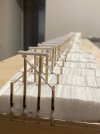
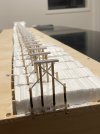
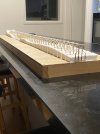
I'm looking at late 1930's to early 1940's. I don't have enough data on the bridge to pin it down specifically. I know there were the out rigger type piles and the battered piles at the Tallangatta (down) end. There's still a few there (I drove past them this week). I made the assumption that the battered piles were where the ground level was closer to the bridge deck. The bridge is level for it's entire length. I've modelled the natural surface level off the original longitudinal plans. I've mad an assumption as to where the piles changed from out riggers to battered (about pile 139).
The crossheads are 14' long as per the standard drawings and the sleepers are 9' (I'm using PCB sleepers from the 2mm Association as per the rest of my layout).
Any information on this structure would be greatly appreciated.
The whole bridge was built to the then current VR standard 20' bridge drawing. The contract for the Mitta Mitta River bridge was signed during 1889 and the closest in date drawing I have to hand for the standard 20' span bridges is the July 1888 version used for the Curdies River bridge on the Timboon line, see attached pdf. Any pier over 14' high would have had the shorter outer piles. You probably have the F series standard drawings for the last version of the 20' span bridge showing the wider deck, crossheads and the angle irons tying the beams to the crossheads. Repairs were always carried out to the current standard drawing so the timber bridges gradually looked like the final standard design.
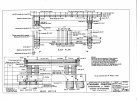
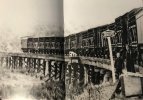
I am not an expert on this particular bridge but looking at photographs gives some clues to what changed over the years. The George Lynch photo in Nick Anchen's A Railway to Cudgewa shows the west end in 1924 with a number of additional piles added. The new battered piles stand out as pale coloured against the dark originals, bridges built before around 1895 were finished with tar so were black all over but repairs and replacement timber was not tarred so weather to pale grey. This photo is before the ballast deck was replaced with the 10'6" wide deck but longer headstocks have been fitted to the piers with additional piles. By the 1930s or 40s there would have been more piers with added battered piles, particularly on the curve.
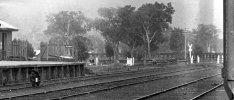
This crop from a VR photo (at PROV) of old Tallangatta shows the west end of the bridge in the distance and is interesting as it shows how much higher the bridge was than the station yard, there was a 1:66 gradient from the level crossing up to the bridge. Not a common feature.
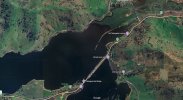
Looking at the current Google Maps image with the Hume Dam level down a bit shows that the VR had done quite a lot of filling of the bridge before the line was relocated - there was a long running program to reduce the length of timber bridges whenever spoil was available from other works, the spoil was dumped over the edge of a bridge until an embankment was built then the bridge beams would be removed. I don't know when the embankment building started on this bridge.
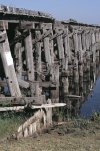
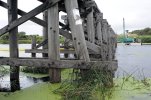
The Merri River bridge at Dennington was built to the same drawing (or the 15' span version) and was modified in the same ways as the Mitta Mitta River bridge but was in service until 1977 so had another 20 years of repairs. It retained the outer piles in the river but not on the sections over the floodplain. These photos were taken in 2010. The black timber shows that there was still some original timber surviving, and some of the piles are also original but the tar didn't stick as well to round timber as it did to sawn timber.
I hope that helps.