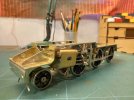
7mm Gladiator Horwich Mogul

P A D

Western Thunderer
I have the Gladiator Fowler 2-6-4t and the Horwich Mogul to do next and after tossing a coin, the 'Crab' won.

Here's what comes in the box. Tons of lovely brass castings, plus a few in white metal along with several in cast resin, notably the firebox which will be a big time saver. There's also a selection of brass rod and copper wire to complete the parts, with the various nuts and bolts sealed in the poly bags.
20251107_123900.jpg

Tender etchings - brass. This has a flush sided tender so will be easier to add the lining than the riveted Stanier mogul.
20251107_124304.jpg

Loco etchings - brass
20251107_124753.jpg

Loco etchings - nickel silver. One of the main frames was already cut out when the nickel sheet was cut down to fit in the Gladiator box.
20251107_125116.jpg

The tender is of original Gladiator design dating back decades, whereas the loco (as is the Fowler 4P tank) is a new design by John Firminger. As I'm familiar with the Fowler tender having recently built the Stanier Mogul, I decided to crack on with the loco first.

Here are the frames after fitting the axle bushes along with some of the spacers. As usual, I've elongated the middle bush holes to allow them to 'float'. The narrow spacer on the left is an error and not used. There is a correction in the instructions and supplementary parts to replace it.
20251107_170318.jpg

There isn't a spacer for the frames at the front which I thought left them a little vulnerable during handling.
20251107_183119.jpg

So I added one madefrom waste fret.
20251108_140517.jpg

And an underside view showing the corrected spacer at the rear (the one with the vacuum cylinder).
20251108_140547.jpg

Next the brake gear is loosely added with only the brake hanger brackets actually soldered. I held it all together with short lengths of silicone tube on the ends of the various pivots. In doing it this way, I was following the instructions and was a little sceptical of the wisdom of the method.
20251108_192502.jpg

20251108_192512.jpg

Then the wheels are fitted and the brake gear can hang loosely.
20251109_162407.jpg

Then the hangers are lined up with the wheels and soldered at the brackets, followed by the soldering the crossbeam pivots one pair at a time. I started at the front and worked backwards. The front brakes have their own vacuum cylinder so the front pull rod is fixed independently front middle and rear ones.
20251109_180217.jpg

Despite my initial scepticism, it was quite straightforward if a little fiddly putting loosely together before soldering.
20251109_180229.jpg

The middle and rear brakes are operated by the cylinder at the rear.
20251109_180616.jpg

The was no pivots detail on the brake blocks, so I drilled them out 1mm and added lengths 1mm brass rod.
20251109_180624.jpg

So far I'm very impressed with the design and fit of the parts and will definitely have more fun building this than the Oakville Ivatt.

Cheers,
Peter
 

Genghis

Western Thunderer
I will, of course, follow this build with interest!
There is a story behind the mainframes. After we had sold the first batch of kits, we had a comment made by a customer that the frames under the cab were wrong with the brake cross shaft being too long and supported by the frames, this arrangement giving no room for the exhaust injector that is angled behind the steps. A quick chat with John Firminger and a check of the drawings showed that the customer was right and that the drag beam was also mis-shaped. John quickly drew up a replacement set of frames, drag beam and a new rear spacer and support arms for the brake shaft. These were duly etched and distributed with new kits. It didn't take long - but unfortunately not long enough for me - to realise that John had drawn up identical left and right frames, so a new set was duly drawn up and etched. This was fine until we realised that the spring detail was now etched on the wrong side of the springs. So we are now on the fourth set of tools for the frame etch. To keep printing costs under control the frames are printed on a supplementary sheet that is too big to fit in our standard box. Hence we supply frets where I have removed the original frames and cut out the replacement so it fits in the box. All of this is in no way a criticism of John, who battled his illness with a cocktail of medication and gave his all to the projects he was helping us with. I relate this anecdote in the hope that those not involved in the production of kits might be interested.
David
 

P A D

Western Thunderer
The cylinders are designed to be individually bolted to the main frames. Note the rebates in the front and rear cylinder plates which are a great aid to fitting the wrapper. The piston gland/slide bar bracket castings are fitted from the inside.
20251110_184136.jpg

Wrappers are provided for the original set up with two relief valves or the later modification. The 8BA screws are soldered in place and cut short on the outside to act as alignment studs. A screw is then inserted from inside the mainframe to fasten the cylinders in place.
20251110_184618.jpg

Although thin, the wrappers are quite robust and were easy to shape without annealing. A small rebate has to be cut in the rear plates to clear the front brake hanger, but this is mentioned in the instructions.
20251110_192532.jpg

The motion braket after laminating.
20251110_200048.jpg

Cylinders and motion bracket in place.
20251110_200231.jpg

On the left the front of the RH cylinder after fitting the front valve cover. I noted from prototype images that there are a couple of screws or rivets on the lower face and I've added these using small brass rivets. On the right the rear valve cover on the left hand cylinder. The brass castings are excellent with no flash and only the remains of the stub after cutting from the sprue to clean up.
20251111_172147.jpg

The rear sandboxes (resin) and running plate support brackets have been fixed, but the middle/front sandboxes (resin) and valve guide support bracket (brass) are only loosely fitted for the photos.
20251111_202257.jpg

At this stage I'm not sure how or if the cylinders and motion will be removable for painting, but I'll cross that bridge when I get to it.
20251111_202306.jpg

There's an awful lot of clutter under the running plate on these locos and it's all represented and mostly in cast brass.
20251111_202317.jpg

20251111_202333.jpg

Cheers,
Peter
 

P A D

Western Thunderer
I did some back tracking on the Crab before progressing further with the build. I wasn't happy with the etched springs as the leaves are etched in a distinct curve and don't give a good representation of the real thing when viewed through the spokes.
20251108_140517.jpg

Here's a comparison with the cast springs from Laurie Griffin. Although compared to works drawings they do not have enough leaves and should be deeper, they are much better than the etchings.
20251112_155609.jpg

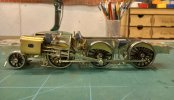
The original springs were removed with a slitting disk. Here's the chassis after fitting the castings.
20251113_150438.jpg

Here are the coupling rods after assembly along with the wheels prepared for fitting. As I normally do, the top hat bushes are tapped 10 BA and the bolts replaced. On the left the rear wheels with the bush filed down to just clear the rod and retained with a 12BA nut tapped 10BA, along with a 12 BA washer drilled to clear the bolt. This give a better appearance. On the centre wheels the bush is screwed onto the uncut bolt to allow for a second bush to be applied in reverse through the connecting rod. On the right the front wheel has a 10BA washer added first to space the rod, followed by a reversed bush with holes drilled in the flange to allow tightening with the points of the tweasers. This is for clearance behind the slide bars.20251113_181129.jpg

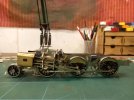
Wheels, rods and balance weights fitted. Pleasingly, the chassis ran perfectly smoothly without any fettling.
20251114_184203.jpg

The sand pipes, sand boxes, and brackets for the valve gear have all been added.
20251114_184215.jpg

20251114_184228.jpg

On this side I've made a start on fitting the slide bars.
20251114_184239.jpg

Cheers,
Peter
 
Last edited:

Dave Holt

Western Thunderer
All looking very nice indeed, Peter.
Love the sand pipe details. You 7 mm guys don't know how lucky you are to be able to take the wheels off the axles, so things like sand pipes and their supports and brake gear don't have to be made removable. When the wheel sets have to be able to drop out of the horn slots, it creates quite a few extra headaches.
Looking forward to further progress.
Dave.
 

P A D

Western Thunderer
Many thanks Dave.
Yes there many things about 7mm scale that makes things a lot easier to do than in 4mm.
How you manage to get the pick-ups between those narrow frames with all the other clutter is beyond me!

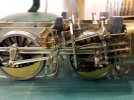
Just a quick update. I've now got the slide bars, crosshead and connecting rods on and all still runs smoothly.
20251115_174610.jpg

20251115_174553.jpg

Cheers,
Peter
 

P A D

Western Thunderer
what pick ups are you preference peter

Normally I make wipers acting on the flanges at the top of the wheels. However, in this case I've decided to give plunger pick ups a go and have a set on order from Slaters.

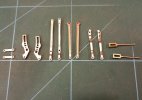
This afternoon I prepared the various valve gear parts ready for fitting.
20251116_175835.jpg

And soldered the return cranks to the outer bushes on the centre crank pins. The bush and crank can be unscrewed for dismantling.
20251116_195348.jpg

20251116_195417.jpg

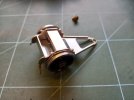
I also added the guard irons to the pony truck to finish that off.
20251116_195438.jpg

Cheers,
Peter
 

P A D

Western Thunderer
Thanks Gary.

Here's a view of the completed pony truck. It's a little spartan, but as I don't have any images of the real thing to show what may be missing, I'm living with it.
20251116_145708.jpg

The cylinders and valve gear are not designed to be removable as a unit, so the gear will need partial removal to allow the cylinders and slide bars to come off. To facilitate the fitting of the radius rod and combination lever, I've cut the valve guide cross beam so that the guides and rods may be fitted individually one side at a time.
20251118_172721.jpg

And added an additional spacer (behind the front sand boxes) to which the valve guides may be secured.
20251118_172739.jpg

Here's the right hand side in place.
20251118_173149.jpg

And with all the rods fitted (apart from the lifting links and reversing rod).
20251118_185825.jpg

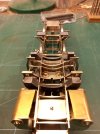
It's just struck me that there is no ash pan below the frames between the middle and rear wheels, but that can easily be added from brass sheet.
20251118_185849.jpg

Cheers,
Peter
 
Last edited:

P A D

Western Thunderer
Thank you Simon.

There was a slight bind in the valve gear which took a while to eliminate, but I finally sussed it out. To finish it off I made up the lifting links/ reversing lever and cross shaft as per the instructions. I wanted it detachable as a unit to allow for dismantling prior to painting, so I cut slots in the frames above the location holes so the shaft can be dropped in place. I'm not sure the real thing would have the bend in the shaft to clear the boiler, but it won't be visible when the boiler goes on.
20251124_173921.jpg

The lifting links are pivoted to allow for the slight fore and aft movement of the radius rod when the loco is moving. Various 'strategic' pins and screws are not fully secured yet to allow the gear to be dismantled.
20251124_174258.jpg

20251124_174328.jpg

20251124_174357.jpg

20251124_174420.jpg

This view shows the cuts made to the motion and valve slide brackets to allow them to be removed separately. Each part is individually screwed in place.
20251124_174508.jpg

With the chassis done for now, I've made a start on the body. The platform has half etched lines for the upward fold and although the instructions mention annealing, I found it unnecessary. Also as the lines are on the outside of the fold there are no witness marks to deal with.
20251124_202327.jpg

20251124_202304.jpg

Cheers,
Peter
 

Dave Holt

Western Thunderer
All looking very neat, Peter.
Actually, the prototype did have the weighshaft bent to clear the boiler, though not quite as pronounced as yours, (about half the shaft diameter) and only the portion between the frames. There was also a gap in the boiler cladding local to the shaft to ease matters.
Making the shaft removable is an excellent idea.
Dave.
 

P A D

Western Thunderer
Thanks Gents.

I couldn't make out (from the drawings in the LMS profile on the class), how the rod passes under the boiler. I considered makings it straight with a cut out in the boiler to clear it, but then decided to go with the instructions.

Got the footplate done this afternoon. The section under the cab is nickel silver so even thought it has half etch grooves at the bend, I still had to anneal it, to get it to fit the valance. I hate annealing as the discolouration won't take solder and is a sod to remove. I scrubbed it bright again in the areas that will be soldered with a wire brush in the mini drill.
20251125_151945.jpg

The next section being brass, was easy to shape and fit without annealing.
20251125_152010.jpg

Here it is after the front section was added to complete.
20251125_155803.jpg

And a dry run on the frames.
20251125_160744.jpg
20251125_160801.jpg

Next up is the cab. I got parts cut out ready for fettling and assemby tomorrow. This image was taken before de-cusping, which is a real chore!
20251125_163028.jpg

Cheers,
Peter
 
Top