A Brutalised Barclay

H spoked wheels for the loco.
  • Brian McKenzie

    Western Thunderer
    Thanks guys. Wheel centres for the tiny 30inch diameter drivers were SLS printed in China from tough Somos® Taurus material.

    S3890002a Barclay wheel prints with counterweight.jpg

    Don't know the orientation of the printing. Has the shiny side been vapour smoothed? The matt side is a bit rugged in places, but will be fine facing inwards.

    The 3D design follows the practice used for cast brass wheel centres, with a preferred machining allowance added to all flat faces and outer diameter.

    First up, a 1/8inch hole is drilled at the axle centre (for a later operation). An aluminium collar was prepared to accept the mouldings which are a light press fit inside, done for better concentricity than the three jaw chuck would deliver. At a later stage this hole will be bored out (not drilled) to the axle's scale diameter of 0.162".

    Wheels pressed into aluminium collar for drilling_S3880002v.jpg

    Further use of the aluminium collar was made by screwing it to a piece of brass bar for ease of clamping to the mill table. Front and back faces of the mouldings were then milled to leave a thickness equalling the width of the tyres to be fitted, matching the prototype's appearance. As the crank boss needed to be 10thou (0.25mm) proud of the counterweight and rim, it was easier to mill around the rim and thus dodge the crank portion when facing the counterweight (although the wheel could be mounted eccentrically for turning this).

    Facing the rim_S3910004v.jpg

    Next step was to turn the OD to be a press fit inside the tyres. The 1/8" hole drilled at the start was used to push the mouldings onto a short spigot for turning. The robustness of the 'Somos Taurus' material allows for this, but that may not be a practical method for less rigid 3D print materials. Although easily turned, the residue comes off as a very fine dust, so light that it drifts in the air almost like smoke. I wore a mask when turning this material once before, but this time a vacuum cleaner hose was tied to the toolpost.

    Vacuuming dust while turning OD_S3930001v.jpg

    Despite aiming for an interference fit of about 3/4 of 1 thou of an inch :rolleyes: ( yes I know, but it is how I work with my mostly imperial equipment :D ), Loctite retainer is also applied. For this to work as intended by the manufacturer, a needle file is used to score a shallow clearance in the centre of the turned perimeter.

    The moulded wheel centre is then pressed a little way into the tyre, and Loctite 680 (Loctite numbers jump around globally) is spread around the plastic perimeter, before the centre is fully squeezed home. Parts were cleaned with Loctite 7471 primer beforehand.

    Loctite.jpg

    As the crank boss protrudes 0.25mm eitherside of the tyre width, the wheel is placed inside a folded wrapper of 0.25mm brass, with apertures cut to clear these bosses, before pressing home fully. This ensures correct positioning of the wheel centre inside the tyre.

    S3940010a 10thou brass wrapper to protect crank boss.jpg

    Several sets were made, giving opportunity to experiment with (as pictured), stainless steel, an alloy steel, and cast iron for tyres.

    S3940002a Stainless-steel-iron tyred wheels.jpg

    Next job is boring for the axles and fitting of crankpins.
    -Brian McK.
     
    Assembling the Wheelsets
  • Brian McKenzie

    Western Thunderer
    Loco wheels were clamped into the end of an aluminium bar to finish bore the axle hole to a scale 5-1/2" dia.

    As all of the crank boss protrudes slightly from the rear of the wheel, the clamp plate has a cut-out to avoid it. Original intention was to use a 1 in 48 tapered reamer after boring (hence the mounting of the wheel backwards), for similarly tapered axle ends, but the reamers at hand were not ideal for that size.

    S3960001a Clocking up wheel for boring.jpg

    So the wheels remained bored parallel, and the axle ends were given a lesser taper, equal to an increase of 1-1/2 thou (0.0015" or 0.04mm) in diameter over the length of the seating, for a tight secure fit in the plastic of the wheel centre.


    Previously, a steeper 1 in 48 taper was given to axle ends for the many brass centered driving wheels made (circa Gauge 1), to fit matching tapered wheel bores. To get axle material sized to display the correct outer end diameter, appropriate HSS drill blanks were purchased. As these blanks come in a hardened state (i.e. a 'drill' before the flutes are ground or twisted in), the cylindrical grinding device shown below was cobbled up to grind tapers concentrically - while the axle material rotates about its own axis in brass bushes. More recently I have gone away from doing that as the supplier began selling drill blanks from Asia - that are anything but round, and/or are heavily surface indented with size or branding.


    For this Barclay loco model, 3/16" dia. silver steel was used, with the ends turned down a little. The $8 motor (ex a scrapped record player) is powered by a Hammant & Morgan Duette, and the drive belt is a slice of mountain bike inner tube. With the axles ends coated by black marker pen, the spinning grinding wheel is lowered, and the taper appears as a bright metal ring steadily growing wider as it produces the shallow angle and removes the black ink. The taper angle applied is determined by the amount the device is 'tipped' over - in this instance by placing a strip of regular 0.004" thick notepaper under one edge. (When grinding the steeper 1 in 48 tapers, a 6inch steel rule was used as packing.)

    S4040001a Cylindrical grinding attachment.jpg

    Why do these tapers? The main reason - and my fetish, is to avoid any wheel wobble or eccentricity, sadly something not uncommon. But with this loco model, there was also a chance to compare the traction adhesion between stainless steel, plain steel and cast iron wheel tyres. Stainless steel has been my go-to in the past, with Avesta pickling paste sometimes used to tone down the shiniest. The intention was to swap wheels around with the wheels only partially pressed on to the axles for tests.

    S4060020a Wheel quartering jig.jpg

    A 'Wheel Quartering' jig was made from two squares of 12mm steel plate. Both were bored to accept the wheels neatly over the flanges. Four holes were drilled equally spaced in a square pattern off those bores for 5mm dia pins - while the plates were stuck face-to-face to each other, using double-sided tape.


    Working off the 3/16" hole in the centre, a 1.15mm dia hole was drilled right through all, to capture the undernourished M1.2 crankpin screws.

    90degree quartering is thus assured by rotating one of the plates 90 degrees on the 5mm pins. With the wheels and axle placed in jig position, the whole lot is squeezed in the vice.


    The next pic. shows at right a short steel pin sitting inside the 3/16" centre hole. The length of the pair of pins used is carefully calculated, to centralize the wheels on the axle, and stops the vice being squeezed to less than the required back-to-back measurement. When the wheel at right is fully pressed on, the axle end will protrude 0.005".

    S4060011a Wheel quartering jig.jpg

    For now, the cast iron tyred wheels have been installed (I rather like the iron colour for the intended rusty finish loco) - and I'm not so keen to pull them off again :rolleyes:. Have already been there and done that. Forgot to add the axleboxes :headbang: .


    Photo below shows a stainless tyred wheel in the wheel puller, that has a 6mm cap head screw in the back, fitted with a brass peg at the business end.
    S4040006a Wheel Puller.jpg

    The Barclay model is not liking what was done to its prototype - so it tried to do a runner.

     
    Cab windows
  • Brian McKenzie

    Western Thunderer
    Coincidentally with Adrian's excellent work contouring cab windows for his Precursor,

    these frames for internally opening windows were pantograph milled
    S4670019a Three of four window frames.jpg

    and soldered in place yesterday. While the frames looked good, the fitted result was a bit deflating - left wondering if it was worth the effort involved.

    S4670058a Internal window frames.jpg

    The width of the front frames needed to be reduced at the top, to clear the overly thick internal roof panel. It was easier to use a toolmaker's clamp to grip them - than placing in a vice.

    S4670022a Needed to reduce width at top of front frames to clear thick roof.jpg

    -Brian McK.
     
    Cab doorway trim
  • Brian McKenzie

    Western Thunderer
    0.045" wide strips, for edging the cab doorway, were milled from 10 thou nickel-silver sheet, temporarily soldered to a piece of brass angle.

    S4680003a Pantograph milling 45thou wide strips in 0.010 nickel-silver.jpg

    The strips were shaped around an aluminium template,

    S4680018a Doorway edging formed around aluminium template.jpg


    and retained with a spot of superglue at each end.

    S4680011a Preforming 0.010 nickel-silver strip for edging cab entrance.jpg
    (The clamp at right was a repair job - rescued from red heat in a furnace - and re-fitted with long screws of studding.)


    S4680027a Doorway edging supported with aluminium template.jpg
    Much jiggery-pokery - but eventually it fitted - and the outer ends were tack soldered.


    Clamps from titanium strip were bent to keep all together,

    S4680029a Doorway edging with clamps after flame soldering.jpg


    and the solder was flowed using a gas torch (which I'm more at ease with than using an iron). Pic shows before clean up.

    S4690042a Cab entrance trim.jpg

    -Brian McK.
     
    Small brass Rivet production
  • Brian McKenzie

    Western Thunderer
    Miniature rivets 14-11-25.jpg

    How did they make these - miniature brass rivets from RB Model and Scale Hardware? Swiss sliding head lathe?

    I've used many from RB Model, but when wanting more, learnt their production had ceased. :(

    Needing a few, in two larger head sizes, I tried making them (rather than wait out the delivery time from USA).

    IMG_2542a Turning 0.7mm Rivet 1.2mm head.jpg

    This ugly tool made a reasonable job of the larger size, when it wasn't really expected to. The head is formed by a notch in the tool.

    IMG_2559AA Turning Rivets 0.7mm [ex MVI].jpg

    Thus encouraged, I put a bit more effort into a better tool for the smaller rivet. As it was only the head size that was important, the shank diameter was maximised - to have the drill size for holes as large as possible.

    Tool for 0.9 head Rivets.jpg

    [ That's swarf building up on the tool - not rivets :) ]​

    6inches of 1/4inch dia brass rod provided 40 rivets. This overly large size brass turned more freely than the smaller diameter rods tried.

    The lathe tools are shaped a bit like a parting-off tool, with a notch made in an internal face (using a Dremel with diamond disc), for shaping the rivet head. All turning was done without any swapping of tools - to keep regular consistency of size.


    -Brian McK.
     
    Making Handrail Knobs
  • Brian McKenzie

    Western Thunderer
    The Barclay progresses intermittently.

    20260406_163052a Saddle tank fittings.jpg


    IMG_2841a Handrail Knobs.jpg
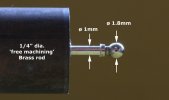
    Handrail knobs needed to be 1.8mm in diameter for 9mm scale, so a bit fatter than those available for 7mm scale at 1.6mm.


    S5160006a Turning tool+Handrail knobs.jpg
    A form tool was made from a piece of 'gauge plate'. This has similar composition to silver steel or drill rod - which could be used alternatively. A hole, the same 1.8mm diameter as for the ball shape, was drilled at a 6degree angle (to provide cutting clearance). Two edges were then cut away to reveal the shape (photo shows a 'spare' hole).

    The tool needs hardening by heating to a bright red - and is quenched in oil.

    IMG_2799a First handrail knob.jpg
    The knobs were turned from 1/4" diameter "free machining" CZ121 brass. Other grades of brass rod snapped off at the undercut before the ball was fully shaped.


    IMG_2856a Handrail knob [ex MVI].jpg

    A jig was cobbled up to drill mostly blind holes for the 0.9mm dia rail.
    20260315_162008a Drill jig.jpg


    IMG_2825a 0.070 dia Handrail knob.jpg

    -Brian McK.
     
    Safety Valves, Chimney
  • Brian McKenzie

    Western Thunderer
    Thanks Tom, and everyone for the likes. Adding the fittings along the top of the tank was enjoyable, more so than much other work.

    The safety valve is mostly assorted turnings - all press fitted into each other.
    164309a Safety Valve components.jpg

    Only the spring needed soldering - to the T shaped pieces at top and bottom.

    The spring was surprisingly quick to make. Brass wire, annealed to red heat, clamped to a spigot turned down to 1.6mm dia. The lathe was set to its slowest speed of 52rpm - and put in reverse. With the outer end of the wire gripped with pliers, it was switched on.

    Done - almost as fast as you read that :)

    152558a Winding safety valve spring.jpg

    20260406_163500a Safety valve.jpg

    The chimney was also good fun.
    115112a Chimney turning.jpg
    Tools were ground (by hand) to the various radii, and for shaping the underside.

    -Brian McK.
     
    Top