A Tale of Two Serpents

RichardG

Western Thunderer
Nick ( @magmouse ) and me have discovered, we each have an unbuilt kit for a GWR ‘Serpent’ in our respective stashes. We think it would be fun to build the two kits in parallel, and record the progress in a shared thread.

DSC_1510.jpeg
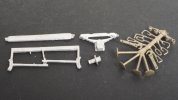
This is the Ennis 75 (formerly Scorpio) kit for a GWR implement wagon to diagram G9. We don’t know whether the kit will go together without difficulty or need some tweaking, but either way there should be some feedback worth sharing here.

To make things more interesting, neither of us has a clear photograph of the deck or the ends of these wagons, though we do have have half a dozen side views and the GA.

Our two models will be different: one for FS and one for S7, with detail differences along the way.

DSC_1512.jpeg
I’ll post this second photo now as a record of many of the part numbers, because these will get disconnected from their associated parts soon after building begins.
 
Wheelsets (Nick)

magmouse

Western Thunderer
I've started by a good look at the instructions and the kit components, to see how the kit is supposed to go together. I've also spent a bit of time looking at prototype photos and the GA drawing (sourced from the National Railway Museum, drawing 8209W of 1889, when these wagons were built). I always find it helpful to understand how the prototype was constructed. In this case, the drawing reveals how the floor of the kit has been simplified, so there is an opportunity to make the model more accurate - more on that when we get to it.

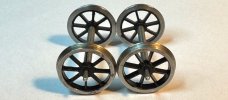
I've also started preparing the wheels. These are Slaters 8-spoke wagon wheels to S7 standards. With these, I use a sharp scalpel to chamfer the back edges of the spokes and rim of the wheel. This helps give a more delicate silhouette to the wheel - the effect is subtle, but worth it in my opinion.

Here is the back of the wheels, modified on the left and unmodified on the right:

IMG_6704.jpeg

And this is what it looks like from the front - again, modified on the left. The rear wheels are unmodified in this picture.

IMG_6702.jpeg

Thanks to Mike Osbourne (@Airnimal on RMweb) for this tip.

Nick.
 

Tony Overton

Western Thunderer
I've started by a good look at the instructions and the kit components, to see how the kit is supposed to go together. I've also spent a bit of time looking at prototype photos and the GA drawing (sourced from the National Railway Museum, drawing 8209W of 1889, when these wagons were built). I always find it helpful to understand how the prototype was constructed. In this case, the drawing reveals how the floor of the kit has been simplified, so there is an opportunity to make the model more accurate - more on that when we get to it.

I've also started preparing the wheels. These are Slaters 8-spoke wagon wheels to S7 standards. With these, I use a sharp scalpel to chamfer the back edges of the spokes and rim of the wheel. This helps give a more delicate silhouette to the wheel - the effect is subtle, but worth it in my opinion.

Here is the back of the wheels, modified on the left and unmodified on the right:

View attachment 254752

And this is what it looks like from the front - again, modified on the left. The rear wheels are unmodified in this picture.

View attachment 254753

Thanks to Mike Osbourne (@Airnimal on RMweb) for this tip.

Nick.
Nick

Having now done some research on the prototype can I ask your views on what you think of the kit as a whole, in its unbuilt state. Besides finding that the floor in the kit had been simplified, do you find the other etched parts dimensionally accurate?
Next the white metal castings. Are you happy with the accuracy, and importantly quality, of the axles boxes and springs supplied. Will you use them, or will you replace them? If you opt to replace then what will you replace them with?
I will watch this build with interest.
Tony
 

magmouse

Western Thunderer
Thanks, Tony.

Bearing in mind construction hasn’t started to any great extent, the following comments are provisional. The overall dimensions are pretty much correct. Width should be very close to the correct dimension (depending on exactly how the sides fold up from the floor). Length appears slightly too long, by a scale 2-3 inches. I’m not going to worry about that, as I don’t think it will be at all noticeable. I haven’t yet checked any other dimensions.

Castings are so-so. The buffers are decent, and I may use them, or I may replace with some PECO ones I have in stock. The axle boxes and springs are less good, and I will probably replace them - in any case I am thinking I will build this with grease boxes, not the supplied oil. Replacements could come from some spare 3D printed parts I have from @simond or from ABS castings I have in stock.

The brake gear castings aren’t great, but would probably clean up okay. I won’t be using them as they represent the later type of brake shoe. I’ll use a concoction of Ambis etches and spares from other kits to make the brake gear.

Overall, I’d say the kit is good value (I paid £30 a few years ago) - it would build into a reasonable representation of the prototype, and offers scope for refinement. That’s assuming it goes together okay, which is still to be tested, of course.

Nick.
 

RichardG

Western Thunderer
Nick

Having now done some research on the prototype can I ask your views on what you think of the kit as a whole, in its unbuilt state
. . .

Tony - I offer my thoughts as well, in case they are worthwhile to you and for the others who are reading the thread.

DSC_1644.jpeg
My feeling is, I will try to source some better buffers. I don't fancy my chances drilling out the stocks (these are solid metal), and some steel heads would look better than the cast brass ones. The white metal castings will clean up, though I don't yet know whether the brakes will line up with the wheels.

The etch looks like it has been drawn on CAD. All of my previous etched wagons have been hand-drawn, so maybe I will be pleasantly surprised.

I think the holes along the side channels make the Serpent an attractive and appealing model . . . but the top parts of these channels are separate parts (long narrow strips) to be attached by the builder. So I reckon this is not a beginner's kit. Then again, this will be my 22nd wagon for 7mm scale so I guess I need to stop calling myself a beginner and apply myself to something more difficult.
 

Tim Giles

Member
Tony - I offer my thoughts as well, in case they are worthwhile to you and for the others who are reading the thread.

View attachment 254793
My feeling is, I will try to source some better buffers. I don't fancy my chances drilling out the stocks (these are solid metal), and some steel heads would look better than the cast brass ones. The white metal castings will clean up, though I don't yet know whether the brakes will line up with the wheels.

The etch looks like it has been drawn on CAD. All of my previous etched wagons have been hand-drawn, so maybe I will be pleasantly surprised.

I think the holes along the side channels make the Serpent an attractive and appealing model . . . but the top parts of these channels are separate parts (long narrow strips) to be attached by the builder. So I reckon this is not a beginner's kit. Then again, this will be my 22nd wagon for 7mm scale so I guess I need to stop calling myself a beginner and apply myself to something more difficult.
I would recommend these buffers from Walsall

Tim
 

RichardG

Western Thunderer
Thanks Tim.

Here are the contact details for Ennis 75 from the kit packaging. They have Facebook pages as "Scorpio Models" and "Ennis 75" but no web site. In case anyone else would like to build the kit or of course something else from them!

They were giving away printed catalogues at Kempton, I guess this is available on request.


2-56267.jpg
 
Last edited:

magmouse

Western Thunderer

magmouse

Western Thunderer
Nick,

You may be out of a job; I think that Richard is telling us that he succumbed sometime last Autumn, maybe end of October or middle of November. I may be mistaken... I think th at a photo towards end of November shows a wagon with Slaters S7 wheels.

Rgds, Graham

Richard has expertly put up a smokescreen. The crane he refers to has S7 wheels, but is 32mm gauge. :eek:
 

Tony Overton

Western Thunderer
Yes, these are a good option for replacing the brass heads/rams, if you still want to use the cast buffer guides. Though I do seem to remember when I used some before thinking the buffer heads were a bit over scale size. CRT also do turned steel heads, though there the rams are a bit thick.
This is where ABS white metal component parts are so sadly missed. They were such good quality.
 

Dog Star

Western Thunderer
Consider talking to Slaters... I think that there are two GWR wagon buffer types in the Slater's range, they have different lengths of buffer stock.


Or, if we can find a suitable drawing, do a 3D CAD drawing of the buffer stock and run off some 3DP parts (with internal dimensions to suit Slaters buffer rams).


Clearly a topic to discuss over a Pie.
 

RichardG

Western Thunderer
The GA drawing of the wagon suggests a buffer stock with a rectangular flange at its base . . . just like the castings supplied in the kit.

I have some buffers from Haywood Railway to hand. It seems a shame to strip them for their heads/rams but they would work if I can drill out the stocks.
 
Last edited:
Preparations, especially corrected curb rails (Nick)

magmouse

Western Thunderer
Over the last couple of days I've spend a bit of time preparing some of the main etched parts of the kit - removing the tags, cleaning up the etch cusp, pressing out the rivets using my rivet press, and doing some of the main folds on solebars, headstocks and sides:
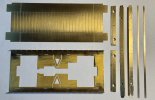
IMG_6710.jpeg

Now, if I were committed to building the kit as designed, I'd be pretty happy. With a bit of fettling the main parts look like they'll fit together, and everything is neat and tidy.

However... as I've worked through the various parts and examined the GA drawing further, a number of issues have emerged. Firstly, the holes along the side rail are quite a bit too small, so I drilled them out to a scale 3 1/2 inches. I did this with a drill in a pin chuck, as I was concerned using the pillar drill might shift the holes off centre. Doing it by hand meant I could make sure the drill was centring itself in the existing hole. I drilled in from both sides to avoid tear-out as the drill came through. You can see the size difference here - half the top holes are done in this picture:

IMG_6707.jpeg

As you can see, it makes a significant difference.

The next issue relates to the floor. The prototype has iron plates at the sides of the wagon, and a wooden floor in the middle. Both ramp up slightly at the ends to get over the buffer heads. The drawing shows that the plates sit on the under frame, and the wooden boards sit on top of that. The kit uses a single piece of brass for the floor, so you don't get the height difference. My initial plan was to make the planks from plasticard and attached that on top - nice and simple.

Further study showed other inaccuracies. The etched outlines of the planks are too wide, so new correct-width planks wouldn't cover the etched lines. Also, the length of the projections over the buffers and the ramped section are incorrect. On the prototype, the flat section of plate work goes all the way to the end, with the ramp a separate piece on top, so there should be a visible edge (but not fasteners - the drawing shows countersunk rivets).

The upshot of all this is that I will use the floor component upside down to make a flat floor, and built up the ramps on top, so I can get the sizes correct and a visible edge where the ramp meets the flat part of the floor. The planking will be done in plasticard. The drawing shows an interesting feature with the planking - it has a small gap (about 1/2 inch) between planks, through which daylight should be visible, as there is no metal plate down the centre of the wagon. I've decided to draw the line at achieving the daylight...

Along the top of the side rails are a series of holes, used to locate the bars that go across the wagon to chock the wheels of the load. The kit has etched holes, which need drilling out to clear them properly - easy enough. However, the kit has holes almost the full length of the wagon, whereas the drawing has not holes in the centre, only at either end. However, the holes don't go far enough to the ends of the wagon.

I have added three holes at either end, and only drilled out a total of 16 holes at either end of the wagon. The undrilled holes will need filling with solder and making good when this part is assembled - see the parts on the right of the first picture in this post. Even with this change, the holes will be wrong, as the kit has them too far apart (2.5mm, when it should be 2mm).

Finally (for now!), The headstocks have a horizontal etched line. I assume the kit designer believed the prototype had a 9 inch deep headstock (the same as the solebars) and then another component on top to make the 12 inch height needed. The drawing shows this is a single C-section part, 12 inches deep, providing the 3" projection above the top of the solebars, so there should be no line there. I plan to fill this etched grove with filler after assembly.

This has all been a bit frustrating, because what is a good kit in terms of the accuracy of the parts and a logical way of building up the wagon from etches has turned out to be inaccurate in various ways. It seems like every time I look at the drawing, I find something else that will add to the total amount of work to be done. I can only assume the designer didn't have the GA drawing I am looking at.

Anyway - onwards and upwards!

Nick.

PS - there won't be much progress next week as I am away for a few days. It'll give time for Richard to ponder whether he wants to make the very rational decision to build the kit as designed and get a model that captures the prototype overall, or follow me down my rabbit hole of lunacy...

 

Tony Overton

Western Thunderer
Excellent Nick, a very detailed account, very helpful indeed - a case of buyer beware for others who may follow !

Sadly my Mite, from the same stable, suffers from similar inaccuracies, creating a lot of extra work. Again I turn to a G/A and its frightening what I find ........

As to rabbit holes of lunacy, it all depends on what each modeller is prepared to accept. Lets get it right is my view.

How have you got on with finding photos of your Serpent, found what you needed?

Tony
 
Top