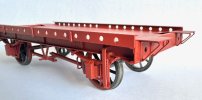
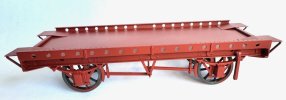
A Tale of Two Serpents

magmouse

Western Thunderer
Almost never.

Agreed - certainly in the pre-group era, which is my interest, there is plenty of photographic evidence that wagons could get pretty filthy, and a bit battered, though always well maintained. Painting intervals seem to have been around 7 years, but probably pretty variable. PO wagons were different, with hire contracts usually including a mid-contract repaint at 3-4 years.

Nick.
 

RichardG

Western Thunderer
So what about those of us who are not members of gOg?
Graham, you know you really want to buy it. You have all the guidance you could wish for here on WT, and you could make a fine model using just the solebars (reduce the bottom flange) and the curb rails (open up the holes), with all of the other parts of your own making or choosing. Just ask Dave for his best price :))
 

Dan Randall

Western Thunderer

ChrisBr

Western Thunderer
It’s been two weeks since any updates on progress… has the last remaining serpent slithered away?

Or has it inflicted a fatal bite on the owner?

Perhaps it has Nick in a constrictor hold and is gradually squeezing the life out of him??

The forum would like to know…..
 

magmouse

Western Thunderer
Well, it is proving more slippery than a slippery thing....

You should get a progress report later today. The last couple of weeks have been busy with other things, but the Accursed Serpent has received a little attention. I just need some glue to dry and I can photograph the current state of play.

Nick.
 
New brake gear (Nick) New

magmouse

Western Thunderer
So - what's happened since I last posted about the build process itself?

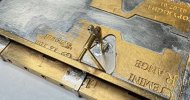
The vee-hanger, cross shaft and tumbler assembly has been made up and soldered in place. The vee hanger is the kit's, the cross shaft is a couple of pieces of tube with 0.9mm wire through, and the tumbler is an Ambis part:
IMG_6924.jpeg

The inner end of the wire represents the single vertical support of the prototype.

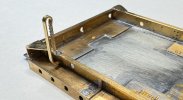
Next, the brake lever guard - this is from the kit:
IMG_6925.jpeg

IMG_6928.jpeg

It fits nicely into the slots etched into the solebar, and makes up to a nice solid part. The ratchet isn't correct, as it should a flat section, not a T, but making these as per the prototype is rather tricky, as the metalwork has to have two 90-degree twists in it, above and below the ratchet. Anyway, this is all good, right?

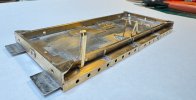
Well, no. The Curse of the Serpent struck again - turns out, the lever guard is in the wrong place, and would foul with the bearing spring shoe. Of course, I realised this after I had done it and was doing a quick check of how the springs fit with the axle guard units. So, the old guard had to be removed, the holes filled, new slots drilled and hacked out with the end of a sharp needle file, and a new guard made up and fitted, a few mm closer to the centre of the wagon. Luckily, I am modelling the wagon in earlier condition with single-sided brakes, and the kit provided for independent either side brakes, so I had a second set of etches for the lever guard.

After that, I turned my attention to the brake gear itself. Chris @ChrisBr 's very lovely brake shoes were glued to strips of nickel silver. I filed a notch in the strip to accommodate the lug on the shoes where the push rods attach:
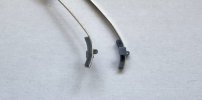
IMG_6930.jpeg

At this stage, the axle guards were not specifically located, which I needed to position the shoes. I used epoxy glue to attach the base of the rocking unit - glued rather than soldered as I needed the axle guard unit itself on the base in order to position it accurately relative to the solebars.

I then used a Brassmasters axle spacing gauge to temporarily locate the second axle guard unit:

IMG_6935.jpeg

With this arrangement I could solder the brake shoes in place relative to the wheels, without the axle guard units being permanently attached - I want to keep them separate until the painting is done.

I'm afraid I was rather remiss and didn't take pictures during the rest of the brake gear assembly, so this is a picture from later on that shows it:

IMG_6953.jpeg

Here you can see the metal strip of the brake shoes soldered in place, then plasticard built up over it to provide a flat surface to attach the safety loops, also folded up from nickel silver strip. The push rods are Ambis etches, attached at both ends with 0.45mm wire through the shoe lugs and the tumbler. Sounds simple when you say it like that, but it was actually a couple of hour's work at least.

The brake lever is the kit component, so nice and easy. Well not quite - for some reason it is far too long. I cut it down and folded the loop for the handle myself, rather than using etched guide lines. I made a mess of the first one, so again it was fortunate I only need one when the kit provides two. I won't fix the brake lever until after painting and lettering, as there is lettering on the solebar and the lever would rather get in the way.
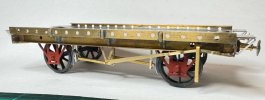
IMG_6947.jpeg

Also in the above picture you can see I have glued the triangular supports for the projecting ramps in place. I used the 3D printed jig discussed earlier to position them, and dropped a bit of thin CA in place on the end of some fine wire, allowing capillary action to draw it into the joint.
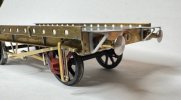
IMG_6948.jpeg

The buffers here are not yet fixed, which is why they look a bit droopy. Again, I'll leave these until after painting, as they'll get in the way of paint reaching the underside of the ramp extensions and the top of the buffer guides.

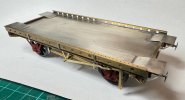
Next, a little refinement especially for Adam @AJC - the top flanges of the solebars, represented by some 10x60 thou plastic strip glued on. Pretty much invisible from normal viewpoints, but I (and Adam) will know it's there...
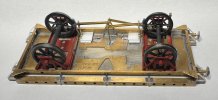
IMG_6952.jpeg

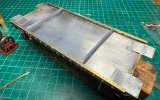
So that's where I've go to. Next the wooden floor and the 'chocks' that sit across the wagon between the sides and restrain the load. Here's a couple more views:
IMG_6949.jpeg

IMG_6950.jpeg

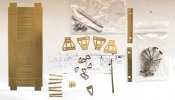
And finally for now, a review of some of the free extra materials and components provided in the kit that you don't need for this build but which might be useful for something else:
IMG_6941.jpeg

Actually, to be fair, some of these are things that are serviceable but I chose not to use - the cast buffer guides and chocks, and the brass cast buffer heads and couplings.

Nick.

 

Attachments

  • IMG_6946.jpeg
    IMG_6946.jpeg
    276.2 KB · Views: 4
New wheel chocks (Nick) New

magmouse

Western Thunderer
A little more progress - the chocks are done, made with cores representing the oak parts of the prototype that @ChrisBr kindly printed, and nickel silver strip. I cut the strip over length, bent the ends to shape, glued the "sandwich" together with thin CA glue, drilled the holes, and finally trimmed the ends to the correct length. You can just about see that Chris included the wagon running number and "GW" incised into the wood - hopefully this will survive painting!

IMG_6959.jpeg

IMG_6957.jpeg

The chocks won't be fixed until I've made the load (a pantechnicon), as they have to be positioned to fit the load's wheels. I wanted to get them to this point, so they can be given a coat of etch primer, along with everything else - hopefully at the weekend.

Nick.
 

magmouse

Western Thunderer
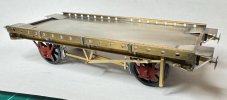
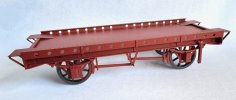
Has it really been nearly two weeks? Anyway, some progress - springs and axle boxes have been fitted, and the wagon painted - first with Upol #8 etch primer, then Halfords red oxide primer:

IMG_6968.jpeg

The brake lever won't go on until after lettering, as the lettering is on the solebar and partly obscured by the lever. Still to do - attach the buffers, the wooden floor, and the chains/tensioners that were provided at each end to secure the load. Then lettering and weathering.

IMG_6969.jpeg

IMG_6970.jpeg

IMG_6971.jpeg

IMG_6972.jpeg

Oh - and the sharp-eyed will have spotted I forgot to add the bearing spring bumpers before painting. D'oh!

Nick.
 

magmouse

Western Thunderer
Waiting for the paint to harden for a few days, I'm working on the chains and shackles these wagons were fitted with. Photos give few clues about what these were, and the photos showing more details are of the wagons after conversion to 'Cartruck' or 'Carfit', when the fittings may well have changed.

The drawing gives a clue, showing the fixing lugs on the top of the headstocks, and a single link/shackle attached. A text note says "screw connection to be coupled direct to this link with half inch binding chain attached long enough to reach chain from opposite end of wagon."

So, I have a set of screw couplings and lugs from CPL, intended for early container wagons, which together with some fine chain and soft iron wire links can be used to make this:

IMG_6973.jpeg

(And, before the Link Police turn up - yes, I've closed up that open link since taking the photo)

A note regarding the chain - this is made from a soft grade of what I assume is brass. As it comes, the links are pretty much circular. I have given each link a squeeze in some fine-nosed pliers, which greatly improves the appearance of the chain. A fiddly job, but actually not too bad once you get a rhythm going. I held one end of the chain in the vice, tensioned it with my left hand and applied the pliers with my right.

Finally - a question for the congregation. I'd appreciate any thoughts on preparing the brass chain and lost-wax cast screw fitting for chemical blackening. Obviously, any kind of abrasive cleaning is impractical, and I find brass blackening pretty hit and miss at the best of times. Is there a good way to chemically clean the metal before blackening?

Nick.
 
Top