Brian McKenzie
Western Thunderer
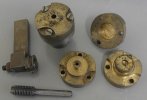
Disappointingly, the driving wheels of two locomotives, using 3D printed centres, have become distorted over two years, and will need replacing with brass castings.
Uneven mass in the wheel centres (large counterweight opposite small crank boss) seems to settle to a new equilibrium within the press fit of the tyre, causing the axle hole to shift off centre.
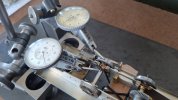
The difference measures 0.0035" T.I.R. at the same position in all wheels. Although not a lot, it looks awful as this eccentricity is highlighted as the side and con rods rotate.
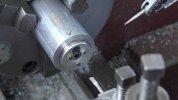
This is disappointing, after the care taken to bore axle holes after clocking up the wheels.
Hopefully, this shouldn't be a problem with wagon wheels and any others with symmetric shape.
It's worth noting that not all injection moulded wheels are immune from a similar predicament, as some plastics (e.g. glass-filled Acetal) have anisotropic shrinkage (i.e. they contract at a different rate out from the gate, compared to the direction perpendicular to it).
-Brian McK.
Uneven mass in the wheel centres (large counterweight opposite small crank boss) seems to settle to a new equilibrium within the press fit of the tyre, causing the axle hole to shift off centre.
The difference measures 0.0035" T.I.R. at the same position in all wheels. Although not a lot, it looks awful as this eccentricity is highlighted as the side and con rods rotate.
This is disappointing, after the care taken to bore axle holes after clocking up the wheels.
Hopefully, this shouldn't be a problem with wagon wheels and any others with symmetric shape.
It's worth noting that not all injection moulded wheels are immune from a similar predicament, as some plastics (e.g. glass-filled Acetal) have anisotropic shrinkage (i.e. they contract at a different rate out from the gate, compared to the direction perpendicular to it).
-Brian McK.