spikey faz
Western Thunderer
This is roughly how it looks with the frames moved out to allow for 28mm wide spacers.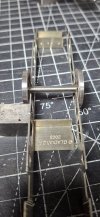
Mike
Mike


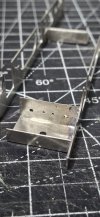
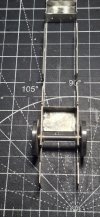
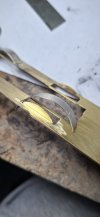
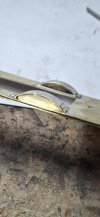
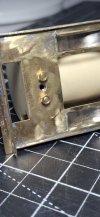
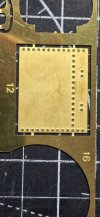
I've made a start by punching out the chassis rivets.View attachment 259944
. . .
That makes sense.Mike - backtracking a tiny bit - the etch for the crane jib looks like the one I used on my own "Nellie". If I was building this again I would find some brass tube large enough to accept the stub axles on the gears. Then open out the holes in the etch to accept short pieces of this tube and solder them in. Having done this, the gears can be fixed into the tubes with epoxy glue after panting, and they will be fixed more strongly than if simply glueing them into the etch.



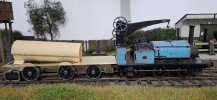
Work has yet to start on the body, but a quick measure of the footplate comes up with 182mm long. The buffer beams appear to be flush with the ends, so you'd just need to add the length of the buffers to each end.One of this is on my 'one day' list, so I'm following along with interest. Mine would also be an S7 build.
Since you are thinking about its length - could you let me know what the overall length is, over buffer beams or over buffers? Thanks.
Nick.

 One of which involves driving the rear trailing axle! The motor (or a smaller motor) could be hidden in the housing that supports the crane.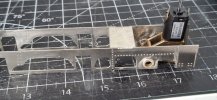


I'm in two minds at the moment. Either go fully experimental with the sort of drive you've suggested, or keep it simple and drive the rear driving axle and pop some sort of dummy inside valve-gear into the chassis.When I first built my 0-14 crane, I built it with a single axle drive, given that it was never going to haul anything but itself. On test it proved extremely disappointing, constantly slipping 'light engine' - and so I had to retrofit a gear train to to the other axle - whereupon it would pull anything! You could always use a 12v N20 driving through bevel gears?




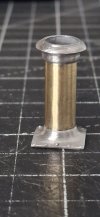
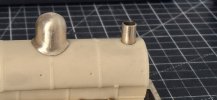
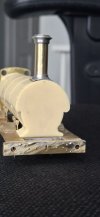
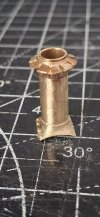

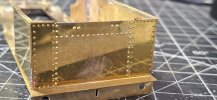

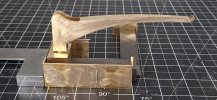
 I'm looking forward to getting the chassis completed.