Hi All.
Merry Christmas everyone!
Been sneaking in a few sessions in the cellar building a second Coal Engine over the Christmas period but have been a little tardy writing it up...
So this is the second of three I need for Crook Street and the first of two Gladiator examples I'll build. The first one was documented in the 'My Workbench' section a while ago and was a Mercian kit - unfortunately no more with the sad loss of Trevor Cousins to the model railway fraternity.
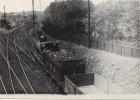
The Coal Engines were Webb's very numerous workhorses of the LNWR, which, in 1920, were superseding the Ramsbottom SDXs that were being withdrawn.
Having built the Gladiator SDX, I don't expect any dramas with this. The prototype were regarded as simple engines but in model form they're quite complex for a Victorian engine in that a lot of the fittings were mounted externally.
However, progress was quite rapid for the tender with a few of my favourite extras added.
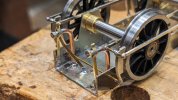
First of all, some suspension enabled by elongating the axle holes downwards for the front and upwards and downwards for the centre and soldered in for the rear. Sprung wire for the front:

And a coil spring strut for the centre, the 'strut' being wire soldered into the bearing, running in a drilled cross member made up from scrap etch:
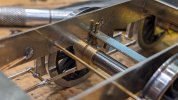
I added a brake actuating rod to the transverse fulcrum shaft:
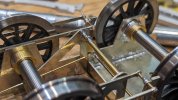
...and some water feed pipes:
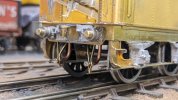
I made the front buffers operate by drilling out the castings and adding sprung rods. They're located by glueing in cross wires - Top Tip: don't put too much glue on.... (don't ask me how I know...). I also hacked the drag box about to accomodate my toy-train-set-style coupling post soldered to the drag beam. The front end looked like this now:
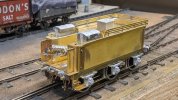
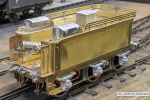
So with all the supplied components soldered and glued in place we have a completed tender:
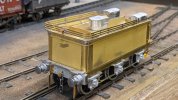
One last thing was filing off the centre rivet heads where the tender plate will go. I didn't do this on the SDX so had to slightly bend the plate, so I strove to get it right this time...!
Post script: On writing this I've spotted an omission - the mount for the brake fulcrum bar which was on the exterior of the chassis - I'll have to add them!
Cheers
Allan
Merry Christmas everyone!
Been sneaking in a few sessions in the cellar building a second Coal Engine over the Christmas period but have been a little tardy writing it up...
So this is the second of three I need for Crook Street and the first of two Gladiator examples I'll build. The first one was documented in the 'My Workbench' section a while ago and was a Mercian kit - unfortunately no more with the sad loss of Trevor Cousins to the model railway fraternity.
The Coal Engines were Webb's very numerous workhorses of the LNWR, which, in 1920, were superseding the Ramsbottom SDXs that were being withdrawn.
Having built the Gladiator SDX, I don't expect any dramas with this. The prototype were regarded as simple engines but in model form they're quite complex for a Victorian engine in that a lot of the fittings were mounted externally.
However, progress was quite rapid for the tender with a few of my favourite extras added.
First of all, some suspension enabled by elongating the axle holes downwards for the front and upwards and downwards for the centre and soldered in for the rear. Sprung wire for the front:
And a coil spring strut for the centre, the 'strut' being wire soldered into the bearing, running in a drilled cross member made up from scrap etch:
I added a brake actuating rod to the transverse fulcrum shaft:
...and some water feed pipes:
I made the front buffers operate by drilling out the castings and adding sprung rods. They're located by glueing in cross wires - Top Tip: don't put too much glue on.... (don't ask me how I know...). I also hacked the drag box about to accomodate my toy-train-set-style coupling post soldered to the drag beam. The front end looked like this now:
So with all the supplied components soldered and glued in place we have a completed tender:
One last thing was filing off the centre rivet heads where the tender plate will go. I didn't do this on the SDX so had to slightly bend the plate, so I strove to get it right this time...!
Post script: On writing this I've spotted an omission - the mount for the brake fulcrum bar which was on the exterior of the chassis - I'll have to add them!
Cheers
Allan


 ... I did the same on the SDX and got away with it... Got to keep your eyes open for those sneaky Crook Street tricksters...