Hobbyhorse. Some more work on the Stirling Single

Hobbyhorse

Western Thunderer
Looking at my notes the splashers proved to be the most troublesome, getting the drawing correct needed an additional visit to York to clamber over the loco to measure the splashers in more detail. All the drawings I had didn’t give the info needed, and as these are the most distinctive feature it was worth the additional time spent on them. Assembling them onto the running plate is fairly straightforward forward following the profile of it.
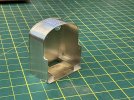
With the cab I made a jig to hold the profile of the rear whilst soldering to the cab front and floor. Adding the internal splashes and beading completed the basic cab.

Simon
54950236577_12e46d8c1d_b.jpg
54951296966_671d5e6bc1_b.jpg
54951597000_a25aee8e69_b.jpg
54951553414_94b7edf757_b.jpg
54951597185_5f7fd074da_b.jpg
54951597180_bb509ab633_b.jpg
 

Hobbyhorse

Western Thunderer
With the cab basics done next on the list is the backplate and its fixing points, this is needed to sort out the fixing of the cab to the fire box.
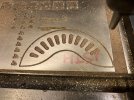
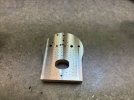
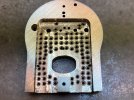
Made from some brass plate which is machined to the correct thickness, next all the various fittings and stays are marked on the pantograph and then the basic shape is machined. The distinctive radius on the edges are hand filled using a template for the radius, then two strips one riveted are soldered around the back edge.
Once all the holes are drilled the back edge is machined to reduce the thickness, and all the stay holes are counter sunk which gives more area for the adhesive to hold the stays.
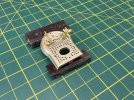
I did consider soldering the stays but this would required considerable heat and could get messy. Making the stays differ from the original as Rob Pulham put me onto cup burrs which cut nice rounded ends into wire, fixing these are a tight fit into the hole with glue as added security. You may notice a few missing stays which I’d opened out the holes a bit too much, these will be added when adding the glue.
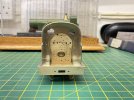
Placing some of the castings on the backplate to check the fitting completes this stage. I find making these backplates really satisfying.

Reminder for Thursday 4th December, Online Modellers Meeting from 18:00 and all Guild member welcome.
Simon


54958569167_870049ceed_b.jpg
54959760310_8374c69b82_b.jpg
54958569162_b5ea164e99_b.jpg
54959707454_d1fb30cdc1_b.jpg
54959707259_66a543c5ff_b.jpg
54959634663_5a175d4ae5_b.jpg
54959635033_1e3252cf36_b.jpg
54959760355_240ab9e192_b.jpg
54958568872_233b4ccbe2_b.jpg
54959707244_e7a8afd644_b.jpg
 

Hobbyhorse

Western Thunderer
The front running contains a lot of details, some quite distinctive.
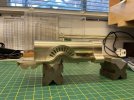
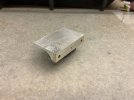
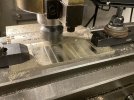
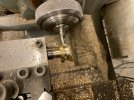
Most of the bits had already been made, but the guard irons hadn’t. These required some interesting machining once the basic shape had been cut out on the profile miller. Holding parts for machining is always challenging, as sometimes the parts can be marked if held in a vice, so to machine the front face to the correct depth, and add the small lip on the bottom I soldered them to some brass plate. Care is needed with the cuts, so lightly does it and with a new sharp cutter, no problems were encountered, the same technique was used on the back face to reduce the thickness for the mounting onto the buffer beam.
That’s most of it completed, with just the buffers, oiling pots , couplings and add a few bolt head details to do.

Simon

54981349119_22a83b4811_b.jpg[/url]
54981400850_5b8f113082_b.jpg[/url]
54981287448_a67c893657_b.jpg[/url]
54981289893_8aab20ebaa_b.jpg[/url]
54981287488_4c93fcfd86_b.jpg[/url]
54981401010_bafba7d5c6_b.jpg[/url]
54981401120_88aebdffbd_b.jpg[/url]
 

adrian

Flying Squad
The front running contains a lot of details, some quite distinctive.
Most of the bits had already been made, but the guard irons hadn’t. These required some interesting machining once the basic shape had been cut out on the profile miller. Holding parts for machining is always challenging, as sometimes the parts can be marked if held in a vice, so to machine the front face to the correct depth, and add the small lip on the bottom I soldered them to some brass plate. Care is needed with the cuts, so lightly does it and with a new sharp cutter, no problems were encountered, the same technique was used on the back face to reduce the thickness for the mounting onto the buffer beam.
That’s most of it completed, with just the buffers, oiling pots , couplings and add a few bolt head details to do.

Simon

View attachment 253072[/url]
View attachment 253073[/url]
View attachment 253074[/url]
View attachment 253075[/url]
View attachment 253076[/url]
View attachment 253077[/url]
View attachment 253078[/url]
Very clever profiling for the lamp irons - I'm assuming you started with a thicker sheet of n/s for the footplate and skimmed virtually the whole sheet - leaving the raised "dog-bones" for the lamp irons.
 

Hobbyhorse

Western Thunderer
Very clever profiling for the lamp irons - I'm assuming you started with a thicker sheet of n/s for the footplate and skimmed virtually the whole sheet - leaving the raised "dog-bones" for the lamp irons.
Thanks Adrian,
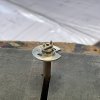
Unfortunately not, each iron is made from 4 parts, base plate, iron and 2 bolt heads. Time spent soldering them on is quite considerable keeping everything in line and solder free, all part of the fun. Expanded photo shows the base plates with the notch for the iron and bolt holes.
Simon
IMG_0968.jpeg
 

Hobbyhorse

Western Thunderer
The cylinder glands and slide bars are fixed to the smokebox which makes assembly a bit tricky but worth the effort. I had enough bits for both glands already made and assembled these. The slide bars I decided to make from solid this time as the original ones are in two parts, but as I’ve now got some thick plate it’s easier to machine the plate to thickness and cut the bars on the engraver. Looking at the connecting rod, each made from three bits, I did consider making from solid which would need quite a lot of additional machining around the crank pin, but decided to use the original bits and add some more details such as pin and bolts. Crossheads again just assembled from the parts already made.
Good news about the wonky motor/gearbox, it’s back from being repaired so next stage is the inside valve gear. It should be interesting as on the original model it’s non working, hopefully my drawings and calculations are correct.
Simon

54997998847_3468ca3394_b.jpg
54999055728_b145f8f239_b.jpg
54945542746_82191171bf_b.jpg
54999055468_bd038c8001_b.jpg
54997998947_e3db6da6d1_b.jpg
54999189450_400f61a60d_b.jpg
54998883816_e3576f21c8_b.jpg
54997999132_c5a86eb9f5_b.jpg
55001253790_4f0d7e7fc5_b.jpg
 

Hobbyhorse

Western Thunderer
The only thing I’m a bit nervous about on this build is the inside motion, as it’s static on the original build so didn’t know if it’ll work. And with the motor returned from repairs and nice and square now it’s time to get on with the inside motion.

55017275938_dc39bfd8c4_b.jpg

Looking at the Eccentrics I’d planned to split them a join together with 16BA bolts, having test drilled them it became very clear a high failure rate with broken drills and breakouts on the sides. So joining both bit together is the plan and to give them strength silver solder was used to join them, and keeping everything in line I turned a cast iron disk the same diameter as the sheaves. I was convinced everything would solder solid but with a bit of black permanent marker ink on the disk all four eccentrics soldered successfully. I’ve shown a photo of the soldering setup which uses a recently purchased Oxygen Propane Torch, It’s something I’ve been considering for some time with its various size micro flame heads. It’s really powerful and quick when dealing with small components, but can also melt most small components quickly as well. And as this was its first proper use I’m impressed.
54999189650_ee4ef53e50_b.jpg
54999055923_d6395b621a_b.jpg

With the motor fitter onto the axle I was able to check the available space either side of the motor for the eccentric sheaves, plenty of room. These sheaves have 14ba steel screws fixing them to the axle, and again are silver soldered together for strength.
Thinking how to assemble all the bits and bobs on the axle, it was obvious I’d need a way of fitting the eccentric’s onto the sheaves after these had been secured, with all the bits sliding on from the plain axle end once the wheel is split. So two disks fit onto the sheaves with a location pin and 14ba screw, which are only fixed in place once the eccentrics are in place, very fiddly but it works.
55017094756_a6073b8420_b.jpg
55017413630_e76d51889f_b.jpg
The weight shaft and valve spindle guides are mounted on two removable plates, this allows complete removal of the valve gear by just dropping out the wheel and undoing 4 screws. At present the reversing rod isn’t fixed into position, so it sets into any direction, when on the rolling road it moves to the direction of travel.
55016214822_c3dbb37251_b.jpg
54997999052_e052c68496_b.jpg

After some time on the rolling road, and plenty of oil on all the moving bit any tight spots have nearly disappeared. One little error did occur having assembled one set of eccentrics in the wrong order, I bit annoying having soldered up the pins, but after a bit of fiddling everything is now as it should be.
Simon
 

Hobbyhorse

Western Thunderer
A couple of people have PM’d me recently asking about some of the jigs I use, especially the one used on chimneys and other boiler fittings. And could I do a blow by blow account of making these, so it’s a fairly long thread. Strangely these are next on the list so its the ideal time, I was going to film it but my camera holding fixtures aren’t really up to the job, I’ll search for a better holder.
Producing chimneys, domes and safety valves has always fascinated me, and much has been said about the process. Since I first made the ones on the original models I’ve refined my technique, which I’ll set out in the post. It uses the lathe, pillar drill, pendant drill, various hand tools and a couple of small fixture used on the lathe.

As this a large post it’s in two parts.

First job is to make the blanks to width, length and tap one end, in this case 2BA.
55033253296_b9b27598dd_b.jpg

Next is to mount the blank onto fixture which is a bar held in the tool post holder that has the 2BA thread
protruding from it, and fly cut the bases. The process is the same for the chimney and safety valve other than the different diameters.
55033253336_b6bb7fb4c6_b.jpg

Check that the fit is OK on the boiler and smokebox. In this case the safety valve cover
55033511559_e532d06a79_b.jpg

Tap the other end, again 2BA. Had to do it this way as the taps aren’t quite long enough to do the entire length of the blank.
55033511554_f1d8108ffe_b.jpg

Machine a flat into the fly cut end, this allows the blank to be screwed onto the arbor.
55033431853_eb10c98af7_b.jpg

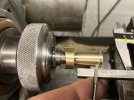
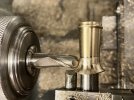
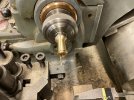
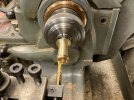
With the blank on the arbor and the diameter reduced in the lathe the basic shapes are set up, here the lip of the cap is cut.
55033253171_c92481679b_b.jpg

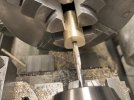
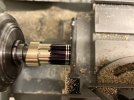
Getting the basic shapes uses hand cutting tools produced from old files. These are held firmly in holders. The shape of the tools is round, flat and thin knife similar to small parting tools. These need to be sharp and you don’t want to remove lots of metal, it’s a slow process similar if you’re used this process in a wood lathe. A word of caution is not to mount the piece in a conventional chuck as these have protruding parts that will do a lot of damage if you come into contact with it, and as you can see mine is in the collet. The tool rest is just a bar mounted on the tool post and set just below centre line of the work piece.
Don’t remove too much metal, just get the basic shape, leaving 20 to 30 thou oversize.
55033431743_0d3ed01d32_b.jpg

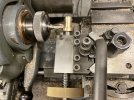
To make the shape around the base the fixture is mounted in the tool post with the chimney screwed firmly onto it, and a suitable sized bullnose cutter held in the lathe.
I made this a long time ago and is invaluable for the process, made from stock material in the workshop, the most important bit is the spindle which holds the part for machining, it need to be a precise fit in the body. I use ground steel bar for the spindle and reamed the body to suit, I can remember buying a new reamer for the job as the one I had did give the fit needed.
I’ve made a few spindles with different tread sizes for different jobs.
55033431458_385265dfce_b.jpg
55033588380_edd4855d10_b.jpg
55033588360_d5e4bd2e7a_b.jpg
 

Hobbyhorse

Western Thunderer
Cutting the flare is a slow process, you have to rotate the workpiece into the cutter, holding on firmly to the large brass wheel, it can grab and pull the workpiece into away from the follower which is in contact with the base, so only a few thou is cut each time.
55033511349_9f8f9b7f02_b.jpg
55033587420_ff2730d4b7_b.jpg

Like the top section leave the bottom oversize by 20 to 30 thou.
55033431568_d47cf189f0_b.jpg

Lots of hand cutting, filling and grit papers bring the chimney to size, using the template.
55033431453_140444b943_b.jpg
55032351037_e051c08402_b.jpg

Next mount back onto the arbor and the top is bored out to fit the expanding mandrel.
55033432778_83a3c289ca_b.jpg

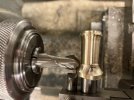
The mandrel mounted in the collet, one of many home made to hold small parts.
55032351032_b2baec799c_b.jpg

With the chimney on the mandrel repeat the boring process into the base.
55032350972_e066e16420_b.jpg

Mounted on the base the top is bored out, it follows the taper of the chimney.
55033254081_e865a5d795_b.jpg

Again mounted on the mandrel, this time on the dividing head on the pillar drill, the fixing holes are drills. Setting this up uses the centre line from the smoke box, the line on the base is shown.
55033254016_7d13453d10_b.jpg

Checking on the smokebox.
55033254021_c8eb0ed72a_b.jpg

Fixings in and soldered on.
55032350267_cf0df6e79b_b.jpg

So that’s the process that I use, I won’t say that each item comes out perfectly as things do go wrong. I always make more than one item as when the various tools are set up it’s just as easy to make a couple, just in case.

A quick plug for our next Online Modellers Meeting this coming Thursday 15th Jan, from 18:00 and open to all Guild members.
Simon
 

Hobbyhorse

Western Thunderer
Producing the safety valve follows a similar process as the chimney, but with bit more hand shaping. The bull nose forming tool was used for the front and rear profile but not the sides as the shape is a very gentle curve towards the boilers, and using a selection of burrs, files and various grades of emery papers the shape was carefully made. In hindsight I should have made a template for the complete side profile as I’d already made for the top profile.
55032350692_4cd25844ae_b.jpg
55032350627_41dc36499b_b.jpg
Basic shape getting close.
55033253771_8353cc2aa9_b.jpg
55033511994_9a9c087402_b.jpg
55033432283_796e9dfbb9_b.jpg
The photo shows the beading tacked soldered on by placing it on the boiler, it looks messy but as the main heat source is applied from the bottom sucking the solder into the joint and not leaving large amounts to remove from the top which would alter the shape of the beading.
55033511894_66ebabae35_b.jpg
The fixing points are added to valve and lots of polishing to achieve a high shine.
55033511829_c9edd20ed9_b.jpg
Fixing to the boiler uses a 6BA bolt.
55061729878_603ed4a58f_b.jpg

Reminder for our online Modellers Meeting this coming Thursday 29th Jan, all Guild members welcome.

Simon
 
Top