
Lubrication service on a small lathe

RichardG

Western Thunderer
One of the drive belts on my lathe looks perilously close to failure (see photo) so I have decided to install a new one. This means taking out the headstock spindle to fit the new belt . . .
DSC_2500.jpeg
Removing the headstock spindle turned out to be far easier than I feared, but the result shows up decades without cleaning and relubrication!

I wonder, what is the simplest/easiest way to remove the caked-on lubricant? I have tried Bar Keepers Friend (applied with a toothbrush) and this does work but it will be labourious and I'm wondering if there is a solvent where I could leave everything to soak for a few days while I wait for the new belt to arrive?

I tried Swarfega too but this had no effect.

A recent experiment has shown me, I must not use petrol indoors again (because the kitchen stank like a filling station) but I could try petrol outdoors, suitably protected from the cat.
 

RichardG

Western Thunderer
It looks like white spirit is going to work, and usefully I have this to hand. The parts will benefit from soaking for a few more hours.

Thank you Dave and Tim.
 

RichardG

Western Thunderer
Well, the white spirit took about three hours to work. I can try the cellulose thinners next time. I have wafted ACF-50 over the cleaned parts, and now I wait for the new belts to arrive.
 

RichardG

Western Thunderer
This is a Cowells ME-90, most of forty years old but the new ones are much the same.

I was a bit nervous of doing so much stripping down, but I have some written instructions with the nine steps needed to do the work, and everything has been straightforward. Nothing had seized in place.
 

JimG

Western Thunderer
A bit surprised you needed to dismantle the headstock to replace a drive belt. What make of lathe is this please?
I think you would be hard pressed to find a belt driven lathe where it wasn't necessary to dismantle the headstock for belt replacement.

Jim.
 

Bob Essex

Western Thunderer
I think you would be hard pressed to find a belt driven lathe where it wasn't necessary to dismantle the headstock for belt replacement.

Jim.

TBH I’d never realised this was necessary with any smaller lathe until now. It leaves me quite bemused. Neither my baby Sieg/Unimat clone or larger Hobbymat need this. Indeed the latter has speed changes available by changing the belts between pulleys since it has induction motor power rather than electronic variable. Do Myfords require dismantling for belt change?

Bob
 

RichardG

Western Thunderer
TBH I’d never realised this was necessary with any smaller lathe until now.

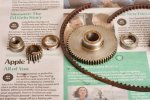
Bob this photo is probably providing more information than you need . . .

DSC_2514.jpeg
The Cowells machine is simple enough, but it has not been cheaply made. The pulley and its gear have been machined separately, and then pinned together. The main bearings are a "total loss" arrangement where you keep putting oil into the little cups and it keeps on running away.

The instructions for changing the belt begin along the lines of "unscrew the knurled nut and pull off the 20-tooth gear" and this gave me some anxiety knowing these probably haven't been disturbed for years. In practice, it was all really easy, and I feel (famous last words!) that even I can put this back together. When the new belt arrives.
 

John K

Western Thunderer
TBH I’d never realised this was necessary with any smaller lathe until now. It leaves me quite bemused. Neither my baby Sieg/Unimat clone or larger Hobbymat need this. Indeed the latter has speed changes available by changing the belts between pulleys since it has induction motor power rather than electronic variable. Do Myfords require dismantling for belt change?

Bob
No - None of the Myford ML series lathes nor the Myford 254s need any such contortions.
The belts on the Colchester Student just pops off the pulleys..
Don't know about Boxfords
John K
 

JimG

Western Thunderer
No - None of the Myford ML series lathes nor the Myford 254s need any such contortions.
The belts on the Colchester Student just pops off the pulleys..
Don't know about Boxfords
John K

I just knew I had made too swingeing a statement about belt driven lathes a few posts back. :) But the standard, small, belt driven headstock lathe usually had the three or four step pulley of the final drive between the front and rear headstock bearings, which necessitated removing the spindle to change the second belt. This was probably for ease of design where the gear drive for the leadscrew was to the outside of the rear headstock bearing, and the pulley could be accommodated between the headstock bearings along with the back gearing.

The Myford ML7, Super 7 and ML10 require the spindle to be removed. The 254 has the multi-step pulley outside the headstock so the belt change could be done without spindle removal. As far as I can see, the Colchester Student has a geared head and the lower end Boxfords appear to have the pulley drive between the spindle bearings.

I've got and ML10 and a Cowells ME90. The ML10 is over fifty years old and I've had to change the final drive belt once. The Cowells is sixteen years old and still on its original belt.

Jim.
 

Bob Essex

Western Thunderer
This is all very interesting. Am I right in assuming that the Cowells and Myfords etc. all use plain bearings? I presume this and the basic bed design dictates how they all go together. Both mine use roller bearing headstocks and I believe once assembled these must not be disturbed since doing so would affect the run-out. The Hobbymat with its 3/4 jaw TOS chucks means I can re-chuck work with no noticeable run-out issues showing on a DTI so I would not wish to loose this advantage by having to mess with the headstock. I do understand the basic Cowells bed design has been inherited from an early cantilever one and allows very high precision work to be produced. I nearly got one instead of the Hobbymat, they were an awful lot cheaper back then and made just down the road from me in Great Bentley, but I couldn’t consider one now given the current prices.

Bob
 

Dangerous Davies

Western Thunderer
The nature of the headstock bearings is immaterial. Myford ML7 is plain bearing, Boxford 4.5/5 inch is taper roller. Myford can be adjusted by changing the shims between the bearing halves, Boxford is adjusted by varying the pre-load on the bearings via two castellated nuts at the tail end of the headstock mandrel. Both machines need the spindle removing to change the belt. Many people use a linked belt such as a Fenner PowerTwist, as Simon has said above, to avoid the hassle of stripping down the headstock. Both Myford ML7 and Boxford 4.5/5 inch (CSB model) have a primary reduction belt which can be changed with ease. Geared head lathes such as the Colchester Student and Triumph have only a primary reduction belt, or belts, which are also easily changed. These machines are also more noisy than belt driven lathes but slippage cannot occur as it does with the Myford and Boxford when taking heavy cuts. I have no experience with the Myford 254.
HTH
Dave
 

RichardG

Western Thunderer
DSC_2521.jpeg
Headstock bearings on my ME-90. I was surprised to see the paint inside them, but they do work.

DSC_2518.jpeg
Top slide after cleaning.

I don't know how old my machine is, but its mains lead has a moulded-on 13 amp plug with bare (unsleeved) live and neutral pins. Sleeving on these pins came in around 1987. I suppose, Cowells might have bought in the mains leads in bulk and taken a while to use them up, or the lead might be a replacement part, but I suspect the machine is most of 35 or 40 years old. In which case, because the parts are cleaning up so well, I don't think it has had much use. The marks from the grinder inside the top slide look so fresh.

What I cannot show in photos is how beautifully the mechanisms are working. Everything feels as if it has been machined to perfection. Which I suspect it probably was.
 
Last edited:
Top