Nick Dunhill's Workbench - Queen #3

Nick Dunhill

Western Thunderer
This is job number 060 since I became a full time builder, and it is also my third Scorpio Queen. They are excellent kits, so I'm not expecting any 'surprises', and I won't bore you with a blow-by-blow account of the build. It will be a model of no 1122 Beaconsfield, and the client also models Broad Gauge alongside, so as in the early years 1875-80. Jeff has sent what he believes to be the correct parts/etchings for the Armstrong tender but they can be built to make a few variants of it. Also it would be good to know where the safety valve and dome will go on the boiler, so does anyone have a pic of 1122 in it's early years?

I have done some of the tender, and I'm hoping I've used the correct parts so far.......

55386936980_977c7d259a_b.jpg

55386673803_2b21ea139f_b.jpg

55386673813_dc0bc4531f_b.jpg

Thanks
 

Nick Dunhill

Western Thunderer
55400198850_2f1671a387_b.jpg

Tender finished with no dramas. Good metalwork.

So, this week's panic is about LGM castings. I will need a set of Stephenson Link parts in the next month or two and he's sold out. Laurie is retiring at the end of this month, does anyone know if he's sold the business, and when the range will be available again?
 

simond

Western Thunderer
Might be a silly question, or it might be my eyesight, but surely the smaller wheel wants to rotate faster than the bigger one?

It looks like the pitch on the small wheeled axle is smaller than on the larger?

best
Simon
 

Nick Dunhill

Western Thunderer
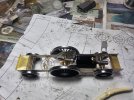
It's engineering time! The short answer is Ennis 75 Models sell the modification. One gearset is 40:1 and the other is 24:1 Wheel diameters are 48.6 and 28.7 mm. The set up runs ok on a test track. The wheels may skid a bit, but not noticeably, but they will anyway on curves. No limited slip diffs here....

So dividing, big wheel comes out at 1.22 and little one at 1.20. So a bit of slippage but not a lot. 98.4% match. Is that good enough?
 

Lawrence Boul

Western Thunderer
It's engineering time! The short answer is Ennis 75 Models sell the modification. One gearset is 40:1 and the other is 24:1 Wheel diameters are 48.6 and 28.7 mm. The set up runs ok on a test track. The wheels may skid a bit, but not noticeably, but they will anyway on curves. No limited slip diffs here....

So dividing, big wheel comes out at 1.22 and little one at 1.20. So a bit of slippage but not a lot. 98.4% match. Is that good enough?
Well outside anything that I've done, but if the idea of the double ended drive is to improve traction, then wouldn't any induced slip be somewhat counter-productive? My first thought would be to use a belt drive between the two axles as it would be easy to turn the pulleys to the exact diameters needed. I'm sure that's easier to say than to do...

More theoretically, tread diameters are quoted new before wear or returning. So you could get a 100% match by returning the tyres to suit without departing from prototype at all. That may not be that easy either...
 

Genghis

Western Thunderer
Might be a silly question, or it might be my eyesight, but surely the smaller wheel wants to rotate faster than the bigger one?

It looks like the pitch on the small wheeled axle is smaller than on the larger?

best
Simon
I’m wondering the same thing!
 

Dave Holt

Western Thunderer
Does the pitch of the worm matter? I thought it is simply the number of teeth on the worm-wheel and the wheel on the rear axle is very much smaller diameter than the driving axle.
Dave.
 

PaulRhB

Western Thunderer
, then wouldn't any induced slip be somewhat counter-productive? My first thought would be to use a belt drive between the two axles as it would be easy to turn the pulleys to the exact diameters needed. I'm sure that's easier to say than to do...

The ‘super creep’ control on the class 59’s relies exactly on a controlled amount of slight slip to increase traction. That’s controlled electronically from a Doppler radar on actual speed but having one wheel rotating a fraction faster should be able to achieve the same in a cruder and less efficient way. What is a problem is a wheel slipping much faster as you get in a sudden breakaway slip because it wastes much of the energy as heat and grinds the rail and tread much faster.
Belt drives on an axle are more difficult to change and really need to be used regularly or the belt can deform to the shape it’s stopped in and then doesn’t run evenly. Locosnstuff recommend removing the belt if not run for 6 months to stop deformation and they put the pulleys on the ends of a lay shaft to make removal easier.
 

simond

Western Thunderer
Does the pitch of the worm matter? I thought it is simply the number of teeth on the worm-wheel and the wheel on the rear axle is very much smaller diameter than the driving axle.
Dave.
Pitch of worm = pitch of teeth on wheel.

Can’t see the wheels clearly, so I guessed that there are more teeth on the smaller wheel (despite it being smaller), hence the uncertainty in my initial question.
 

Nick Dunhill

Western Thunderer
I suppose, If I could be bothered, I could skim a bit off the diameter of the big wheels to get closer to parity. I calculate having to reduce the diameter from 48.6 to 48.0 to get 100% match. I would need a form tool though etc.

Maybe not worth it, it is so close anyway. The two Queens I have already made are fine but could have done with improved adhesion. They are a bit skiddy setting off with a train. This method may help, although not perfect. The worst that can happen is that I have to take the worm to the smaller wheel off. The bigger problem is getting enough ballast inside the loco. Now then, Uranium has a larger density than Lead............
 

simond

Western Thunderer
I suppose it’s a bit like a compensated chassis, you’d want to spread the thrust equally between the two axles, which suggests a differential.
 

adrian

Flying Squad
Pitch of worm = pitch of teeth on wheel.

Can’t see the wheels clearly, so I guessed that there are more teeth on the smaller wheel (despite it being smaller), hence the uncertainty in my initial question.
Or the worm wheel is a 2-start on the small gear and a single start on the larger gear wheel.
 

Renovater

Western Thunderer
What you're doing here i don't think i've ever seen before, an interesting subject. Springing the driving axle in only the downward direction and having the weight concentrated would surely help the adhesion if you decide to let the second worm go.

Colin.
 
Top