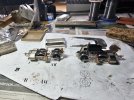
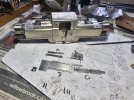
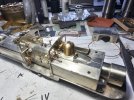
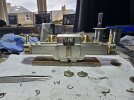
We left it last week with assembled chassis with modified axle horns and height adjusters. I began the week looking to install the wheels. The kit comes with Alan Gibson wheels specifically designed for this kit. They are a press fit on OO axles (16.5 mm gauge) and the instructions stress that the wheels cannot repeatedly be removed and reinstalled as the interference fit will be lost. However you have to quarter the wheels yourself, and the instructions do recommend a press and quartering tool made by GW Models. This was out of stock, but luckily I have a fair amount of experience of quartering wheels by eye.
I made an NGG16 loco with these wheels in the past and realised that I'd better make up the gearbox first, as it is captive in one of the wheelsets, along with a pair of axleboxes and shims to limit end float. Each bogie is an 0-4-0, so no endfloat is required on any of the axles.
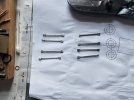
First the gearbox. The kit has an etched gearbox chassis, a set of spur and final drive gears, some bearings and spacers and a worm for the small Mashima motor, also supplied. I looked at the components and the suggested way of assembling them, and folded up the gearbox etch. The instructions suggest that the two spur gears are to be mounted on a 2 mm rod, leaving it free to turn on the rod, and some spacers installed to keep the gear in the correct position to engage with the adjacent gears. The spacers looked suspiciously like top hat bearings, and the gears wobbled about a fair bit on the shaft. I realised that if I used a rod with a slightly bigger diameter the gear would be a nice press fit (no wobbling) and the spacers could be repurposed as bearings in the etched chassis. I mounted both (nylon or similar) spur gears using the revised method. I had to make some distance pieces from brass tube, but the spur gears meshed very nicely. I also had to open out the intermediate shaft holes in the gearbox chassis to accept the 'top hat bearings', solder them in and ream them out to accept the slightly bigger shafts.
I soldered the bearings in the gearbox for the final drive gear, rims inside as recommended, and shortened the bearings so they'd fit snugly between the axleboxes. The final drive gear was different from the item shown in the illustrations in the instructions. The original gears had to be Loctited (!!) to the axle when all was assembled, and the one supplied had a grub screw. A definite upgrade! HOWEVER, the new gear was too wide to fit between the bearings. I had to cut a slice off the gear side of the wheel.
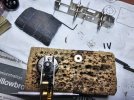
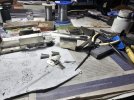
The modifications were successful though, and a very nice running and strong gearbox was the result. When running at a decent speed the axle could not be stopped by hand! I did make another modification to turn the motor through 80 degrees so that I could cut off the 'ears' to which the motor is screwed. This allowed the gearbox to pass through the chassis and be removed for paint. This will make the painter very happy.
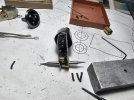
The motor is wonky because the motor fixing screw interfered with one of the spur gears.
Flushed with success I looked at making the second gearbox and paused. The first one is easily powerful enough to power the loco and pull a decent train, and the DCC will be easier to tune with only one motor. I didn't bother making the second gearbox, and decided to make one of the chassis free wheel.
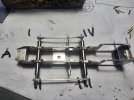
After the extensive mods to the gearbox pressing the wheelsets together was a mere bagatelle (done in my drill press). I did have to take lots of measurements and install the appropriate amount of shims to limit end float, and quarter the wheels by eye, but quickly ended up with some free running, unbinding chassis. Beer was imbibed.

The cylinders were easy to make as the etches were very good, the slidebars were laminated etches and fitted very nicely into the crossheads and piston rod gland castings with only minimal fettling. I bought some Ffestiniog Chopper couplings from the 7 mm NG Association which looked good. I mounted the mechanical lubricators on the motion brackets and made an operating mechanism attached to the inner axles.
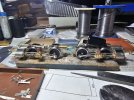
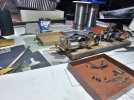
Next week I should be able to button the chassis up quickly and move on to the body. So far I'm enjoying this build. The kit is good and it is well detailled.