Lawrence Boul
Member
Responding to a suggestion from SimonD that a model deserved its own thread...
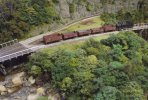
Rewanui is a work in progress that features elsewhere from time to time. First and foremost it's a place where I get to try stuff. So this thread is likely to be occasional and eclectic, but will all be based around this South Island West Coast NZ coal branch in 1940.
An interesting prototype:
It's 100% scratchbuilt other than rail, motors and gears etc. But I'm a small manufacturer, so scratchbuilt also means that I'm building my own kits. Very little is completely finished, but it's progressing quite fast now.
The trackwork is simple as more or less just the station is modelled, with virtually no compression. Trains come up the incline from a fiddle yard. Empties are shunted over a back shunt bridge to the offscene bins (also the fiddle yard). In this way full/empty exchange is achieved invisibly. It's really a shunting plank. I've nowhere to put it, so the layout only actually runs at exhibitions. That's OK as my attention span is short and I have a lot of other things on the go.
Track is NMRA compliant, but wheels are a bit of an orphan profile that is not too far over scale. This is an accident of history that I've no intention of changing at this point. If I had time over, I would tighten the track standard, but I can live (just) with wide flangeways.
So to kick this off, one of the big issues was autocoupling. The layout is deliberately high and I wanted some action to be seen through the trees. That can only work with reliable autocoupling. NZR used 'Norwegian' choppers, so that was a hurdle. The video from a year or two ago shows how this turned out as well as showing the control system which is a custom application running as a webserver on top of DCC-Ex. The schematic shows how uncoupling works. In reality coupler centring is no problem as with hands free uncoupling the couplers stay centred (but they are magnetically centred, as I'm a belt and braces type).
Finally there is an image of some actual modelling.

Rewanui is a work in progress that features elsewhere from time to time. First and foremost it's a place where I get to try stuff. So this thread is likely to be occasional and eclectic, but will all be based around this South Island West Coast NZ coal branch in 1940.
An interesting prototype:
- 3' 6" Narrow gauge
- A Fell incline (centre rail used for braking only in this case)
- No road access
- Once a day there are two engines in the yard.
It's 100% scratchbuilt other than rail, motors and gears etc. But I'm a small manufacturer, so scratchbuilt also means that I'm building my own kits. Very little is completely finished, but it's progressing quite fast now.
The trackwork is simple as more or less just the station is modelled, with virtually no compression. Trains come up the incline from a fiddle yard. Empties are shunted over a back shunt bridge to the offscene bins (also the fiddle yard). In this way full/empty exchange is achieved invisibly. It's really a shunting plank. I've nowhere to put it, so the layout only actually runs at exhibitions. That's OK as my attention span is short and I have a lot of other things on the go.
Track is NMRA compliant, but wheels are a bit of an orphan profile that is not too far over scale. This is an accident of history that I've no intention of changing at this point. If I had time over, I would tighten the track standard, but I can live (just) with wide flangeways.
So to kick this off, one of the big issues was autocoupling. The layout is deliberately high and I wanted some action to be seen through the trees. That can only work with reliable autocoupling. NZR used 'Norwegian' choppers, so that was a hurdle. The video from a year or two ago shows how this turned out as well as showing the control system which is a custom application running as a webserver on top of DCC-Ex. The schematic shows how uncoupling works. In reality coupler centring is no problem as with hands free uncoupling the couplers stay centred (but they are magnetically centred, as I'm a belt and braces type).
Finally there is an image of some actual modelling.