Staying with the 4 wheel wagon theme, 3D printing has obviously revolutionised what is possible.
My first printed kits (as built by
@Overseer) were, more or less, derived straight from the original drawings.
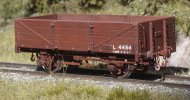
This wagon (1/64 from a few years ago) has a 3D printed body on an etched underframe that in an earlier iteration carried an injection moulded body sourced from others. The print was quite an improvement. It didn't need fettling and filling, wasn't constrained by avoiding undercuts and had details like the chains to retain the door pins. Wagons like this though suffer somewhat from the uniformity and lack of character typical of RTR, and are somewhat soulless. (This example still awaiting hoses. The frustration of sidechains also evident).
It didn't take me too long to start thinking about distressing the underlying 3D model. It is not at all difficult to distort planks, replicate loose hinges etc to get something that looks a bit more used.
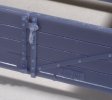
This one is 9mm/ft I think, but is the only image handy to show the initial development where the doors were allowed to sag and hang outwards against the pins. This simple step improves things quite a bit.

Shortly after, I was working on a simple coaling stage. This is possibly the most boring and featureless subject imaginable without the inclusion of character due to the vicissitudes of hard use. So I put in some effort to beat it up a bit. This was achieved by a) adding warp and twist to the planks and b) adding wood grain.
Grain is added (in Blender) by adding a texture to the timbers based on a real image of weathered planks. This is real 3D texture, not just a graphic fudge. The image shows my first attempt which I felt worked extremely well and was somewhat by luck than management. This printed timber was painted a light/mid grey and then treated with a black/brown enamel wash. That's it.
Thus encouraged, I predictably wanted some of this on wooden wagons as well.

This one is 9mm/ft. Wood grain, per se is not especially visible on the outside of a painted wagon. On the inside it can be heavier as, a) loads and weather will etch the timber a bit, and b) extra relief will allow weathering to show the grain. Depth of grain is very easy to adjust in software.
Around the time I was doing this
@KrustySimplex pointed out that the distress in weathered timbers is primarily cracking not grain as such. If one can stand the critique, the merit of putting up one's work is that such observations lead to improvement.
Adding cracks is quite a bit easier than adding grain. That's useful as grain is exhausting and files get quite large (=slow). Being relatively simple cracking can realistically be varied between prints for an individual look.

This example (back to 1:64) is the latest iteration of an increasingly protracted development. Timber has grain and cracks (subtle here, but very worthwhile in the flesh). The model is printed in 1 piece with an etched brass floor (plus the odd cast and etched detail). Grain on the brass floor is drawn on with a pencil.
Couplers are now finally correct for my 1940 period. Thanks to prototype research from
@KrustySimplex, I'm now able to get the combination of wagon body/underframe/axlebox/handgrab etc correct for the wagon number applied.

Another 1:64 highsider showing the underframe. Almost everything here is a single print (including axleboxes, brake shoes, brake stretchers and loops) other than brake linkages (etch/wire), shunters step, handgrabs etc. Axleguards are etch and the wagon has sprung suspension based on guitar string. Cat hair included at no extra charge.
These latest wagons are probably as far as I'm ever likely to go. I'm working on my painting, and doubtless there will be some incremental improvements in the models, software and printer capability. But there is a lot of work to bring other aspects of the layout to this standard, so it's unlikely I'll be putting much more effort into wooden highsiders.
Now I just need to build a fleet. Not too daunting as these things can be assembled in an hour or so. Painting them takes considerably longer.



