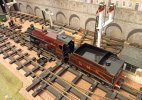
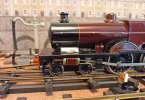
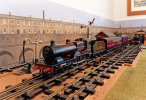
Rivermead Central

John R Smith

Western Thunderer
Some additional information on the Dinky/Hornby figures.

Thanks very much for that info, Martin. It clarifies things a great deal. So it turns out that I have had most of the figures from both the early and later sets - I did have the hikers, but sold them on because I just didn't like them much. I wonder why they changed the size to smaller figures (which are actually under scale). Was it just a cynical move to use less metal?

John
 

simond

Western Thunderer
An idle thought. Imagine the masters were lost or worn, and they remastered from existing stock cast figures.

Would the shrinkage explain the difference in size?
 

40057

Western Thunderer
An idle thought. Imagine the masters were lost or worn, and they remastered from existing stock cast figures.

Would the shrinkage explain the difference in size?
Hi Simon

They didn’t do that because the clothing and poses were changed. The post-1937 figures are not just smaller, they are different.

Martin
 

40057

Western Thunderer
Thanks very much for that info, Martin. It clarifies things a great deal. So it turns out that I have had most of the figures from both the early and later sets - I did have the hikers, but sold them on because I just didn't like them much. I wonder why they changed the size to smaller figures (which are actually under scale). Was it just a cynical move to use less metal?

John
I wonder if the smaller size was so the figures looked better with the Dinky road vehicles — which were to a smaller scale than 0 gauge trains. I don’t know what the notional scale was of Dinky cars (1:50?), but the scale wasn’t consistent. Models of larger vehicles were to a smaller scale so they would fit in a standard box size.

Martin
 

Overseer

Western Thunderer
I wonder if the smaller size was so the figures looked better with the Dinky road vehicles — which were to a smaller scale than 0 gauge trains. I don’t know what the notional scale was of Dinky cars (1:50?), but the scale wasn’t consistent. Models of larger vehicles were to a smaller scale so they would fit in a standard box size.

Martin
I just logged on and saw your message. I downloaded these scans from somewhere on the web some years ago. The provide the nominal scales, I would expect they are not all in proportion in all axis.
Dinky toy scales 1. 7b_1355354656.jpg
Dinky toy scales 2. 8_1355354807.jpg
 

John R Smith

Western Thunderer
I wonder if the smaller size was so the figures looked better with the Dinky road vehicles — which were to a smaller scale than 0 gauge trains. I don’t know what the notional scale was of Dinky cars (1:50?), but the scale wasn’t consistent. Models of larger vehicles were to a smaller scale so they would fit in a standard box size.

Good thinking, Martin. Just a quick measure up of some of my post-war Dinkys, reveals that they are not 7mm to 1 ft or 1/43 scale. My Jaguar Mk 2 3.4 litre checks out at exactly 1/48, or 1/4" to the foot, as in the above list.

And as many of the figure sets were marketed under the Dinky brand, not Hornby, it would seem logical that they should match up with the road vehicles, perhaps.

John
 

40057

Western Thunderer
I just logged on and saw your message. I downloaded these scans from somewhere on the web some years ago. The provide the nominal scales, I would expect they are not all in proportion in all axis.
View attachment 264662
View attachment 264663

Thanks, for this — very interesting.

I note ‘0 gauge items’ (not specified) are shown at the correct scale.

Some very odd mixtures here, which mean models that would ‘go together’ won’t. For 0 gauge, the telephone box is under-scale, the pillar box over-scale. The postman is not the same scale as the pillar box. The lawn mower is twice the size of the garden roller and wheelbarrow.

Martin
 

John R Smith

Western Thunderer
Some very odd mixtures here, which mean models that would ‘go together’ won’t. For 0 gauge, the telephone box is under-scale, the pillar box over-scale. The postman is not the same scale as the pillar box. The lawn mower is twice the size of the garden roller and wheelbarrow.

Martin

True enough, but compared with some of the Hornby Series railway range the discrepancies are minor. We have already had a discussion about the signals, which are certainly a tad on the large side, but how about the Hornby luggage items or the sack truck which are just enormous?

I think we should be very wary of judging vintage models by the standards of today. And at least Meccano Ltd did document all the different Dinky scales used in some detail.

For example, if you are comfortable with the B-L Lowko track, why would you really object to mixing the Dinky telephone box and the piller box together on the concourse outside Rivermead Central? ;)

John
 

40057

Western Thunderer
Martin

True enough, but compared with some of the Hornby Series railway range the discrepancies are minor. We have already had a discussion about the signals, which are certainly a tad on the large side, but how about the Hornby luggage items or the sack truck which are just enormous?

I think we should be very wary of judging vintage models by the standards of today. And at least Meccano Ltd did document all the different Dinky scales used in some detail.

For example, if you are comfortable with the B-L Lowko track, why would you really object to mixing the Dinky telephone box and the piller box together on the concourse outside Rivermead Central? ;)

John
Hi John

I think it reasonable to judge vintage items by the criteria claimed by the manufacturers and within the constraints of what was economically and technically feasible.

The Hornby and other ranges sold by Meccano Ltd were marketed as good quality toys for children. As such, they were excellent. Judge them as scale models — and of course they are awful. Not just by today’s standards, but in comparison with the scale models sold by others in the ‘20s and ‘30s. But wholly unfair to Meccano Ltd to criticise them for not achieving something that was never their aim.

Bassett-Lowke always claimed to sell scale models. These had to run around absurdly small radius curves, so wheels and some dimensions could not get even close to correct scale size. That’s fair enough, to produce a practical model. But a Peckett tank that is a scale 16’ tall is not a scale representation, by any standard. It fails if judged on Bassett-Lowke’s own stated aim.

Lowko Track is certainly over-scale. But it was designed in 1908 when Gauge 1 would have been the most common size for a proper model railway, and to make it economically, the same parts had to be used for gauges 0, 1 and 2. So I see Lowko Track as reflecting the state of the hobby at the time it was first made.

Probably don’t want a Dinky telephone box, however.

Martin
 

Fitzroy

Western Thunderer
There was a lot of commonality between gauge 1 and 2 as well- the w iron and spring pressings were identical between each, as were the filler pressings on the Anglo-American and tar tank wagons.
 

John R Smith

Western Thunderer
Lowko Track is certainly over-scale. But it was designed in 1908 when Gauge 1 would have been the most common size for a proper model railway, and to make it economically, the same parts had to be used for gauges 0, 1 and 2. So I see Lowko Track as reflecting the state of the hobby at the time it was first made.

Martin

Very true, and that applies to the B-L Scale Permanent Way which I use as well, and to all the other track sold for O gauge in the 1920s and 30s by Milbro, Bonds and so on. Re-reading my post above, I do apologise if it sounded as if I was denigrating your choice of the Lowko track range - far from it, it is an eminently sensible track for your layout, and is perfectly appropriate for a period layout.

Pondering on our discussion a bit further, I think that what happens when we place a model human figure on a railway layout is rather interesting. Suddenly, it is as if we had placed a ruler in amongst our other models - we are so used to estimating height and length against the human form the we do it without concious thought. So everyday and familiar objects like a phone box, post box, or car shout out at us if they are wrongly sized in relation to the figure.

Funnily enough, this was not something which bothered me as much as a child. I remember happily mixing up Britains 1/32 toy soldiers with my Hornby tinplate O Gauge clockwork trains, and having a lot of fun loading the field gun onto a railway wagon.

John
 
Last edited:

40057

Western Thunderer
Martin

Very true, and that applies to the B-L Scale Permanent Way which I use as well, and to all the other track sold for O gauge in the 1920s and 30s by Milbro, Bonds and so on. Re-reading my post above, I do apologise if it sounded as if I was denigrating your choice of the Lowko track range - far from it, it is an eminently sensible track for your layout, and is perfectly appropriate for a period layout.

Pondering on our discussion a bit further, I think that what happens when we place a model human figure on a railway layout is rather interesting. Suddenly, it is as if we had placed a ruler in amongst our models - we are so used to estimating height and length against the human form the we do it without concious thought. So everyday and familiar objects like a phone box, post box, or car shout out at us if they are wrongly sized in relation to the figure.

Funnily enough, this was not something which bothered me as much as a child. I remember happily mixing up Britains 1/32 model soldiers with my Hornby tinplate clockwork trains, and having a lot of fun loading the field gun onto a railway wagon.

John
Hi John

I certainly didn’t take your comments as a criticism! Anyway, criticism and challenge is healthy and welcome.

I still like the look of Lowko Track best of all the vintage track types. Even if I do curse its in-built faults that cause so much work. Were I starting now, would I still choose it? I really don’t know; post-WW2 Scale Permanent Way is so much easier to find in ready to use condition, but its 18” standard lengths mean it just eats up space because points have to be 18” apart, instead of 15” with Lowko Track. Objectively, post-WW2 Scale Permanent Way is a far better track than Lowko Track: (a bit) closer to scale, narrower flange-ways and properly pivoted switch blades.

Scale did bother me from a very young age, probably before I knew the word. We had a model farm, buildings home made by my dad, people and animals and the tractor all Britain’s, so 1:32. I desperately wanted a combine harvester and I was given one made by either Corgi or Dinky. I wouldn’t put it on the farm because it was the wrong size. I would have been maybe six or seven when I was given the disappointing combine.

There must be a fine-scale modeller in me somewhere.

Martin
 

40057

Western Thunderer
Martin

Very true, and that applies to the B-L Scale Permanent Way which I use as well, and to all the other track sold for O gauge in the 1920s and 30s by Milbro, Bonds and so on. Re-reading my post above, I do apologise if it sounded as if I was denigrating your choice of the Lowko track range - far from it, it is an eminently sensible track for your layout, and is perfectly appropriate for a period layout.

Pondering on our discussion a bit further, I think that what happens when we place a model human figure on a railway layout is rather interesting. Suddenly, it is as if we had placed a ruler in amongst our other models - we are so used to estimating height and length against the human form the we do it without concious thought. So everyday and familiar objects like a phone box, post box, or car shout out at us if they are wrongly sized in relation to the figure.

Funnily enough, this was not something which bothered me as much as a child. I remember happily mixing up Britains 1/32 toy soldiers with my Hornby tinplate O Gauge clockwork trains, and having a lot of fun loading the field gun onto a railway wagon.

John
It occurs to me you can cite a notable precedent for using 1:32 figures with 0 gauge trains. In the pre-WW1 catalogues, Bassett-Lowke offered sets of station staff ‘suitable for use with gauges 0 and 1’. These were Britain’s standard size figures (1:32 scale). I am not sure when B-L first listed correct scale 0 gauge figures. Mid-‘20s, I think, and I presume commissioned by B-L and sold exclusively by them. The first B-L 0 gauge size figures were certainly not made by Britain’s, but I don't know who the manufacturer was.

Martin
 

John R Smith

Western Thunderer
post-WW2 Scale Permanent Way is so much easier to find in ready to use condition, but its 18” standard lengths mean it just eats up space because points have to be 18” apart, instead of 15” with Lowko Track.

Martin

Just to mention that it is in fact very easy to trim a Scale Permanent Way left or right-hand set of points down to 15"" length - you just have to trim off one sleeper (crossing timber) from the diverging end. Of course, then you lose the standard geometry for the other parts of the plan. I have had to do similar on Kingswell Street, by trimming off one side of a parallel point from 24" to 18" in order to fit my run-round loop into the space available.

Obviously, the ghost of W. J. Bassett-Lowke is probably going to come back to haunt me . . .

John
 
Top