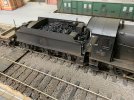
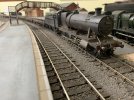
Scorpio 2884 build

3 LINK

Western Thunderer
And means that you can play with it…. :D
Well, it looks more like a choo choo :rolleyes:

The motor-gearbox is a MSC, Helical 40:1, hopefully it will fit, I will definitely have to trim down the shaft where the flywheel is normally fitted, but being DCC I haven’t fitted a flywheel in years.

Martyn.
 

simond

Western Thunderer
Nice. Assuming it’ll fit through the wasp-waisted firebox, that’ll be the dog’s whotsits.

cheers
Simon
 

3 LINK

Western Thunderer
Nice. Assuming it’ll fit through the wasp-waisted firebox, that’ll be the dog’s whotsits.

cheers
Simon
Hi Simon, hopefully width wise should be fine, I fitted exactly the same motor - gearbox in my 2251 class, and that loco is one of my smoothest performers, for want of a better word.

Cheers, Martyn.
 

3 LINK

Western Thunderer
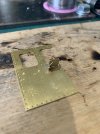
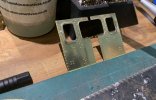
I was going to carry on with the brakes/ linkage/etc on the chassis, but decided to make a start with the cab instead. Thought I would solder the seats to the cab sides as they are easier to fit now, rather than struggle once the cab is built up. All went well until I happened to look at a couple of photos of a 12” version and noticed the drivers side seat is mounted to the side of the reverser. It could have been worse at least the cab sides were still flat pack, so seat removed for later fitting.

IMG_7827.jpeg

IMG_7831.jpeg

IMG_7832.jpeg


And before anyone mentions it, the cab handrails are level, it’s just my iPhone playing tricks again.

Martyn.
 
Last edited:

Stuart Dodd

Member
I have been after a kit of a 2884 for a long time, originally Pete ( JLTRT ) told me he was going to bring one out, but it never materialised. So, I thought I would try the kit Scorpio had on offer, I only needed the loco as I already had a spare Finney 7 tender. Jeff at Scorpio was happy to supply just the loco.
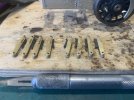
On inspection the etches were crisp and clean and I couldn’t fault the price which included the Slaters wheels (optional extra). The only thing I wasn’t sure about was the method of using two rocking beams on both sets of drivers, and what was also different was that instead of the usual inside beam method these where sited on the outside of the frames and the plates (beams) also incorporated the brake shoes. Now I have been told these actually work very well but I decided to cut out the main frames and install Slater's brass horn guides and blocks, see photos below.

View attachment 244327

View attachment 244328


Below are the rocking beams supplied.

View attachment 244330


Below, I am setting out the datum for the height and spacing of the hornblocks and guides.
As per usual with me, it's one step forward two steps back. In all kits the mainframes have the axle holes already etched in place, whereas because of the rocking beam design I am left with no datum to work to, oh dear.
Obviously, this is a very crucial part of any build as I need to get the coupling rod spacing exactly spot on, and the ride height. So, I prepared the two main frames and temporarily tacked them together then I pinned the rocking beams behind of where they would normally be sited, this then gave me hopefully the correct spacing for the axles. Rather than using engineers blue which I find very messy, I use a felt tip pen to highlight areas that need marking and then scribe gently the exact markings. Right, so out with the piercing saw, wish me luck.

View attachment 244332

I have scribed on the mainframes exactly where the horn guides are to be spaced using the couplings rods that I always use from Bill at Premier Components, being an 8 coupled loco I like the rods jointed and you can’t beat milled rods in my opinion. So, using a piercing saw I gingerly cut out the opening for the horn guides, I was concerned about the ride height but what does help there is a small witness mark halfway up the Slater's horn guides
One of the frame spacers needed notching out as the hornguides protrude inwards, but not a problem.

View attachment 244333
And the final photo, shows the frames and rods in place.
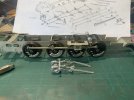
Voila, one free-wheeling chassis, always a bonus when there aren’t any tight-spots or binding. I placed some weights on the chassis to compress the springs and the ride height is spot on, what a relief. I was out of my comfort zone because there were not the usual etched holes in the chassis to help with setting up the rods and ride height, so down tools and off to the garden for a beer or two.

View attachment 244334

Martyn.

Lovely work Martyn, I installed the rocking beams as per kit provision but would chose your guide method next time as the beams are tricky to install current collection, although I did manage it successfully.
 

3 LINK

Western Thunderer
Lovely work Martyn, I installed the rocking beams as per kit provision but would chose your guide method next time as the beams are tricky to install current collection, although I did manage it successfully.
Thank you for the kind words Stuart, and thank you for warning me about the next part of the build, the firebox….

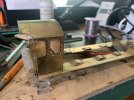
Now on to the firebox, there are 3 formers and 3 parts of the firebox, 2 sides and the top. I was lucky that Stuart had already told me of the problem which is that the middle and front formers are not quite correct, especially the front former. So I used the white metal casting of the firebox front as a template so I could see how much needed filing off the formers for a decent fit. Not a big problem as I was forewarned, and apart from that small discrepancy the kit is a joy to build.

IMG_7850.jpeg

IMG_7852.jpeg


Martyn.
 

3 LINK

Western Thunderer
Cheers Simon, in my opinion it’s a good kit, I haven’t had a good look at the quality of the white metal castings yet, but the etchwork is quality ( except for the firebox formers ) :rolleyes:

Martyn.
 

simond

Western Thunderer
I scratched a 28 some years back, and have more kits than I need, but it does look very nice. One day, perhaps. :rolleyes:
 

3 LINK

Western Thunderer
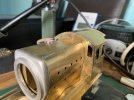
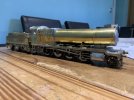
The tapered boiler and smoke box went together well without any trimming, and also the smoke box saddle. I have not soldered it all in place yet, just plonked it on for the photos as I have still got to fit the boiler bands, etc. That’s it regarding the body for now, I am going back to finishing off the chassis next, dummy valve gear, brakes, etc.

IMG_7877.jpeg

IMG_7872.jpeg

Martyn.
 

3 LINK

Western Thunderer
I really can’t fault this kit, apart from my own mods it goes together very well. As for the white metal castings they are also of a good quality, the two additions I did change were the outside steam pipes, there was no rivet detail on the white metal ones, so a good friend on WT printed up some for me, cheers Mick.

IMG_8238.jpeg

The other parts were the brake hangers, I went with the Laurie Griffin equivalent, the reason for this is that you can insert the Slaters plastic brake shoes so no chance of any electrical shorting out.

IMG_1866.jpeg

IMG_7986.jpeg

IMG_7987.jpeg

Next up is to fit the dummy valve gear, a bit of a cop out, but after fitting working valve gear to my 2251 there is very little to gain in my opinion :rolleyes:.

Martyn.
 

3 LINK

Western Thunderer
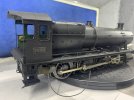
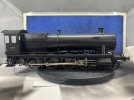
Apart from the backhead, cab glazing and a few small bits and bobs, the loco is nearly finished. So I thought I would try out my new spray booth and after a few light passes with Halfords primer, I decided to try Railmatch acrylic Black as a top coat through the airbrush. I have always been a diehard enamel man, but I am pleased with the acrylics so far. I’ll give it a few days and then throw some weathering at the loco. Apologies for the quality of the pictures, I was in a rush.

IMG_8135.jpeg


IMG_8134.jpeg

Martyn.
 

3 LINK

Western Thunderer
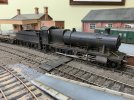
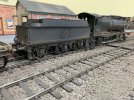
Well I’m almost there, the loco still needs the backhead fitted, and a bit more weathering including the coupling rods, etc. DCC has now been fitted and she runs nice and smooth… So next job will be back to Church Norton and create some more scenic work.

IMG_8293.jpeg

IMG_8295.jpeg

IMG_8298.jpeg

IMG_8299.jpeg

IMG_8303.jpeg

If there’s any interest I will try and attempt a short movie clip of the loco running.

Martyn.
 
Top