
You are using an out of date browser. It may not display this or other websites correctly.
You should upgrade or use an alternative browser.
You should upgrade or use an alternative browser.
Slaters Manning Wardle F class 0-4-0 Conversion
- Thread starter PaulR
- Start date

john lewsey
Western Thunderer
Hi Paul, further down on the S7 thread I asked about wheel turning and there maybe and answer there for you.

PaulR
Western Thunderer
Hi John,
Yes, thanks for the info. I have the opportunity to purchase a finished loco and I'm confident that I can get the wheels turned, but wasn't sure whether I have the skill to deal with the adaptation of the cylinders to line up with the connecting rods. Perhaps I should just be confident about it!
Paul
Yes, thanks for the info. I have the opportunity to purchase a finished loco and I'm confident that I can get the wheels turned, but wasn't sure whether I have the skill to deal with the adaptation of the cylinders to line up with the connecting rods. Perhaps I should just be confident about it!
Paul

spikey faz
Western Thunderer
Only one way to find out!Hi John,
Yes, thanks for the info. I have the opportunity to purchase a finished loco and I'm confident that I can get the wheels turned, but wasn't sure whether I have the skill to deal with the adaptation of the cylinders to line up with the connecting rods. Perhaps I should just be confident about it!
Paul

Mike

RichardG
Western Thunderer
. . .
View attachment 204750
View attachment 204751
I do think the High Level 'Roadrunner' fitted in well here. It is almost invisible from above. The external trappings of radio control (switch, aerial and charging socket) will be almost impossible to see too.
. . .
Here are two photos of my FS class F in case they help.
The big ends here ought to be thicker and this would reduce the inward angle of the connecting rods. Though to be honest, I don't really notice this when the loco is the right way up.
If the cylinder castings have been attached with nuts and bolts and you are short of space behind the crossheads, there would be scope to put some shims behind the castings. I know this isn't really a true scale approach but I doubt such a subterfuge would show up very much.

Rob R
Western Thunderer
That sounds like a plan, the wheels will be a tad thinner as well which will help and of course no side play required.Here are two photos of my FS class F in case they help.
The big ends here ought to be thicker and this would reduce the inward angle of the connecting rods. Though to be honest, I don't really notice this when the loco is the right way up.
If the cylinder castings have been attached with nuts and bolts and you are short of space behind the crossheads, there would be scope to put some shims behind the castings. I know this isn't really a true scale approach but I doubt such a subterfuge would show up very much.


Ian@StEnochs
Western Thunderer
I haven’t built one of the kits in question but I have quite a few other 0-4-0 outside cylinder tanks, some from Agenoria kits and some scratch built but all to S7 standards. If your wheels are turned to scale thickness and there is no sideplay on the front wheels, none needed on an 0-4-0 even for tighter than scale curves, then cylinders can be set at prototype distance apart.Hi John,
Yes, thanks for the info. I have the opportunity to purchase a finished loco and I'm confident that I can get the wheels turned, but wasn't sure whether I have the skill to deal with the adaptation of the cylinders to line up with the connecting rods. Perhaps I should just be confident about it!
Paul
The tricky bit is getting the front crankpins flush with the rod. I counterbore the rod to take the head of the crank pin and secure it from the back of the wheel.
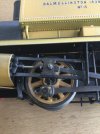
This photo shows the principle on an Agenoria ‘Markham’ tank.
Ian.

Overseer
Western Thunderer
Depending on how old the loco/kit is there are two types of wheels it could be fitted with. The early ones had D ended axles and the wheels have a D shaped hole. The more recent ones have the 1/8th inch version of the Slaters square end with countersunk screw axle. Slaters never made S7 D end axles but they are easy to make yourself - clamp a length of 1/8 th inch silver steel rod to a hard surface, make a pair of 3mm height blocks and file flats on each end of the silver steel, just make sure both flats are parallel, ie on same side. If the loco has screw fitted wheels you will need to buy new S7 axles from Slaters.
The front axle compensation in the kit is not very clever/resolved so it may need some attention to make it work, depending how it was assembled. I think the quickest way to convert an already assembled loco would be to cut the underframe down the centre line and solder it back together with some strips of brass under the spacers. Choose a width which will get the frames closer to scale width and leave the cylinders etc in place there will be plenty of room for the coupling rods and crossheads.
I really should finish my kit, one of my longest unfinished kits bought and started in 1988.
The front axle compensation in the kit is not very clever/resolved so it may need some attention to make it work, depending how it was assembled. I think the quickest way to convert an already assembled loco would be to cut the underframe down the centre line and solder it back together with some strips of brass under the spacers. Choose a width which will get the frames closer to scale width and leave the cylinders etc in place there will be plenty of room for the coupling rods and crossheads.
I really should finish my kit, one of my longest unfinished kits bought and started in 1988.
RichardG
Western Thunderer
I think the quickest way to convert an already assembled loco would be to cut the underframe down the centre line and solder it back together with some strips of brass under the spacers. Choose a width which will get the frames closer to scale width and leave the cylinders etc in place there will be plenty of room for the coupling rods and crossheads.
Unfortunately, moving the frames apart will leave the cylinders sticking out, and the slide bars will no longer tuck inside the motion bracket. Also the pivoting frame holding the front axle will now be too narrow. So this will take you to filing down the backs of the cylinder castings to move the motion inwards to its original position, and reworking the front suspension.
 By design, the fronts of the brake shoes line up with the fronts of the wheels. If you widen the frames you will have to rework the brake gear too.
I think, the conversion would become a major rebuild and it would be easier to swap the wheels and add some shims to remove the sideplay.