Some of my Gauge 3 rolling stock

Mike W

Western Thunderer
I'll take a break from posting pictures for a while, but hopefully I've shown how a large and varied selection of goods stock can be made in Gauge 3, mainly from kits produced by a wide range of people in several different materials. The pioneers of modern Gauge 3 kits were GRS and Brandbright and I don't even have any of theirs among my own c70 wagons, so there is a lot of choice. Who said its a minority scale!
 

john lewsey

Western Thunderer
I like the Bolster wagons , I made a couple out of plasticard in 7mm in my Scraps I have in the cupboard thread.
John

It looks great Mike.
 

Mike W

Western Thunderer
Thank you John. Just before he died, Adrian Swain had patterns for a 7mm LNWR D12 bolster wagon, but he never marketted it. I think he even had some body resins cast and I laser cut some stanchions for them. Whether it went to Dave Parkin with the rest of 43to1 I don't know.
Mike
 

Mike W

Western Thunderer
Well, there's been a break, so perhaps time to talk about some other kits and things in Gauge 3. This was a kit design that didn't quite work. "flexikits" were the work of John Candy and intended to be a whole range of 1923 wagons and vans sold at cost price as an entry to Gauge 3. The moulds for the large home-cast resin parts didn't maintain accuracy over time, stretching or shrinking slightly, making a model which, compared to my normal kits with professionally cast bodies, were very time consuming to produce, time consuming to assemble, not as strong as a on-piece casting and not as crisp, though they were cheap. Notwithstanding favourable comments in Garden Rail magazine, they were not what the Gauge 3 market appears to want, being a bit Marmite.

Halfords black and very old Letraset, thouched in by hand and then weathered (I'm not good at that) to disguise the blemishes!

MikeBute 3.JPG
 

Mike W

Western Thunderer
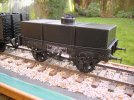
A spin-off from the cheap and simple "flexikits" was this tar tank. It has a home-cast resin skeletal frame with overlays for solebar and headstock detals, then a professionally cast resin tank and metal fittings. It was one of those projects that "I wouldn't have started from here" and with hindsight it would have cost little more, and been quicker to build, if the whole body was cast in one piece. Painting in plain black should have been easy but just occassionally paint seems to react with resin, even though no release agent was used and the moulding was scrubbed before assembly. In this case the effect it produced around the filler, to me, looked just right for spilled tar, so I left it. Sometimes we need a little luck!

Tar Tank finished.JPG
 

Mike W

Western Thunderer
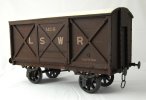
To me the LSWR D1410 van is the epitome of LSWR, the one everyone thinks of in the same way the GWR has the iron Mink, the Midland have their van with offset door, etc! Another one piece resin body and my usual running gear. This is Precision Paints, waterslide transfers and then a light blow over with Humbrol matt varnish from a rattle can. All went well until the varnish reacted with the paint beneath and the whole lot bubbled up as if I'd put cellulose over oil. Disgusted with myself, I went to bed and the following morning it looked brilliant. No carrier film visible at all and probably the best transfers I've ever done! Steve Cook weathered it (I need to weather more wagons really). This is the main reason that many of my wagons since this have been hand lettered or the transfers applied by Liz Marsden - I know I can't do it.

Wagon Shot 1.JPGLSWR van transfer disasetr.JPG

Mike
 

Mike W

Western Thunderer
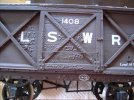
This LSWR van highlighted another problem which the smaller scales rarely encounter. The door runners were etched brass, but leaving a wagon on a garden railway in summer can make it get very hot, and the brass expanded (just visible in the picture). It didn't go back when it cooled down either. The solution was to have some runners laser cut in stainless steel which has a much lower coefficent of expansion.

Mike
 

magmouse

Western Thunderer
Mike - this looks terrific, If I can get the finished wagon to look as good as that when I do my 7mm example, I shall be very pleased (The final result, I mean not the intermediate stage! :) ).

Nick.
 

Mike W

Western Thunderer
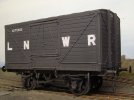
The big LNWR D88 covered van. The patterns for this were made by John Candy and it has a one-piece resin body including the roof, but no floor. This was done so that the side/roof and end/roof joints can be perfect and who needs a floor anyway? Alternative doors are provided for LMS (vertical planks) or D88a (full height doors, with no drop door). I must get around to builidng one as a D88a with a large white circle on the side, but a vacuum fitted one would also be nice, with white stripes on the side, and how many D88s can I really justify!P5030084 Charles King photo.jpg
 

lankytank

Western Thunderer
.......the side, and how many D88s can I really justify!

How many did the LNWR have.....? Lots.

So, maybe, but, not quite - Lots. But more than a few...... :rolleyes: :) :thumbs:
 

Mike W

Western Thunderer
I mentioned earlier that Don Crouch offered to make the wooden pattern for the body of a private owner wagon, for moulding in resin. When it was done he told me that he'd made three bodies whilst he was about it! This one of the "extra" ones. An RCH design, but 12 tons make it noticeably larger than the usual 7-plank wagons. The SECR had a large number when the Kent coalfields were being opened up, but the LBSC and teh GNR also had some. Werrett even says that the LNWR hired some, probably as a stop gap for shortages, having provided so many wagons for the war effort. So, a one-piece resin body, usual range of materials for the rest and my own transfers. SECR lighter.JPG
 

Mike W

Western Thunderer
All these wagons need an engine, or a few engines, so this was the first one I acquired. One-off, built by Alan Headech c1980 for Mike May, who used it as station pilot for his Holyhead layout. It has an old fashioned and heavy lead/acid battery inside and, just like the real thing, the speed control is the regulator handle inside the cab. A basic model with no brakes, but accurate, well engineered, painted by Brian Badger, and it performs beautifully. Seen here many years ago on the lovely garden line of the late Alan Marsden with just about every wagon I possessed at that time!rsz_g3_chopper_on_goods.jpg
 
Top