Hi Julia, yes I'm impressed with this too, I've been following the formlabs videos. We have a lot of 3D printers at work so I am interested in trying it for forming.Absolutely fascinating! The results from it are amazing.
I am aware that people have tried using 3D printed form tools for low quantity runs too. It certainly brings the technology to the home user when you haven't got access to expensive machines.
Julia

You are using an out of date browser. It may not display this or other websites correctly.
You should upgrade or use an alternative browser.
You should upgrade or use an alternative browser.
The Mad Squasher Strikes Again.......
- Thread starter Fitzroy
- Start date
Hi PieterHi Martin- short answer is yes you can. You need to make some effort to protect the litho by polishing the dies and maybe greasing them heavily with tallow - these days you'd use thin self adhesive plastic film. But sadly getting metal decoration done is getting harder and harder. When Alan Middleton did his repro Hornby no 2 coaches, there were probably at least half a dozen litho tin print shops in Melbourne, but the last one left moved to Sydney several years ago. I think Ace and Darstaed using suppliers in China, and the onward march of demographics, have pretty well satiated the market for tinplate coaches these days.
I wonder if there is still a market for tinplate rolling stock, and the short answer is I don’t know. Neither Ace nor Darstaed appear to making tinplate coaches currently, indeed Darstaed seems to have gone over entirely to fine-scale, or at least ‘scale’ rather than ‘tinplate’.
My problem with most of the modern ‘tinplate style’ coaches that Ace and Darstaed did produce was simply that they were nowhere near as well made as Bassett-Lowke’s. Rather crude cast bogie sides, no embossing to represent the window frames etc. (and strengthen the sides). Incorrect fonts for lettering. No hand finishing to cover the exposed steel at the edges of the tinplate sheets at the corners of the coach But silly gimmicks like massively over-scale tail lights. So the modern coaches just looked completely wrong next to genuine vintage vehicles. Both manufacturers seemed very anxious to advertise how keenly priced their coaches were. Personally, I might have bought some if they had been more expensive but better made.
So I do wonder if there would still be demand for really nice vintage style tinplate coaches, following the approach you took to your A1/A3 locos …
Goods vehicles too. The use of diecast underframes meant the modern vehicles looked quite different to real 1930s and earlier models. Alternatively, some really very nice wagon bodies were put on modern Continental European underframes. A rectangular tank tar wagon comes to mind.
I wonder if, properly done, vintage style goods wagons would still sell. It was noticeable, for instance, that the modern manufacturers did not produce LMS, SR or GW goods brakes to go with their wagons, let alone any pre-grouping types.
Martin

Brian McKenzie
Western Thunderer
For anyone not aware, have a look at Pieter's fabulous work as 'Fitzroy Loco Works'
The pressed components are so impressive .
.
Any update on that 'dashing blue' S class, Pieter ?
Brian McK.
The pressed components are so impressive
.Any update on that 'dashing blue' S class, Pieter ?
Brian McK.

Hi Brian, I really need to update the website....For anyone not aware, have a look at Pieter's fabulous work as 'Fitzroy Loco Works'
The pressed components are so impressive
Any update on that 'dashing blue' S class, Pieter ?
Brian McK.
I finished the locos and they all went off in early 2025. In the end I made 22 in total- one prototype, one production prototype, and 20 production engines. I will end up making more but not in batches of 20! I think 5 a time would be my limit next time. It became a bit of a rod for my own back. I will also do some with finescale wheels, but that might entail suspension.
Cheers
Pieter

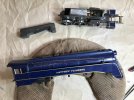
More progress in the last couple of days. I formed up the sides and roof by hand to see how it all looks with the rivet detail, and reassembled the prototype coach with the new piece. Since then, I have been scratching my head about tools to do the job a little quicker. It turns out my friend Ed, who would be known to some in the Bassett-Lowke Society, still had his tools he had made for forming replica Exley coaches out of aluminium sheet and he very kindly offered them to me.
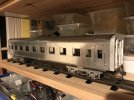
Since this was made I have been working on the Exley tools (the roof profile is effectively identical, which is a funny coincidence because my profile is an exact scale replica of the Spirit of Progress stock, but not quite the notional scale of the Exley K6 LMS coach profile).
The main work has been cleaning and derusting with a rotary brush, and easing some mating parts with careful grinding to make sure they don't lock together or shear off the sides if over-pressed. They were never intended for doing any large quantity of parts, so there were shortcuts involved in their welding and fabrication. However, considering how they were made they are exceptionally good and pretty accurate. I will be adding some stops and alignment features too, but I was able to finally do an end to end tryout today and it all worked.
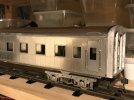
The coach ends behind the cast floating vestibule/streamline corridor connectors are also pressed out of tools I had lasercut in slices and then pinned together. I'll post something on those in the next few days. The doors are actually folded over flaps of the ends, and the handrail knobs hold the ends on. I need to make embossing dies for the door window frames, and master models for battery boxes and air conditioner units and air cylinders, but its coming together. Oh, and I need to make dies to press seats for the compartments. I want to at least make some rough dummies of the underfloor parts to get a feel for how it all presents itself. Anyway, more anon.
Pieter
Since this was made I have been working on the Exley tools (the roof profile is effectively identical, which is a funny coincidence because my profile is an exact scale replica of the Spirit of Progress stock, but not quite the notional scale of the Exley K6 LMS coach profile).
The main work has been cleaning and derusting with a rotary brush, and easing some mating parts with careful grinding to make sure they don't lock together or shear off the sides if over-pressed. They were never intended for doing any large quantity of parts, so there were shortcuts involved in their welding and fabrication. However, considering how they were made they are exceptionally good and pretty accurate. I will be adding some stops and alignment features too, but I was able to finally do an end to end tryout today and it all worked.
The coach ends behind the cast floating vestibule/streamline corridor connectors are also pressed out of tools I had lasercut in slices and then pinned together. I'll post something on those in the next few days. The doors are actually folded over flaps of the ends, and the handrail knobs hold the ends on. I need to make embossing dies for the door window frames, and master models for battery boxes and air conditioner units and air cylinders, but its coming together. Oh, and I need to make dies to press seats for the compartments. I want to at least make some rough dummies of the underfloor parts to get a feel for how it all presents itself. Anyway, more anon.
Pieter
