Hayfields 7mm 3D Printed Turnouts

martin_wynne

Western Thunderer
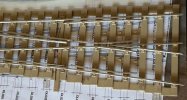
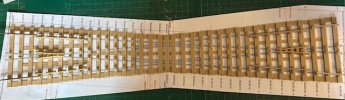
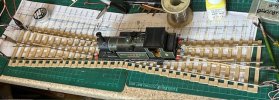
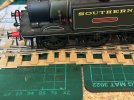
Needs the FDM supports removed, bonding wires and tie bar fitting

And painting, and ballasting, and some cosmetic fishplates, and ... :)

To create some wood texture "grain" effect -- splits, cracks, sawmill marks, etc., streak a little white typing correction fluid* on the timbers before painting.

*from the pound shop. Still used in schools, for crafts, etc. Dries quickly in thick streaks.

Martin.
 
Last edited:

Hayfield1

Western Thunderer
550.jpeg

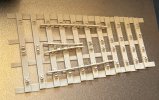
A test build of a V6 single slip which has been on the back burner for a while, finished today and learnt some lessons for a better version. Tested with a 4 wheel coach but needs tiebars and wiring to test fully

551.jpeg

You may see the Templot Tiebar (designed to be covered by some ballasted card, next one will be built using the CARROT version

552.jpeg

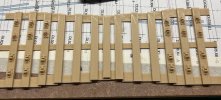
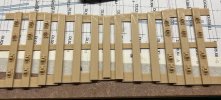
End of a V6 diamond using the CARROT version, center third on the printer

553.jpeg

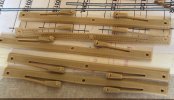
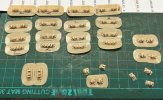
Batch printed some Templot tiebars

John
 

Hayfield1

Western Thunderer
557.jpeg

The first thing I did was to cut out and form all the rails (some left over length) as I formulated a build sequence

558.jpeg

With the stock and closure rails in place I cut the obtuse bent rails to length, then fitted them in place with various chairs I printed, some cut in half to aid construction

559.jpeg

Both obtuse crossing stock rails were fitted

560.jpeg

Then the check rails had half chairs added and stuck into place

561.jpeg

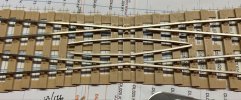
After electrical bonding wires were added I was able to bench test the diamond crossing

562.jpeg

Adding etched fishplates to the rail joins

All in all so very much easier than a total scratch build. Certainly a very much quicker build.

A few track build skills are required plus a bit of track building experience. but nothing like what's required in scratch building.

I initially was a bit skeptical about the FDM printed check and wing rails prior to building both a turnout and this diamond crossing, but it simply makes life so much easier, not to say far more accurate. A big thumbs up from me

John
 
Last edited:

Hayfield1

Western Thunderer
I have had a busy couple of weeks, an interesting and challenging (I am not used Zoom very much, let alone using 2 computers plus switching between 3 programs) evening session over the internet last week, since then I have been preparing for Guildex at Stafford show ground this weekend

guildex 1.png

Terry Downs who owns Kosmik will be there both days, Terry as well as being a 3D printing guru also laser cuts track bases and does other 3D activities. Martin Wynne will be there on Saturday and I will also be there both days.

Terry will be giving a short presentation at 10am Saturday in the lecture hall

There will be 2 computers with monitors so we can show how Templot 2D & 3D works and hopefully my printer will be working in the background

Do come and say hello, we have asked for a few extra chairs so folk can sit and see Templot in action
Terry has offered (if possible) to look at any Templot files you have (put them on a USB stick) and on Saturday we have Martins wealth of knowledge to fall back on

John
 

Pencarrow

Western Thunderer
I have had a busy couple of weeks, an interesting and challenging (I am not used Zoom very much, let alone using 2 computers plus switching between 3 programs) evening session over the internet last week, since then I have been preparing for Guildex at Stafford show ground this weekend

View attachment 247033

Terry Downs who owns Kosmik will be there both days, Terry as well as being a 3D printing guru also laser cuts track bases and does other 3D activities. Martin Wynne will be there on Saturday and I will also be there both days.

Terry will be giving a short presentation at 10am Saturday in the lecture hall

There will be 2 computers with monitors so we can show how Templot 2D & 3D works and hopefully my printer will be working in the background

Do come and say hello, we have asked for a few extra chairs so folk can sit and see Templot in action
Terry has offered (if possible) to look at any Templot files you have (put them on a USB stick) and on Saturday we have Martins wealth of knowledge to fall back on

John

I see you're on stand D5 John, I'm next to you in D6 all weekend. Will be very interesting to see those printed tiebars in the flesh.
 

Hayfield1

Western Thunderer
After concentrating on Guildex, then a week later going to Puglia for our holiday, my 3D printer has been a bit inactive. Firstly I wanted a break from track building, secondly I wanted to dismantle an old EM gauge project to make space for a mini 7mm scale layout in my workroom

The design is nothing more than a larger scenic test track/storage yard for stock, a very much shortened terminus

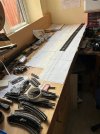
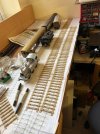
1.jpeg As well as starting to clear the baseboards, my wife volunteered me to clear some remnants of his past railway modeling activities, surprising how this eats away at ones time

8.jpeg Track roughly laid out simply to see what it will look like

The first set of prints to 0mf standard have been printed, they need a bit of tidying up and rails fitted, prior to a closed cell foam track bed being laid,

Nothing very interesting or ground breaking, but it's not only a very economical way to produce track, but built to a scale gauge not supported by the RTR trade and designed with 60' track panels with 12" sleepers at both ends using S1J chairs. Why use flexi track when you can accurately print the curves you require, you never know but it might actually catch on one day

John

For anyone thinking of having a go with 3D printing both the A1 and A1mini now being sold at knock down prices (A1 now £199 mini £130ish?)
 

Hayfield1

Western Thunderer
What do you think of the new Bambu A2L?
Asterix

At the moment I am firmly in the Neptune 4 queue, I have looked at the Bambu A1 and A1 mini and come to the conclusion I would be better off waiting for the next new batch of developments. One concern with the A1 series is they are not quite as bulletproof as they seemed at first

The little I have seen of the A2 I like the benefits of the larger print bed, but its far too early for me to take the step into a more modern 3D printer. My interests are in 7mm scale and a larger print bed is of interests. At the moment its summer with holidays approaching, I have just started the process of buying a battery system for my solar panels. Next up is looking at my airbrush and compressor. But a new 3D printer could be something I will have to invest in in the near future.

If I did not have a 3D printer or needed to replace one I would be interested in it, its the old game of waiting to see what comes along in the next few months. No doubt Martin is keeping a close eye on technology and perhaps Templot Club would be a better place to ask the question

John
 

martin_wynne

Western Thunderer
No doubt Martin is keeping a close eye on technology
@asterix2012 @Hayfield1

I don't have a Bambu A2L so I can only comment on the published data.

For 3D-printed railway track it is effectively an A1 with 60% more bed area, but at 60% more cost. For a 7mm modeller that would be worth having, but in 4mm scale the A1 size seems adequate and the extra money might be better spent on something else, such as a filament dryer.

For general modelling the A2L has a £60 attachment available which converts it to a blade cutter similar to the Silhouette Cameo. This can be used to cut out (or score out) intricate parts in plasticard for scratch building. I don't know if that process is still popular -- there is a long-running workshop topic on the subject on RMweb at: https://www.rmweb.co.uk/topic/79025-a-guide-to-using-the-silhouette-cameo-cutter

Martin.
 

Hayfield1

Western Thunderer
As I mentioned earlier last week I printed an EM gauge B7 turnout and an 00 gauge V5 with a 9' switch. Given I have a slightly older machine (Neptune 4) with a 0.4mm nozzle, the results are reasonably good.

In fact it it was 2016 and not 2026 I think people would be amazed at the results. There will be some who criticize a slight dulling of detail from using the 0.4mm nozzle that could be remedied by using a 0.2mm nozzle, but at normal viewing distances could it be noticed? But what are the options available to those who criticise these prints ?

Ready To run

I have not looked close at them, but for starters the geometry is for set track and not prototypical, the broken and bent end timber etc

C&L and Exactoscale ranges

Only Exactoscale (in 4mm scale only), has a range of special chairs and for not all sizes, Exactoscale are only available through societies. But I have noticed against 3D prints the chairs seem to be overscale to my eye, those who only use C&L will have a limited type of chairs for turnouts

British Finescale

This range is to my mind the best commercially option, sadly for commercial viability it has a limited range of sizes. An easy to build kit and a cheaper option to the other commercially available options, the chairs are finely printed and a bit better than those I can print with my 0.4mm nozzle

If I were interested in 4mm scale I would either change the nozzle in the Neptune 4. Or more likely buy a Bambu A1 mini, which would give me a much more detailed print in 4mm scale. As for the range of sizes, detail and geometry, 3D printing of turnouts really come into their own, bespoke turnouts available to all

But when it comes down to costs and time saving, the reality kicks in

A V5 with a 9' switch cost 17p to print using about 1m of rail (2.15 at most) Total cost about £2.30
The EM gauge B8 would cost a little more, but not much, probably around £3 with rail.
With the CARROT format (printed wing and check rails, the build process is relatively easy and quick. similar to British Finescale kits which are even easier as Wayne preforms the rails and supplies tiebars. But then these are 3D kits

For me in 7 mm scale the Neptune 4 with a 0.4 mm nozzle is a good cost effective option, and I would add to a quality I would find impossible to match scratch building, in a verity not available commercially.

Commercial kits in 7mm scale are over £100, RTR turnouts start in the £70 + bracket
I can print a bespoke turnout for around £10 with most of the cost being for the rail

Back to a question I was asked would I buy the Bambu A2, probably if I did not have the Neptune 4 already, or needed to replace my Neptune at this point of time, but subject to asking the question to my more learned friends at Templot club probably

John

John

 

Hayfield1

Western Thunderer
@asterix2012 @Hayfield1

I don't have a Bambu A2L so I can only comment on the published data.

For 3D-printed railway track it is effectively an A1 with 60% more bed area, but at 60% more cost. For a 7mm modeller that would be worth having, but in 4mm scale the A1 size seems adequate and the extra money might be better spent on something else, such as a filament dryer.

For general modelling the A2L has a £60 attachment available which converts it to a blade cutter similar to the Silhouette Cameo. This can be used to cut out (or score out) intricate parts in plasticard for scratch building. I don't know if that process is still popular -- there is a long-running workshop topic on the subject on RMweb at: https://www.rmweb.co.uk/topic/79025-a-guide-to-using-the-silhouette-cameo-cutter

Martin.

Martin

Thank you very much for the quick reply, one thing I find important is to seek advice from a more knowable group of 3D modellers, originally the old codgers, but a few more youngers are joining in. Going with the flow for support is far more important to me than buying the latest machine

I have really benefitted from the knowledge and help from Martin and the other members of the group, more now are stepping up to assist Martin to enable him to enjoy his experiments with coding, its Martins hobby which he generously shares with us

A big thanks

John
 

martin_wynne

Western Thunderer
Martin

Thank you very much for the quick reply, one thing I find important is to seek advice from a more knowable group of 3D modellers, originally the old codgers, but a few more youngers are joining in. Going with the flow for support is far more important to me than buying the latest machine

I have really benefitted from the knowledge and help from Martin and the other members of the group, more now are stepping up to assist Martin to enable him to enjoy his experiments with coding, its Martins hobby which he generously shares with us

A big thanks

John

Thanks John.

A lot of Templot developments in the pipeline. I'm currently experimenting with a filament which has a greater temperature resistance for when soldering dropper wires. The next program updates will have several new features -- a wood texture effect on the timbers, slab & bracket chairs, a short CASROT-printed section of rail for the stock rail set or joggles. This removes the remaining need for any accurate rail bending for assembly. And additional chairs and functions for complex formations such as tandem turnouts.

Thanks to Steve Cornford there will be chairs for parallel-wing crossovers, and full 3rd and 4th rail options. These will be for both cosmetic printed conductor rails or working metal conductor rails.

Templot is primarily about bullhead track. For modellers interested in modern flat-bottom track, James Walters is making great progress with his TrackIT software.

All this means that modellers can now easily build track and pointwork for little more than the cost of rail. Once you have an FDM printer a 4mm turnout costs under £3 and a 7mm turnout about £10 including rail. With no track gauges or jigs to buy. The Bambu A1 mini printer is currently on offer at £140 and £8 for an easy-swap 0.2mm nozzle. The A1 mini is a bit small for track, but Templot has functions which let you print track bases in short clip-together sections. And the A1 mini is ideal for printing other model parts and components.

Still a long way to go -- we don't yet have K-crossings, slips, diamonds, double-junctions. So you are joining an unfinished ongoing experiment -- but one worth being part of. :)

Martin (no connection with Bambu).
 
Top