7mm Rob's Rolling Stock Workbench

Rob Pulham

Western Thunderer
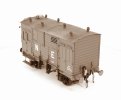
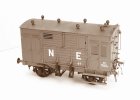
Stepping briefly back to the Diagram 67 Horsebox for a moment. I fitted the buffers and couplings but rather than bore you with yet more shiny clean photos I thought we might pretend to step back in time after all that what we model for.

54503338990_124f3686a3_h.jpg

54502977371_54fa630b49_h.jpg

54503103819_10c6e473b4_h.jpg
 

Rob Pulham

Western Thunderer
I wasn't exactly sure where this would fit best but here is as good as anywhere.

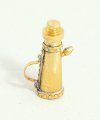
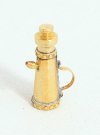
Prompted by the recent oil can production, I decided to scratch a long time itch.

Way back in 2010 for my first 7mm scale build an LMS Period One Full Brake, I scratch built a full interior from brass. As part of that interior detailing I made a couple of fire extinguishers, not having a lathe at that time I made them from brass tube and other bits and pieces finishing them with a couple of 4mm scale etched plates that I had in my spares box.

54555900770_8ba9120d8a.jpg

I fitted one in the coach and the other sat in my spares box for a long time. I can only assume that I fitted it to a brake van at some point because I can’t find it.

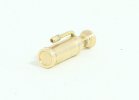
I made them from tube etc. because that’s the only way that I could see to make one up and I was really pleased with the result. However since then I have had a longstanding itch to make one of the tapered/cone type fire extinguishers. My recent success with the oil cas prompted me to have a go. I found a few photos and had a go. The first attempt wasn’t that great because my rivets were to pronounced so I changed the punch on my rivet press and had another go. This time I was happy and although they look big in the photos because that are massively magnified they do look the part when viewed at normal distances.

54546672358_3eda9a71cc_c.jpg

54546777025_24e182cffe_c.jpg

54546620474_8c1973ae6b_b.jpg

54546777020_087d463276_h.jpg
 

Rob Pulham

Western Thunderer
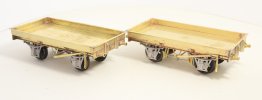
At the last Bolton Show before its sad demise I picked up a Connoisseur kit for a pair of Single Bolster Wagons. These were the last design of 13 ton single bolster wagon built by the LNER between 1945 and 1948 with all steel body and underframe.

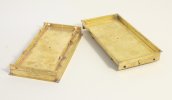
Having finished the LSWR Brake vans that I had previously been working on while demoing at shows I needed something else so at Harrogate show last year I made a start by folding up and soldering the body pans which are all one piece. These were then put aside until Wensleydale show this May when I did some more at them.

I didn't get much done on Saturday because it was so busy. Literally all I managed was to solder three layers of brakes together for each wagon.

54518701259_ee2af413c3_h.jpg

Sunday it was quieter so I managed to get quite a bit of detailing done on both bodies.

54518868280_ff70b12c83_h.jpg

As I was adding the details I had been looking at the rivets in each corner of the body initially thinking that I would have to fill in the unsightly dimples on the inside faces where I had pressed them out with the rivet press. This got me thinking that there must have been something on the inside. A Google search found an good image of a preserved example at Bo'ness which clearly showed that there is an inner washer plate which isn't provided in the kit so on Monday morning I had a go at seeing if I could make some.
It took a couple of goes to sort out the spacing and sizes but I got there in the end. The most fiddly bit was getting them to fold straight.

54518778358_40a3eab56d_h.jpg

They just need soldering in now.
 

Dave Holt

Western Thunderer
I have to admire your commitment there, Rob. After all, the dimples are on the inside and not readily visible in the normal operating orientation, especially once the W-irons and brake gear are added. Or are you planning to stage regular derailments so people can see the underneath?:))
Not getting much done at show demonstrations in both normal and good, as it usually means you spent lots of time talking/explaining to people.
I did demo at one local show (Ludlow - not local to me but aimed at a local audience) where not many visitors had any interest in P4 loco construction. So, with plenty of time to fill I got quite a bit done, only to realise when I got home, that I'd added some parts back-to-front. Grrr.
Dave.
 

Rob Pulham

Western Thunderer
Hi Dave,

Sorry I didn't explain clearly, the corner plates fit inside the body so they are visible from normal viewing angles.

I hear you on the fitting parts back to front bit. I soldered the smokebox wrapper of my N10 on inside out while demoing and had to make a new one, due to wrecking it when I removed it.
 

Rob Pulham

Western Thunderer
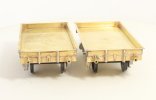
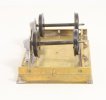
I took the bolster wagon along to Embsay last weekend and made a start on Friday morning before it got busy. In no time at all I managed to get a pair of axle guards soldered to each body and then added bearings and axles in preparation for adding the other two axle guards on each wagon and getting them up on their wheels.

This is where it all went pear shaped. I had previously tried the bearings in the holes in the castings to ensure that they seat far enough in. What I had failed to notice is that the bearing holes in the castings are not at right angles to the rear face of the axle guards they have been cast at an angle.
54628512636_2e5ba31f04_h.jpg

It was at this point that I also realised that I didn't have 2.0mm drill bit with me to attempt to straighten out the holes. So I ended up putting these aside and working on something else for the rest of the weekend.

Last Monday I had the thought that if I could find one a 2.5mm burr, might be better to straighten out the hole than a normal drill bit. I did a search and found a set with what I needed on Amazon


54717168828_7d6df8280f_z.jpg

Now they were only £8 for the set so probably not that hard wearing but I figured that if I only ever use them on whitemetal or brass they should be fine.

My next problem, was that the the drill chuck hit the wagon body, long before the burr reached the workpiece, so I had a choice. I could either remove the axle guards that I had fitted and then drill them out, or I could make an extension arbor to allow the burr to reach the hole without the chuck hitting the wagon body.

I chose the latter as being easiest for me.

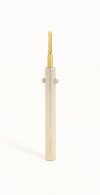
Using a piece of 6mm steel rod recovered from a toner cartridge (my mini pillar drill chuck only opens to 6.5mm) I drilled out the end 3.25mm to take the burr and then cross drilled and tapped M3 to take a couple of grubs screws to retain the burr in the arbor.
54631034164_444012f8e2_h.jpg

Because the axle guard castings have a retaining strap across the bottom, they don't sit flat in the open vice jaws when laid face down. So I cut a couple of coffee stirrer type strips and double sided taped them to the jaws at one end of my vice.

54631650297_29cc9f910b_h.jpg

Then using a couple of offcuts of steel as supports I was able to get the axle guards to sit level and use the extended burr to re-drill out the holes to allow the bearings to sit straight. I also used the Proxxon's depth stop to drill the bearing holes a little deeper without breaking out of the fronts of the axleboxes.

54632705839_71d06001f1_h.jpg

I didn't do any sophisticated clamping, I just held the axle guard down with one hand, while operating the drill with the other.
All the axle guards are now drilled out correctly and ready for the other side to be fitted. I can't decide whether to do it now or wait until Thirsk show at the end of this month.

 
Last edited:

Rob Pulham

Western Thunderer
After discovering the out of square holes and correcting them at Redcar show I was able to get both wagons up on their wheels and the single sided brakes fitted.

54717194209_9dbbb1dbf4_h.jpg

Further progress was made on Saturday while supporting the Stainmore Railway Railwayana event with the buffers and the main brake cross shaft fitted. I had some spare Slaters cast buffer stocks so I replaced the whitemetal castings provided in the kit. I also managed to do something that I haven’t done for some time and that is melt a couple of white metal T stanchions for the ends while tinning them with 100 degree solder. I was busy talking to a gent and wasn’t concentrating.

54726286512_c949f7d45b_h.jpg

I am in the process of making some replacements from some coarse scale bullhead rail that I have to hand. The profile makes a great starting point for T section.

54729008833_b2f187b495_h.jpg
 

simond

Western Thunderer
Or ebay


my experience with anything less than a millimetre is that they go “click”, and I go “bugger” far too quickly.

and wear safety glasses.
atb
Simon
 

michael080

Western Thunderer
my experience with anything less than a millimetre is that they go “click”, and I go “bugger” far too quickly.

and wear safety glasses.
atb
Simon
That depends very much on the supplier of these little buggers. Stay away from everything Chinese for less than 2 GBP . A very good source are resharpened bits from PCB manufacturers. They have a good industrial quality, but they are too short for their machines. Expect to pay 20gbp for a package of 10 bits.
 

simond

Western Thunderer
That depends very much on the supplier of these little buggers. Stay away from everything Chinese for less than 2 GBP . A very good source are resharpened bits from PCB manufacturers. They have a good industrial quality, but they are too short for their machines. Expect to pay 20gbp for a package of 10 bits.
Interesting, Michael.

we have a good relationship with another local business who produce PCBs on enormous, stone bed high speed milling machines with auto tool break detection and rework. When I mentioned my interests, the boss, Paul, didn’t say what they did when the bits were resharpened enough times to be unusable. They certainly did do resharpening.

Maybe I’ll speak to him again…
cheers
Simon
 

Rob Pulham

Western Thunderer
A trip out to Harrogate show on BH Monday allowed me to get the T stanchions fitted and as a bonus, I also got the brake rigging finished on both wagons so just bolsters, buffer heads and couplings to sort now.

54748244385_c9551e8294_h.jpg

54748117299_beff91804a_h.jpg

54747899846_a0e3f15091_h.jpg

I even gave them a good scrub, although now they are dry, I obviously made a better job of one than the other.
 

Rob Pulham

Western Thunderer
One of my many Shelf Queens is a North Eastern Railway Open Carriage Truck. Notes in the LNER Volume of Historic Carriage Drawings indicate that during WWI they had their top rails removed in order to carry aeroplane parts. Now I am not sure what these consisted of, but felt it reasonable to assume that they might be carried in packing cases. So last October at our weekly arts and crafts group, I started to making a packing case.

The A&C see group is as much a talking shop as a doing shop, so progress was slow and steady. The packing case proper was finished before Christmas but I wanted to add some "nail" holes. It took me a couple of hours to drill out all the holes with a 0.4mm bit held in an archimedes type drill.

Our session yesterday was spent adding some very diluted Vallejo smoke to those holes via a sewing machine needle held in a pin vice.

55053427328_fc0561b31d_h.jpg

55053386749_d2fd987f5d_h.jpg

55053311903_02a6180035_h.jpg

55053311888_b6de3ecb72_h.jpg

55053386694_adeafe598c_h.jpg
 
Last edited:
Top