
You are using an out of date browser. It may not display this or other websites correctly.
You should upgrade or use an alternative browser.
You should upgrade or use an alternative browser.
A Ffestiniog Experiment: part 3 Linda becomes Blanche
- Thread starter David B
- Start date

AndyB
Western Thunderer
Apologies in advance for a minor thread hijack.
Going back a long way to posts 37 & 40, @Tim Watson & @David B mentioned Dick Relph. I didn't know anything about this gentleman until linking his name with a Mr C Courtice, prompted by a post on the Gauge 3 forum.
Can anyone tell me more of Mr Relph?
The Model Engineer Index has these entries - I assume they are all the same person?
In later years I believe Mr Relph lived in Cornwall.
Where did he live previously and what was his profession? I've found a possible match who was a Civil Engineer, born in 1909 and living for many years around the Finchley area.
As Messrs Relph, Courtice and Harrison worked together on model locomotive control, my assumption is that they were all based around London / Home Counties.
Mr Courtice is proving very elusive to work out who he was!
Any additional information or pointers would be most welcome.
Thank you.
Andy
Going back a long way to posts 37 & 40, @Tim Watson & @David B mentioned Dick Relph. I didn't know anything about this gentleman until linking his name with a Mr C Courtice, prompted by a post on the Gauge 3 forum.
Can anyone tell me more of Mr Relph?
The Model Engineer Index has these entries - I assume they are all the same person?
In later years I believe Mr Relph lived in Cornwall.
Where did he live previously and what was his profession? I've found a possible match who was a Civil Engineer, born in 1909 and living for many years around the Finchley area.
As Messrs Relph, Courtice and Harrison worked together on model locomotive control, my assumption is that they were all based around London / Home Counties.
Mr Courtice is proving very elusive to work out who he was!
Any additional information or pointers would be most welcome.
Thank you.
Andy
No worries about the thread hijack - he was indeed a civil engineer, and yes, Dick Ganderton posted something years ago confirming that his sublime indoor live steam layout was located in Cornwall. I’ll try to check my various old magazines to see if I can find anything else. (And thanks for the thread bump - I’ve been meaning to add some posts about my ongoing conversion of a Roundhouse Engineering FR ‘Linda’ into ‘Blanche’, per the photo below).
David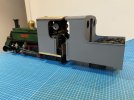
David
Hi Andy
I’ve had a trawl through my old magazines to see what else I can find about Dick Relph. I suspect this won’t add anything new to what you already know, but there are some references in the Merioneth Society journals to his work on electric control of live steam locos - nothing biographical, however, other than that he started work on the control system straight after WW2 and confirming that he was a civil engineer by profession. There are also three references to him in Sixteen Millimetre Today (the in-house journal of the 16mm Association), but there is nothing biographical. The only other stuff I could find are the two photos below, from the Model and Miniature Railways part work of the early 70s. I’d be interested to know if your researches throw up any new material about him. Good luck!
David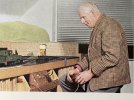

I’ve had a trawl through my old magazines to see what else I can find about Dick Relph. I suspect this won’t add anything new to what you already know, but there are some references in the Merioneth Society journals to his work on electric control of live steam locos - nothing biographical, however, other than that he started work on the control system straight after WW2 and confirming that he was a civil engineer by profession. There are also three references to him in Sixteen Millimetre Today (the in-house journal of the 16mm Association), but there is nothing biographical. The only other stuff I could find are the two photos below, from the Model and Miniature Railways part work of the early 70s. I’d be interested to know if your researches throw up any new material about him. Good luck!
David

James Spooner
Western Thunderer
David,No worries about the thread hijack - he was indeed a civil engineer, and yes, Dick Ganderton posted something years ago confirming that his sublime indoor live steam layout was located in Cornwall. I’ll try to check my various old magazines to see if I can find anything else. (And thanks for the thread bump - I’ve been meaning to add some posts about my ongoing conversion of a Roundhouse Engineering FR ‘Linda’ into ‘Blanche’, per the photo below).
DavidView attachment 256401
That is looking very good. I see you have changed the cylinders to the piston valve ones fitted in around 1972; are you going to add a pony truck as well?!
Nigel

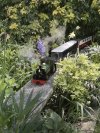
So after slicing up a Double Engine (above), why am I now mutilating poor old Linda? She‘s a Roundhouse Engineering Mk1 live steam model, given to me 16 years ago by my wife. She’s been a superb performer - gutsy, loud and reliable - with a lovely Lightlines paint job by the late Geoff Munday. Here is a blurred still from a video of her pulling 14 heavy WHR and FR bogie cars with ease (part of a challenge from my brother to see what she was capable of hauling):
But if you’ve read the first page of this thread, you’ll understand why I’ve always wanted her to be Blanche. There’s something about Blanche - a former FR General Manager has described her as a much-loved little green rocket, the current GM called her the FR’s Engine of the Year a couple of seasons ago, while Paul Martin of EDM Models (a regular driver of Blanche) refers to her in his blog as his ‘other woman’. If you haven’t yet felt the unique magic of this strange-looking 2-4-0STT, try this video of a footplate ride
. The American who filmed it describes the experience as the most exhilarating footplate ride he’d had anywhere, and the second half (where Blanche is unleashed on main valve regulator with a full load on the line beyond Penrhyn) is just fabulous.
But turning Linda into Blanche isn’t a simple matter. There‘s a totally different tender, cab and cylinders to begin with. And then there’s the awkward matter of the Roundhouse model portraying Linda in the 1960s - as Nigel says above, in 1972, Blanche was fitted with extended front frames, a longer smokebox to accommodate superheating and a pony truck. There were a few more issues as well:
1. Roundhouse made Linda as a gauge-adjustable model, so the frames are set further apart to accommodate 45mm gauge wheel sets, which has in turn made the bodywork too wide, with proportions adjusted to match. They did a good job of this, but when I finally found an accurate plan, I realised that while the other general dimensions are pretty close, the width is out by a full 10mm (just like the otherwise lovely Accucraft NGG16 Garratt).
2. As far as I can tell, there are no accurate published plans of Blanche in post-1972 condition (I would love to be corrected about this). There is one widely available drawing, but it is poorly drafted and doesn’t even show the extended front frames and smokebox at all. I did, however, have a 16mm scale plan of Linda in original condition drafted by Hunslet’s own Don Townsley and published 50-odd years ago in Model Railways, and this gave me some useful data, such as the correct depth of the chunky red axle cranks (5.5mm, rather than Roundhouse’s anaemic 3mm).
3. There is no room for the pony truck - the space is taken up by the cylinder valves and exhaust piping. The pony truck should have a 1’ diameter wheel (originally taken from one of the long-withdrawn Single Fairlies), so I would need around 20mm of headroom (to allow for flanges and vertical movement) - on my Linda, there is a maximum of 7mm at the lowest point, which is, of course, directly where the pony truck axle needs to go.
4. Lastly, there are plenty of people who know a great deal more about Blanche from first-hand experience than I do, including our own Nigel (James Spooner), Simon D and others, so taking the big step of applying saws, knives, soldering torch and files to one of my nicest, best performing locomotives seemed like too big a risk…….
…..until I took a close look at the smokebox door last summer and saw flaking, bubbling paint. When I looked even more closely, I saw that the smokebox door had also begun to distort, leaving an air gap which would have crippled the steaming of a real Stephensonian steam loco. So I had to dismantle the smokebox and remove the door for repairs. Which promptly fell apart in my hands:

I don’t know whether this failure was caused by mazac rot (which it looks like to me) or by excessive heat over the years (despite the presence of a factory-fitted stainless steel heat shield behind the door), but either way it was a goner. So the big question arose: do I take the lazy route and simply ask Roundhouse for a replacement casting, or do I use this as the opportunity for a proper rebuild so that I could finally have my miniature Blanche…..
But if you’ve read the first page of this thread, you’ll understand why I’ve always wanted her to be Blanche. There’s something about Blanche - a former FR General Manager has described her as a much-loved little green rocket, the current GM called her the FR’s Engine of the Year a couple of seasons ago, while Paul Martin of EDM Models (a regular driver of Blanche) refers to her in his blog as his ‘other woman’. If you haven’t yet felt the unique magic of this strange-looking 2-4-0STT, try this video of a footplate ride
But turning Linda into Blanche isn’t a simple matter. There‘s a totally different tender, cab and cylinders to begin with. And then there’s the awkward matter of the Roundhouse model portraying Linda in the 1960s - as Nigel says above, in 1972, Blanche was fitted with extended front frames, a longer smokebox to accommodate superheating and a pony truck. There were a few more issues as well:
1. Roundhouse made Linda as a gauge-adjustable model, so the frames are set further apart to accommodate 45mm gauge wheel sets, which has in turn made the bodywork too wide, with proportions adjusted to match. They did a good job of this, but when I finally found an accurate plan, I realised that while the other general dimensions are pretty close, the width is out by a full 10mm (just like the otherwise lovely Accucraft NGG16 Garratt).
2. As far as I can tell, there are no accurate published plans of Blanche in post-1972 condition (I would love to be corrected about this). There is one widely available drawing, but it is poorly drafted and doesn’t even show the extended front frames and smokebox at all. I did, however, have a 16mm scale plan of Linda in original condition drafted by Hunslet’s own Don Townsley and published 50-odd years ago in Model Railways, and this gave me some useful data, such as the correct depth of the chunky red axle cranks (5.5mm, rather than Roundhouse’s anaemic 3mm).
3. There is no room for the pony truck - the space is taken up by the cylinder valves and exhaust piping. The pony truck should have a 1’ diameter wheel (originally taken from one of the long-withdrawn Single Fairlies), so I would need around 20mm of headroom (to allow for flanges and vertical movement) - on my Linda, there is a maximum of 7mm at the lowest point, which is, of course, directly where the pony truck axle needs to go.
4. Lastly, there are plenty of people who know a great deal more about Blanche from first-hand experience than I do, including our own Nigel (James Spooner), Simon D and others, so taking the big step of applying saws, knives, soldering torch and files to one of my nicest, best performing locomotives seemed like too big a risk…….
…..until I took a close look at the smokebox door last summer and saw flaking, bubbling paint. When I looked even more closely, I saw that the smokebox door had also begun to distort, leaving an air gap which would have crippled the steaming of a real Stephensonian steam loco. So I had to dismantle the smokebox and remove the door for repairs. Which promptly fell apart in my hands:
I don’t know whether this failure was caused by mazac rot (which it looks like to me) or by excessive heat over the years (despite the presence of a factory-fitted stainless steel heat shield behind the door), but either way it was a goner. So the big question arose: do I take the lazy route and simply ask Roundhouse for a replacement casting, or do I use this as the opportunity for a proper rebuild so that I could finally have my miniature Blanche…..

Chris Veitch
Western Thunderer
Good to see you starting on another FR project, which looks like it presents some interesting challenges - I'd never realised that these models were widened to accommodate 45mm gauge but it makes obvious sense and presents obvious issues. The video was one I'd not seen before and was fascinating - a glimpse into recent history with much younger versions of some very familiar faces. Love the shot of the fireman casually lighting up after leaving Penrhyn.If you haven’t yet felt the unique magic of this strange-looking 2-4-0STT, try this video of a footplate ride. The American who filmed it describes the experience as the most exhilarating footplate ride he’d had anywhere, and the second half (where Blanche is unleashed on main valve regulator with a full load on the line beyond Penrhyn) is just fabulous.
Thanks Chris - I love the fact that you know the people in that video! I was impressed by the way they weren’t fazed at all by the water in the saddle tank running out well below TYB. Interesting too from a historical perspective to see the handful of sand being thrown into the firebox to keep the oil burner/tubes clean.
Before making any irreversible changes to Linda, I looked long and hard at the issues of the excess width and the need to extend the front end. In the end, I reluctantly decided I would have to live with the width - tackling that would effectively require making a brand new model from scratch, and after all I had lived happily with a slightly broad-in-the-beam Linda for 15 years. The extra length, however, looked manageable, despite the lack of any reliable plans. I managed to find out that the frames were extended by 8 inches in 1972. In terms of modelling this, as far as I could tell only one person had recorded doing this to a Roundhouse Linda - this was a very talented and creative modeller called Will Curry, whose Facebook page about his previous FR modelling endeavours is well worth a look (it’s at Facebook.com/whrnantllebranch ). Will’s Linda really looked good, so it encouraged me to have a go. So here is the revised front end - all the unpainted metal is new, while the existing vacuum brake stand has been moved across to the opposite (correct) side. The replacement steel bufferbeam is produced by H Jones Engineering of (appropriately) Blaenau Ffestiniog:

I turned up the new smokebox door on the lathe - at the moment, the rest of the loco is clearly still Linda, but I’ve added Blanche nameplates. Sadly I stuck them on too low, so they’ve had to
come off again. Quite a lot of this refurbishment has had to be redone at least once - I’m clearly getting sloppy!
Looking from a slightly different angle, you can see a glimpse of the first iteration of the pony truck peeping below the cylinder:

I turned up the new smokebox door on the lathe - at the moment, the rest of the loco is clearly still Linda, but I’ve added Blanche nameplates. Sadly I stuck them on too low, so they’ve had to
come off again. Quite a lot of this refurbishment has had to be redone at least once - I’m clearly getting sloppy!
Looking from a slightly different angle, you can see a glimpse of the first iteration of the pony truck peeping below the cylinder:


And so to that pony truck and the non-existent headroom beneath the Roundhouse cylinders. The cosmetic solution adopted by Will Curry for his Linda was to chop a wheel into 120 degree sections and fix two of them very slightly above the railhead. It looked fine in the photos, but there was no actual pony truck and ever since my 7mm days I’ve wanted my front bogies and pony trucks to contribute some level of side control to the front of the loco - there is a school of thought over on the other channel that big green Eastern Region locos look fine in motion with their front ends waggling about in an unrestrained way, but it doesn’t work for me.
As there was no possible way for any wheel bigger than 6mm in diameter to rotate in the available space, my first plan (which ultimately did not survive contact with the enemy) was to channel Marklin, prototypical third rail contact shoe practice and Santa Claus by creating a low resistance shoe or sledge, whereby I would cut sections of wheels which would be soldered to a lightly-sprung pony truck and then slide along the rail surface ahead of the driving wheels like a pick-up shoe, guiding the locomotive into curves. I know, I know - what was I thinking?
In terms of the sacrificial wheel needed to create the smaller sections, the correct full diameter needed to be 16mm. Don’t tell @Jordan or Plymouth Mad but the only ones I had in stock were from an old Atlas Plymouth shunter. The tread width was a good match for the other wheels on the loco, but the flange was far too fine. I therefore soldered a steel washer to the Atlas wheel, turned the profile on the lathe to match the Roundhouse wheels and then sawed the wheel into sections.
I arranged for the new pony truck to be sprung laterally and vertically before soldering on the wheel sections. Time for a quick trip out to the garden railway and I fired the loco up, full of eager expectation. The first few laps on a full 8 car load were great - I could see the pony truck leading the locomotive into curves and following any vertical irregularities. But then I found I was having to open the regulator wider and wider to maintain speed. Now my Linda has always been noisy, thanks to the Summerlands chuffer in the smokebox, but this volume was beyond anything I’d heard before and my wife informed me that it was audible from a long way down the lane that runs beside our garden and what on earth did I think I was doing making all that racket? Now I quite like a loud Hunslet-style bark (if you do too, try this video of both Ladies showing the NGG16s how to do it:
but clearly I had a problem. When the engine had cooled down, it became clear that while the pony truck had done its job, the dummy wheels had flats on them that would not have disgraced an HST after a long slide. So much for trying to channel Marklin and third rail practice….
However, the pony truck had worked well….so I thought again and realised that a good theatrical illusion would be to encase a pair of 6mm stainless steel roller bearings within the dummy wheels, so that the friction would be minimised and I would have actual turning wheels on the pony truck, albeit one third of the correct size.
The pony truck now looks like this:
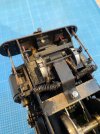
The side view looks like this:
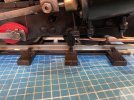
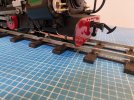
It’s quite hard to see in these views, but out on the line the presence of the pony truck is quite clear as it moves under the smokebox to guide the loco into curves. Time will tell how the roller bearings cope in the longer term, but I am hopeful of minimal wear…..
As there was no possible way for any wheel bigger than 6mm in diameter to rotate in the available space, my first plan (which ultimately did not survive contact with the enemy) was to channel Marklin, prototypical third rail contact shoe practice and Santa Claus by creating a low resistance shoe or sledge, whereby I would cut sections of wheels which would be soldered to a lightly-sprung pony truck and then slide along the rail surface ahead of the driving wheels like a pick-up shoe, guiding the locomotive into curves. I know, I know - what was I thinking?
In terms of the sacrificial wheel needed to create the smaller sections, the correct full diameter needed to be 16mm. Don’t tell @Jordan or Plymouth Mad but the only ones I had in stock were from an old Atlas Plymouth shunter. The tread width was a good match for the other wheels on the loco, but the flange was far too fine. I therefore soldered a steel washer to the Atlas wheel, turned the profile on the lathe to match the Roundhouse wheels and then sawed the wheel into sections.
I arranged for the new pony truck to be sprung laterally and vertically before soldering on the wheel sections. Time for a quick trip out to the garden railway and I fired the loco up, full of eager expectation. The first few laps on a full 8 car load were great - I could see the pony truck leading the locomotive into curves and following any vertical irregularities. But then I found I was having to open the regulator wider and wider to maintain speed. Now my Linda has always been noisy, thanks to the Summerlands chuffer in the smokebox, but this volume was beyond anything I’d heard before and my wife informed me that it was audible from a long way down the lane that runs beside our garden and what on earth did I think I was doing making all that racket? Now I quite like a loud Hunslet-style bark (if you do too, try this video of both Ladies showing the NGG16s how to do it:
but clearly I had a problem. When the engine had cooled down, it became clear that while the pony truck had done its job, the dummy wheels had flats on them that would not have disgraced an HST after a long slide. So much for trying to channel Marklin and third rail practice….
However, the pony truck had worked well….so I thought again and realised that a good theatrical illusion would be to encase a pair of 6mm stainless steel roller bearings within the dummy wheels, so that the friction would be minimised and I would have actual turning wheels on the pony truck, albeit one third of the correct size.
The pony truck now looks like this:
The side view looks like this:
It’s quite hard to see in these views, but out on the line the presence of the pony truck is quite clear as it moves under the smokebox to guide the loco into curves. Time will tell how the roller bearings cope in the longer term, but I am hopeful of minimal wear…..

Jordan or Plymouth Mad
Mid-Western Thunderer
None takenDon’t tell @Jordan or Plymouth Mad but the only ones I had in stock were from an old Atlas Plymouth shunter.

 there's plenty worse been done to innocent, long suffering Atlas Plymouths over the years.
  ...good job so many were made I suppose!!
Incredible trick there with the 'mini' wheels, too.

Like you Jordan I’ve had so much fun with those shunters over the years - whenever Victors advertised a new batch in stock in the mid 80s, I’d jump on the next fast to Paddington, scoot round to Kings Cross on the Circle Line and buy another. Funny how the sun always shone on Pentonville Road in those days, and a Large Logo 50 was always waiting to bring me home (quite possibly with @Brian Daniels in the driver’s seat) - happy days! And those old Plymouth shunters are truly the gift that keeps on giving.

Brian Daniels
Western Thunderer
(quite possibly with @Brian Daniels in the driver’s seat)
Oh I did like driving those 50's on the Oxford-Padd trains, I didn't spare the horses!
AndyB
Western Thunderer
Hi Andy
I’ve had a trawl through my old magazines to see what else I can find about Dick Relph. I suspect this won’t add anything new to what you already know, but there are some references in the Merioneth Society journals to his work on electric control of live steam locos - nothing biographical, however, other than that he started work on the control system straight after WW2 and confirming that he was a civil engineer by profession. There are also three references to him in Sixteen Millimetre Today (the in-house journal of the 16mm Association), but there is nothing biographical. The only other stuff I could find are the two photos below, from the Model and Miniature Railways part work of the early 70s. I’d be interested to know if your researches throw up any new material about him. Good luck!
David
Thanks David. Here is what little I've found so far.
Richard John Kesterton Relph
Born 1909 in Cricklewood to parents Herbert John Relph (Dental Surgeon) and his wife Norah. In domestic service with them was a nurse and general domestic servant.
They lived at 38 Keyes Road - incidentally, only a couple of blocks away from James Carson (Anson Road) and his works on Oaklands Road, but Richard would have been too young to appreciate that at the time!
1921 - now living at 81 Hampstead Way, Golders Green, Richard has a younger sister, Irene.
By 1932 they are in Heathcroft, Hendon.
Having married Daphne Webster in 1937, by 1939 Richard & Daphne were living in Glenfield Close, Finchley. Richard's occupation is given as Civil Engineer and Surveyor employed in municipal works, and that he was in the Auxiliary Fire Service. Still at that address in 1944. Another incidental - not too distant from here lived James ('Uncle Jim') Crebbin, in Finchley.
Presumably he retired in the early-mid 1970's, which, as noted in the article above gave him plenty of time to 'play trains'.
Died 16 Sept 1989 in Milford on Sea, Hampshire, although his home was in Cornwall. Daphne lived another 10 years after that.
I've still not managed to identify Mr Courtice at all.
Andy
I’m pleased with the way that the new tender body and the cabsides match each other. Having as small a gap as possible between loco and tender is important here, as the real Blanche has a very neat arrangement. There is also the flexible tarpaulin-like cover between the cab roof and the tender cab to consider. The challenge for me is that, while most of the curves on my garden line are generous, there is one flange-squealingly tight 5 foot radius curve that sets the minimum for all the rolling stock.
Now the easy way would be to ease out the distance between loco and tender, but that would spoil the appearance. On the closest setting of the existing Roundhouse coupling, the loco and tender look great on straight track, but not so good on that 5’ radius:

Looking at that tight spot in close up, there is no way that this is going to work:

Then I remembered that Roco and Fleischmann had introduced couplings that increased the gap on corners more than 50 years ago, and the UK RTR market had eventually caught up. Might it be possible to fabricate something similar for Blanche? So that became a happy project over the last weekend as a distraction from caring for elderly parents. As I was unsure how successful it would be, I designed the coupling so that it could be fixed into two existing 6BA tapped holes in the rear spacer, rather than create a bespoke mounting for something that might not work in the end. So here is the result of that work:

The gap on straight track is the same, but here is the improvement on the 5’ radius:

So it seems to work - I now have the smallest bit of clear blue water (or cutting mat) on the tightest radius, but the gap closes beautifully as the radius eases. What I can’t yet tell (because the garden line is out of use while the rain continues to pour down) is how well it will work in practice. The current version is made from brass, and while it will have presumably work-hardened during manufacture, the curved surfaces that guide the movement may wear quickly - the trains that Blanche will be pulling weigh 12 - 14kg, which will put some strain on those surfaces. I may need to replace those with steel moving parts. I’m also unsure how well the self-centring will work with a heavy load - I’ve read that some commercial 4mm versions can leave the tender crabbing along behind the loco at an angle. I’ve added a trial spring to see whether that helps - I may well need to use a much beefier spring attached further back, but then the reverser servo will be in the way……when the weather finally improves, I’ll give the arrangement some proper tests (and I can always simply revert to the original drawbar on a longer setting if needed).
Now the easy way would be to ease out the distance between loco and tender, but that would spoil the appearance. On the closest setting of the existing Roundhouse coupling, the loco and tender look great on straight track, but not so good on that 5’ radius:
Looking at that tight spot in close up, there is no way that this is going to work:
Then I remembered that Roco and Fleischmann had introduced couplings that increased the gap on corners more than 50 years ago, and the UK RTR market had eventually caught up. Might it be possible to fabricate something similar for Blanche? So that became a happy project over the last weekend as a distraction from caring for elderly parents. As I was unsure how successful it would be, I designed the coupling so that it could be fixed into two existing 6BA tapped holes in the rear spacer, rather than create a bespoke mounting for something that might not work in the end. So here is the result of that work:
The gap on straight track is the same, but here is the improvement on the 5’ radius:
So it seems to work - I now have the smallest bit of clear blue water (or cutting mat) on the tightest radius, but the gap closes beautifully as the radius eases. What I can’t yet tell (because the garden line is out of use while the rain continues to pour down) is how well it will work in practice. The current version is made from brass, and while it will have presumably work-hardened during manufacture, the curved surfaces that guide the movement may wear quickly - the trains that Blanche will be pulling weigh 12 - 14kg, which will put some strain on those surfaces. I may need to replace those with steel moving parts. I’m also unsure how well the self-centring will work with a heavy load - I’ve read that some commercial 4mm versions can leave the tender crabbing along behind the loco at an angle. I’ve added a trial spring to see whether that helps - I may well need to use a much beefier spring attached further back, but then the reverser servo will be in the way……when the weather finally improves, I’ll give the arrangement some proper tests (and I can always simply revert to the original drawbar on a longer setting if needed).
Last edited:

Tim Watson
Western Thunderer
I well remember Dick Relph giving a talk / demonstration on his locos at Hassocks (precursor to Missenden Abbey). Apart from the remote control aspects, he also discussed how he deliberately made the locos ‘inefficient’ which was evidenced by the very loud chuff they emitted. He was also a very approachable and modest individual.
Tim
Tim