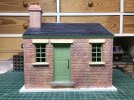
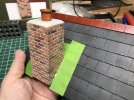
Garden railway in 16mm: Wilmington Light Railway

Greengiant

Western Thunderer
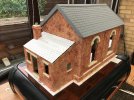
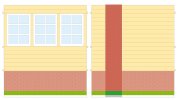
To give me something to do over the winter months, I made a start on the buildings, the first up being the engine shed, so I made a rough mock up to judge size and positioning.
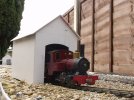
50463918957_8030547fcf_c.jpg

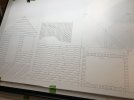
Then on the computer drew up some full scale (16mm) drawings.

50470353876_1b68b13ab5_c.jpg

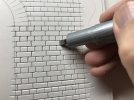
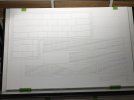
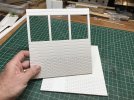
Using these computer drawings, I dug out my old drawing tools from my art college and early paste-up days and set to work drawing the building out on PVC Foamex, this being a new material to me and inspired by the work of Nikki Wilkes, thought I would give it a go. I used a print out of brick courses taped at the top of the drawing board as a measurement guide when marking out the Foamex.

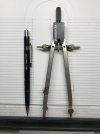
50375133831_c409cde287_c.jpg

50374435173_72fd26a95a_c.jpg

This I embossed and cut with a selection of tools.

50374435228_4a5ac97bc1_c.jpg

50374435193_53b6e455b1_c.jpg

50374435283_c584bb3272_c.jpg

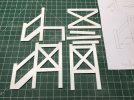
Until eventually I had effectively a building kit of parts.
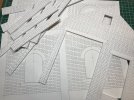
50375303947_f895044557_c.jpg

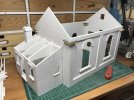
Assembly went quite smoothly and soon took up a lot of space on the workbench.
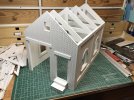
50433074432_24f0134a6b_c.jpg

In my research I came across this superglue used in the double glazing trade, comes in a decent sized bottle and is very powerful, I tried a test piece first and the Foamex broke and not the glue joint.
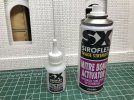
50380435951_4c60bbd782_c.jpg

Martin
 

Greengiant

Western Thunderer
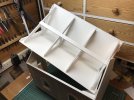
I made a roof with trusses which is a very snug fit into the building and hoping this will hold in place when it gets windy in the garden, if not, I will find some way of fixing in it place.

50433074327_d1e974306f_c.jpg

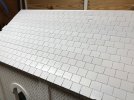
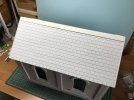
The roof was covered in nearly 800 slates, hand cut and chipped or broken where required.

50432211143_a82cc407c2_c.jpg

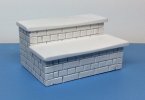
A set of steps for the pedestrian side door was also made, sanding the flag stones to simulate years of wear.

50433073767_e4b8f9be9b_c.jpg

Now in position by the doorway. The first step does look high at the moment, but when on the railway the building is effectively 'planted' in gravel, so the building has 15mm extra added to the wall bottoms to cater for this.

50433074362_5816af8b83_c.jpg

As the build progressed, I felt the end of the shed lacked interest, so a driver and fireman rest was added.

50433074472_1c80b4f82d_c.jpg

Ridge tiles and end boards have been put on the roof.

50470708847_ed84424556_c.jpg

Next I need to start getting some paint applied.

Martin
 

Greengiant

Western Thunderer
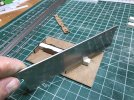
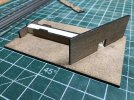
There is need for a cattle/sheep dock on the railway, so one was drawn up on a 600mm x 400mm sheet of 5mm PVC Foamex and scribed.

50432211153_0d246162fe_c.jpg

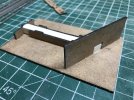
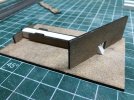
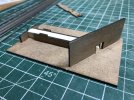
It did not take long to glue the main structure up, again, like the engine shed, this has an extra 15mm depth to the sides to embed it into the gravel.

50432905226_bc84ce4315_c.jpg

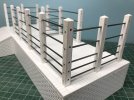
Some posts for the railings were made by laminating some 5mm and 3mm PVC Foamex, then trimming to final size with a bandsaw on it's slowest speed setting.

50433074492_e3f3b52b42_c.jpg

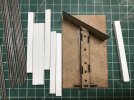
I wanted the posts to have a pointed top, I have some five bar gates on the driveway at home so measured the angle of the pointed tops of the posts which came out as near enough 30 degrees. My mitre saw block only had 45 degrees, so I laser cut a saw and drilling guide to help with batch processing, also makes it a lot easier to hold a post than a mitre block would in this size. The photo shows the laser cut 2mm MDF jig with 30 degree guide and one of the two drilling guides. Also some of the post blanks and a selection of 2mm mild steel rod for the rail, which I am hoping will rust nicely over time.

50489868411_10c240685b_c.jpg

How the jig is designed to work, first a post is inserted up to the end stop, then the first cut is made.

50490016667_3b97153793_c.jpg

Which gives this first cut that gets a few passes with a file to smooth flat to guide.

50490016647_1701bc5905_c.jpg

Then the post was withdrawn and rotated through 90 degrees away from me and inserted back thus...

50489868251_d74df16004_c.jpg

Another cut is made...

50489868291_fddfc0b995_c.jpg

Repeat until the fourth cut...

50489868306_48b9846d93_c.jpg

Eventually I ended up with 15 posts...

50490016672_8d39023af4_c.jpg

Martin
 

Greengiant

Western Thunderer
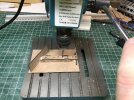
Each post was put in the jig and drilled with one guide, then each one was rotated 90 degrees and put back in the jig with the second hole guide in place and drilled.

50489868386_895dda020b_c.jpg

Ending up with 15 identically drilled posts, what I have not shown is the end stop also had a central hole to drill and tap the post base 8BA so they can be bolted to the main base.

50489868191_efe61bdafb_c.jpg

The posts were bolted to the base, using a pin chuck to set the length of the steel rod to be cut.

50489157428_a7ba9e3087_c.jpg

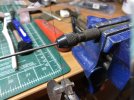
Using the pin chuck as a saw cut guide, the pin chuck was clamped in a bench vice and the rod cut with a piercing saw.

50489868246_009363c7a1_c.jpg

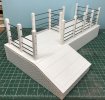
Once complete, all the rods were threaded into the posts.

50489157463_e53ee8df58_c.jpg

50489868156_f181a190ed_c.jpg

Martin
 

Jon Nazareth

Western Thunderer
There is need for a cattle/sheep dock on the railway, so one was drawn up on a 600mm x 400mm sheet of 5mm PVC Foamex and scribed.

View attachment 262380

It did not take long to glue the main structure up, again, like the engine shed, this has an extra 15mm depth to the sides to embed it into the gravel.

View attachment 262381

Some posts for the railings were made by laminating some 5mm and 3mm PVC Foamex, then trimming to final size with a bandsaw on it's slowest speed setting.

View attachment 262382

I wanted the posts to have a pointed top, I have some five bar gates on the driveway at home so measured the angle of the pointed tops of the posts which came out as near enough 30 degrees. My mitre saw block only had 45 degrees, so I laser cut a saw and drilling guide to help with batch processing, also makes it a lot easier to hold a post than a mitre block would in this size. The photo shows the laser cut 2mm MDF jig with 30 degree guide and one of the two drilling guides. Also some of the post blanks and a selection of 2mm mild steel rod for the rail, which I am hoping will rust nicely over time.

View attachment 262383

How the jig is designed to work, first a post is inserted up to the end stop, then the first cut is made.

View attachment 262384

Which gives this first cut that gets a few passes with a file to smooth flat to guide.

View attachment 262385

Then the post was withdrawn and rotated through 90 degrees away from me and inserted back thus...

View attachment 262386

Another cut is made...

View attachment 262387

Repeat until the fourth cut...

View attachment 262388

Eventually I ended up with 15 posts...

View attachment 262389

Martin
I used to order in gateposts many years ago. The terminology for posts that have their tops cut as you have done is called, ‘four times weathered’. Not a lot of people know that……

Jon
 

Greengiant

Western Thunderer
The panelled side door on the main engine shed has been made.

50524217778_2504bbbf49_c.jpg

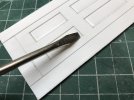
The panels were bevelled using a screwdriver blade.

50524217618_4e6d0864b4_c.jpg

A lean to office window and the two main shed doors are work in progress.

50525106182_ec00c73b44_c.jpg

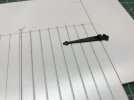
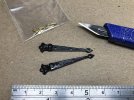
I found some dolls house hinges online, not worth scratch building them for the cost of these. They turned out to be a waste of money and cracked in one day of being on the railway. I will need to scratch build some in brass.

50570360697_80b82de88e_c.jpg

50524217848_2159de88d4_c.jpg

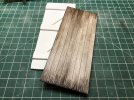
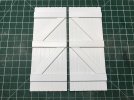
The insides of the doors showing the framing and scribed planks, they all have wood texture scratched in.

50525106347_48a641e54f_c.jpg

A before and after distressing of the lower edge of the doors.

50570360677_7c04322521_c.jpg

Some paint on the outers.

50569477833_7283001f43_c.jpg

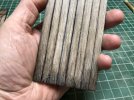
A close up and a hand to give an idea of scale.

50570225441_06e325d769_c.jpg

An inner and outer with more painting still to do.

50570360942_07b09a4943_c.jpg

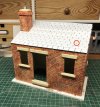
The office now has a roof.

50570225446_d9a0f884b4_c.jpg

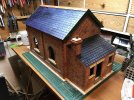
Three colours now on the walls and the main roof in primer.

50569477763_0cced325f7_c.jpg

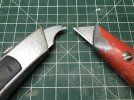
This may be of interest, these are the blades I use for the main cutting. The curved blade does the bulk of the cutting, the straight blade just for nicking into the corners.

50570225591_5ecb32fa73_c.jpg

Martin
 

Bill Campbell

Western Thunderer
Hi Martin

I am a little concerned that the roof on the lean-to is a bit holy - and not in the religious sense.

It looks as though your "slates" are not deep enough in that a gap can be seen between each of the "slates" in the row above.

As a rule of thumb slates should be about 2.5 times the length of the visible part so that the top of each slate is covered by the corresponding slate 2 rows up.

I have highlighted the problem for one example in the photo below:


50570225446_d9a0f884b4_c.jpg

Welsh Slate produce a very useful brochure that can be downloaded for free here:


Regards.
 

simond

Western Thunderer
I’m loving the colours and textures. Does the foamed stay put when embossed or does it have a tendency to spring back, either at first, or over time?
 

Greengiant

Western Thunderer
Hi Martin

I am a little concerned that the roof on the lean-to is a bit holy - and not in the religious sense.

It looks as though your "slates" are not deep enough in that a gap can be seen between each of the "slates" in the row above.

As a rule of thumb slates should be about 2.5 times the length of the visible part so that the top of each slate is covered by the corresponding slate 2 rows up.

I have highlighted the problem for one example in the photo below:


Welsh Slate produce a very useful brochure that can be downloaded for free here:


Regards.
Hi Bill,

You are indeed correct. I cut them short in an effort to save material cost, once painted it does not show. On later models I switched to using black PVC Foamex and plasticard, also tweaking the join lines I cut.

Martin
 

Greengiant

Western Thunderer
I’m loving the colours and textures. Does the foamed stay put when embossed or does it have a tendency to spring back, either at first, or over time?
Thank you. The PVC Foamex embossing has stayed put for the past three years so far. I know some people score any lines with a scalpel first before embossing, I have not found the need to do this, maybe I am pushing harder.
Martin
 

Greengiant

Western Thunderer
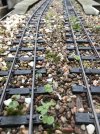
Have done a line inspection and found plants growing on the track bed.

50702144676_f94fe8e563_c.jpg

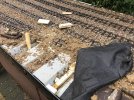
Further along the line we have had overnight visitors!

50702216696_cb7d2bd25b_c.jpg

My Mum recently threw out an old mini greenhouse, the frame poles of which can support some protective nets for the time being.

50702144771_ac43eccbb8_c.jpg

Martin
 

Greengiant

Western Thunderer
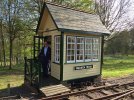
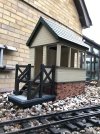
As a bit of light relief from the engine shed, I have made a start on a signal box, this is a mash up of the two boxes on the Bredgar & Wormshill Light Railway, both of which I have operated.

The box at Warren Wood...

50702963481_ffdc838e0b_c.jpg

The box at Stony Shaw, that's me in the doorway...

50702963366_5d92e5a9db_c.jpg

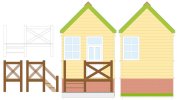
My drawings to work out all the sizes.

50701402478_2919a5d315_c.jpg

50702143771_067c2b0a5c_c.jpg

50701402363_c1783596d3_c.jpg

Some of the parts drawn and embossed.

50702144346_9d02ee7738_c.jpg

The front wall cut out from 5mm PVC Foamex.

50701403198_c9ea89dec3_c.jpg

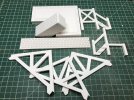
Some parts for the steps and verandah cut from 3mm PVC Foamex, which will later have 2mm laminated both sides in places to give a thicker timber look to the posts.

50702144721_faa9b8c4f0_c.jpg

The chimney coming together, made from 5mm PVC Foamex.

50702144506_d62facf826_c.jpg

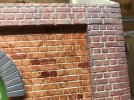
Here can be seen some of the laminated stairs sides, the roof trusses, the rear of the chimney, the chimney top and the brick edged concrete base the stairs and veranda sit on.

50702144766_5f500de3ee_c.jpg

Starting to put things together in this picture. Inside can be seen the stove and the scribed and painted floor, along with the inner scribed walls, most of which is a waste of time because from the normal viewing angle you will not see it, but at last I know it is there!

50701403228_eb5d052365_c.jpg

A better view of the wood burner and warming plate for those cups of tea.

50701402873_daab91455e_c.jpg

I made a mistake with the roofing trusses, so had to put a small packing piece in and file to shape so that they sit correctly on the wall tops. PVC Foamex is very forgiving, easy to superglue a piece in, then cut and sand to shape.

50702144281_0381ba4993_c.jpg

I have painted the walls, inside and outside with an initial coat, you can just see the roof trusses from this angle. The basic roof structure is now made and is a sliding fit into the walls. Currently I am cutting the roofing slates from 30thou styrene, then the roof with the upper chimney can be finally assembled.

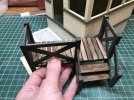
Next I will make up the stairs and verandah and make a start cutting out the windows and door.

50701403093_25aeb853c1_c.jpg

Martin
 

David Hall

Western Thunderer
Martin,

What a wonderful story you are telling. It's absolutely fascinating. A mix of heavy engineering and modelling techniques we are used to seeing indoors, just scaled up for (very!) big trains!

I'm very much in awe of your work.

I look forward to seeing where you take this. Thanks for sharing.
 

Greengiant

Western Thunderer
Martin,

What a wonderful story you are telling. It's absolutely fascinating. A mix of heavy engineering and modelling techniques we are used to seeing indoors, just scaled up for (very!) big trains!

I'm very much in awe of your work.

I look forward to seeing where you take this. Thanks for sharing.
Thank you, most kind of you to say.
The work of Henry Holdsworth and his Lynbridge layout first got my interest into finescale 16mm modelling as teenager. It has been an itch waiting to be scratched for many years. There is a lot of potential for 16mm finescale, rather like the shunting plank, boosted 7mm modelling many years ago. You do not need much space to have fun and the locos have a lot of space for batteries, speakers, smoke effects etc.
Resin 3D printing has made fantastic advances in model figures. I am not a fan of the cartoon type figures seen on lots of garden railways, but accept a lot of people find them fun, the same with some buildings.
I have a lot of catching up to do in this thread to get it right up to date.
Martin
 

Greengiant

Western Thunderer
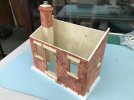
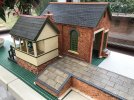
The engine shed, signal box and cattle dock are coming along now.

50852658433_bff652f667_c.jpg

The cattle dock has now been going through the second stage of painting blending the colours together, a WIP photo.

50852658398_283aeef699_c.jpg

The same with the loco drivers rest room, just half a wall to do.

50852658388_895e584557_c.jpg

The engine shed gets the same treatment.

50852658428_20903bf49b_c.jpg

50852658438_ea6658e028_c.jpg

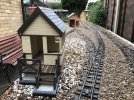
Once this stage had been completed I 'planted' the office on the railway to get a feel for how it was looking outside.

50853382026_ed5fa0b541_c.jpg

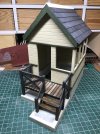
Signal box is now on the second stage.

50853381956_023b7b7614_c.jpg

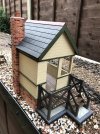
Chimney stack coming along.

50853381971_3b7ee929d3_c.jpg

Martin
 
Top