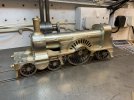
Hobbyhorse. Some more work on the Stirling Single

Hobbyhorse

Western Thunderer
Time to get on with fitting all the technology.
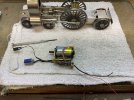
The sounds sound file I’ve chosen for the Stirling is from Rapido, used on their 4mm model. The chip is the 21 pin version 5 from ESU. Designing the DCC fitting has been part of this build from the start which was different with the original build as DCC was in its infancy, and very much an afterthought without any sounds. Using this chip with the adapter board has the benefit of being able to remove the chip easily without any unsoldering, with only the stay alive connected directly to the chip. The adapter board has mounting holes, this was fixed on some brass box section to raise it away from the chassis and mounted below the motor.
55033511749_a965c7861a_b.jpg

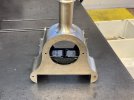
The twin speakers fit neatly into the smokebox with a small connector to the adapter, and mounted on a plate which is removable from the smokebox.
55033253466_a6b766c122_b.jpg
55033511709_0d8461e828_b.jpg

Thoughts at the moment is to have the pickups in the tender, the original models used the American system which in hide sight was a mistake. Picking up from all wheels on the tender should be adequate.
Generally fitting any DCC equipment can be a bit of a challenge, especially with most kits which are not designed or having much space available, but this model has been fairly straightforward other than the chip initially not excepting the CV changes to activate the stay alive, after interrogating with JMRI it sprang to life.
55061552951_8e5cd88e5c_b.jpg
55074041548_a0e8c75eb1_b.jpg

The short video shows the basic setup of the chip just to check all functions ok, once the tender is built and wired up the final setup will be completed and the sound levels set. Click on the link to see the video.
DCC testing Stirling

Simon
 

Hobbyhorse

Western Thunderer
With the major body bits completed on the loco its time to start the detail parts, these are somewhat fiddly and time consuming but give the loco its character.

Starting with the small trailing wheel splasher just ahead of the cab.
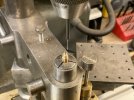
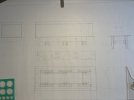
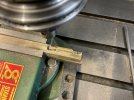
I’d made a fixture to turn up these parts by machining a cap that was the diameter of the splasher and fixing it to a mandrel, luckily I had enough space on the fixture from the first build so it was just a case of marking up and cut off the bits on the mill, and with a couple on mounting plates the part was added to the running plate.
55060650232_8c94c4842f_b.jpg
55060650292_fdfdb11729_b.jpg
55061552641_c821fb5dc5_b.jpg

Next the sandboxes which are quite prominent just ahead of the the driving wheel splasher together with the brass beading around the splasher, quite a few smaller details will be added to the sandboxes but that’s for another day.
55061729773_2f2ebf1f7c_b.jpg
55061552681_e1a7f3237d_b.jpg

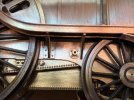
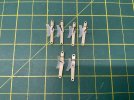
Lastly for this update the small steps on the running plate in front of the splasher, made from 4 parts which are extremely fiddly to apply but after a long session there on.
55060650162_34e7ec639c_b.jpg
55088515296_f1810af187_b.jpg

Simon
 

Hobbyhorse

Western Thunderer
I rely on the various machines in my workshop and when one has issues I try to resolve it quickly. So when my Schaublin 70 lathe began tripping the house RCD it was time to investigate the problem, as the household management was not impressed.

I’ve had it a while as it came with a business I acquired, manufactured in 1967 it’s well built and very heavy and has done some work but is extremely accurate and fairly fast at 4000 RPM. The motor is 3 phase and large at 3HP, and being an industrial machine it’s built to run for long periods. After doing some investigating it would appear that the motor is at fault, as I fitted a small 3 phase converter rated for the motor, but unfortunately modern converters have issues with older type motors over a period of time.

Original motor in place
55122650738_497f8531c9_b.jpg

So the starting point was to try and replace with a new Schaublin motor, that was quickly dispelled as the cost was eye watering and difficult to obtain.

Old motor removed, not easy as quite heavy and restrictive access in the lathe
55122650798_299ec02264_b.jpg

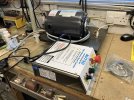
I had another motor/controller combination in mind as I’d used one before upgrading a friends lathe, it’s marketed for Myfords and Boxfords. But the benefit is the controller is pre configured to the motor, so a simple fit. The down side is its only 1HP and a slower motor with a smaller drive shaft diameter. As the clutch and belt arrangement is very free running on the lathe I’m not concerned with the power output on the new motor, it’s not going to run continuously so wouldn’t overload it. But achieving a similar top end speed is important, and as a new drive pulley is needed I could make a new one larger to get closer to the old top speed.
55121568312_15939f1433_b.jpg

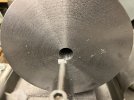
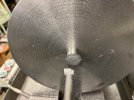
Like most of us I’ve collected bits and bobs over the years, and found a un-machined large chuck back plate. Some quick calculations showed that with this machined to the largest diameter this would give speed of around 3600 RPM, which I’m happy with.
55121568302_e0ed7110b9_b.jpg

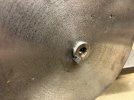
Machining the new pulley did take a bit of time as the casting had a thick hard skin, but using a selection of different tools the basic shape came out OK. Boring the shaft to size was straightforward. The pulley is fixed to the shaft with a key and a couple of locking screws, as a don’t have a key way cutting broach a different approach was required. I’ve used the Myford lathe in the past, so I ground up a tool to cut the key way and cutting small amounts using the carriage winding in and out produced it.
55121568307_9e2ee10a2d_b.jpg

Boring to shaft size.
55122650803_b7eb338161_b.jpg

Testing hole with shaft gauge.
55121568297_fbec392472_b.jpg

Machining the V for the belt.
55121568262_bb47ca519d_b.jpg

Cutting Keyway.
55122650823_480bfb6dbf_b.jpg

Test fit on motor shaft.
55122704684_de9a89d7de_b.jpg


The new motor has rubber bushes on a mounting plate, and as the holes on the plate didn’t match those on the machine. I used the machine ones to fix a steel plate to, this in turn had the new motor fixed to it. The new motor is fairly heavy and with limited access inside the machine and I couldn't get it inside to get the fixing position correct, so the motor was removed from the mount plate and the new pulley was used with a jig to establish the position. This was easily achieved and to tension the belt the weight of the motor pulling it self down on the mounting slots fix this.

Mounting plate in using original fixing points.
55122704764_e97945e867_b.jpg

Jig being made.
55122650658_972ed6fb69_b.jpg

Jig fitted to to set motor fixing points.
55122704634_0f66792027_b.jpg

Motor fitted, just need to fix the wiring into position.
55122704629_6045e6c6ba_b.jpg

The control unit was fixed to the front of the lathe, and testing found the top end speed to be around what I’d estimated. This has been a good little project that’s got the lathe up and running. And it’s actually quite nice to machine some big lumps, as the majority of my bits are tiny in comparison.
55122704689_b306a1ef0e_b.jpg

Simon
 

Hobbyhorse

Western Thunderer
With the lathe working well and after a bit of a break, I’ve managed a few hours in the workshop.

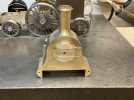
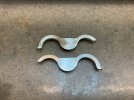
Starting with the smokebox door, this I’d already made so it was just to add the hinges, which basically is just a couple of strips and a few turnings.
55087628507_898624e17a_b.jpg

The other part made is the cylinder front with the bolt details.
55088515356_c34d0a4cbf_b.jpg
55087628812_58847fb29e_b.jpg

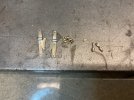
Quite small details for the hex nuts are machined onto some nickel silver rods, with minimal solder used to fix to the front plates.
55088778444_f3fd2b5862_b.jpg
55088721073_39fa5002c5_b.jpg

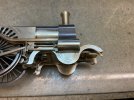
The bogie splashers are fiddly to assemble with three parts for each one, these screw into the cylinder block with a couple of 10BA fixings.
55087628732_21269f5157_b.jpg
55088721528_18458a51fc_b.jpg[/url]
55088721433_f5514c3c4d_b.jpg
55087628352_a0c0e21914_b.jpg
55087628417_c9b330a735_b.jpg

Clearance is an issue but I’ve just fixed them into position and will return to them once a lot of the other bits and bobs around them are added.

Simon
 

Hobbyhorse

Western Thunderer
Moderling time is at a bit of a premium at the moment, but I’ve managed to complete the handrails and the brake rigging.

The handrail is fairly straightforward with a joint on the smokebox represented with some brass tubing.
55214874414_14e375abb6_b.jpg

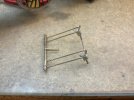
The brake rigging is quite delicate and well detailed which I had most of the parts to hand, with only a few other bits to make.
55087628542_a38c095939_b.jpg
55088883935_6efa3f96c2_b.jpg

Again adding extra details was achieved on the rear brake fixing and the loco brake hanger.
55088884170_cf7da37c87_b.jpg
55087628877_20c7c01646_b.jpg
55087628302_1572dd9d82_b.jpg55088779279_378e997090_b.jpg
55088884150_aeede4ef3c_b.jpg
55088721478_a289c8d322_b.jpg

And for comparison along side together.
55088779319_6e8e281e39_b.jpg

Well I’m happy with the progress so far and still a lot of details to add. The plan was to start on the tender, that was until a friend suggested why not do the new version currently attached to No1 . So if I can obtain enough information I could be persuade to do it.
While I looking at tenders Its a good opportunity to do some work on another project, Its not O gauge but 16mm. If you would like to see what I’m doing it can be found on Wester Thunder under Scratch Building Darent in 16mm. [

Simon
 

Hobbyhorse

Western Thunderer
Lovely stuff Simon.

Did you change the way you did anything compared to the initial builds?

Best regards

Tom
Thanks Tom,

Having more specialist tooling has made machining a lot of the parts easier, although most of the parts date back to the initial build. I'm amazed how well the parts were made 30 years ago.
The parts that I'm remaking to add the extra details do have a crispness that certainly shows.

Simon
 
Top