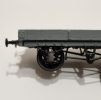
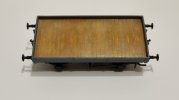
Liver & Fry's workbench

GER lowmac 'Mac K'
  • Liver & Fry

    Western Thunderer
    To start things off, here is a wagon build I undertook in January 2023 during some downtime between night shifts.

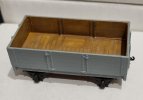
    It is a GER lowmac (later Mac K), using the Dapol lowmac kit as a starting point. The Dapol kit is based on the BR built 'Mac K' lowmacs which themselves were built to a GER design incorporating Diagrams 25/50/75 between 1886 and 1914. This gave me the perfect starting point for a kit bash that would give me another GER wagon.

    The starting point for this was to prepare the wagon sides; namely removal of the axleboxes and fitting appropriate GER ones. This was done using a dremel and by making a makeshift guard out of plasticard the slot around the axlebox, allowing me to sand back to a level without damaging the rivet detail on the original mould. The moulded bearings were then drilled out to take brass bearings. This process is demonstrated below:
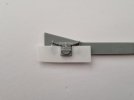
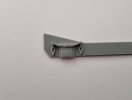
    20230123_140323.jpg
    20230123_142249.jpg
    20230124_093807.jpg

    Other erroneous details were also removed as part of the preparation process.

    The kit was then built "as intended", following the instructions provided, with the exception of fitting a brass coupling hook and whitemetal buffers that are of a greater quality than those provided by Dapol.
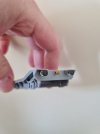
    20230124_132938.jpg

    Having built the kit, I then fitted the new axleboxes. These are GER Type E axleboxes salvaged from a spare Oxford Rail GER van chassis.
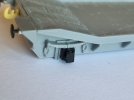
    20230124_152946.jpg

    One of the main visual differences between the original GER wagons and the later Mac K's is the orientation of the planks on the deck; on the later wagons, as represented by the kit, these are horizontal but on the GER examples these were longitudinal. To rectify this on the kit, I sanded down the raised moulded details on the deck and used Evergreen 2mm plastic strips (1.5mm for the outer edges), cut to size and laid plank by plank on the deck of the wagon. I then created and fitted some wire tie down loops using a technique I discovered in this handy video:

    This was the result of those efforts:
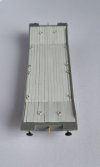
    20230126_112307.jpg

    Some final details were added and Alan Gibson wheels were fitted, meaning that the building aspect of the project was now complete:
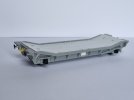
    20230126_110825.jpg

    All that was left was to paint and add lettering, using Powsides presfix transfers (a fiddly job for the smaller letters and numbers!):
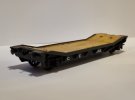
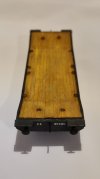
    20230130_181034.jpg
    20230130_181250.jpg

    Weight in the form of Liquid Gravity was added underneath, although it is my long term intention to build and add a load, such as a stationary engine, to aid this.

    I have to say I'm quite proud of what I achieved! It was my first foray into learning how to paint a realistic wood finish and this is something I've continued to develop and enjoy as the year has progressed (In fact, my current wagon builds, a pair of Jones Highland Railway opens with sheep flakes fitted, were chosen so I had an excuse to paint some more wood!).

    Let me know what you think!

    - James
     
    Achieving a wood effect
  • Liver & Fry

    Western Thunderer
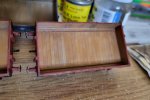
    So, as a nice segue from the lowmac build, one of my main take aways from said build was that of learning how to achieve a painted wood effect (after all, you kind of have to learn when the main surface and visual focus of the wagon is a wood deck!).

    As such I revisited a number of open wagons I'd previously worked on; these included two kit built HR Jones open wagons (Mousa Models) and two reworked NB jubilee wagons from Oxford Rail. Originally I had painted the insides of these wagons with a generic "wood" colour, but this lacked any tonal variation and the shade was far too golden. It did (and does) however make for a great base colour to build up from.

    My method involves drybrushing; first applying a patchy layer of earth brown, focusing on crevices, corners, plank gaps and the like. This is followed by a more generalised layer of a sandy yellow/brown (I've actually been using a tin of loco tan!) to lighten the overall tone before finishing with highlights of light grey, owing to the fact that sunlight bleaches wood to give it a silver sheen.

    This results in the effect seen below:

    20230806_102936.jpg
    20230806_102628.jpg

    Hopefully this offers a little insight for anyone wondering how to approach this same challenge!

    - James
     
    GER covered goods vans
  • Liver & Fry

    Western Thunderer
    Right, strap in because this one's potentially a long one!

    In early 2022 Oxford Rail brought a ready-to-run model of the GER Dia.72 covered goods van to the market. This naturally peaked my interest and so I purchased six of these, plus two of the later LNER banana vans, in order to see what I could do with them and how many variants I could create.

    Straight out of the box, we are presented with this:

    20230927_210145.jpg20230927_210205.jpg

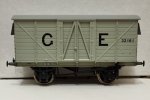
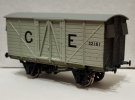
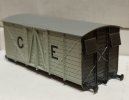
    For all intents and purposes, this is a faithful recreation of the van in question. However, two errors are immediately noticeable: the ends of the van are too light (they should be slate grey) and the sole bars are black, whereas they should be French grey like the bodyside.

    So, my first reworked van is simply a corrected version of GE 32161:

    20230927_212435.jpg20230927_212506.jpg

    For this I used Phoenix Precision P505 and P506. Keeping the "as released" running number meant I could paint around, and thus keep, the running number on the solebar.

    Next up, some body swapping! The Dia.72 vans were introduced in 1911 and were a 19ft long version of the earlier Dia.47 of 1903, which was almost identical aside from being a whole 3 inches longer. In 4mm scale this equates to a 1mm discrepancy which is unnoticeable and thus something I'm willing to accept if it provides wider variety in my fleet.

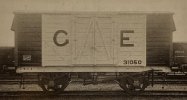
    With that in mind, here is a photo from 1st September 1910 of Dia.47 GE 31050 (Credited to Peter Tatlow):

    20220222_183846.jpg

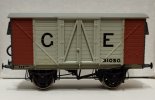
    This particular example was fitted with vacuum brakes and carried a special livery that incorporated red oxide end panels to denote this feature.

    The diagram of banana van also released by Oxford Rail was based on the Dia.72, except these vans were all fitted with vacuum brakes and had no end vents and thus this presented me an opportunity; by swapping the bodies of a Dia.72 van and a banana van, I could add two more variants to my GE van fleet.

    First up is my take on GE 31050:

    20230927_210020.jpg20230927_210818.jpg

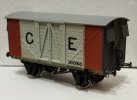
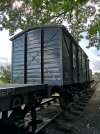
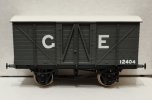
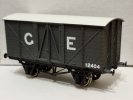
    Of course, this body swap meant I was also with an unfitted, unventilated van. Enter GE 12404, now preserved on the Mid Suffolk Light Railway:

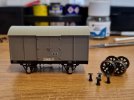
    IMG_20190818_153658.jpg20230927_212919.jpg20230927_212820.jpg

    Being unventilated means GE 12404 carries GER slate grey as opposed to the French grey bodysides seen on the other examples. The GE lettering and numbering was done using Powsides presfix transfers.

    Finally we have GE 31612:

    20230927_212945.jpg20230927_212700.jpg

    This is another bodyswap to create a further vacuum fitted example, except this time the van carries the post-1912 livery for fitted vans, whereby the red ends were replaced by a large V. It's less aesthetically pleasing than the earlier livery, but I included it to complete the set and have one of each, so to speak.

    Of the original eight vans purchased, three Dia.72s and both banana vans have been used to create four different variants of GE van. One of the spare chassis donated its GE axle boxes to the lowmac build previously discussed. Two Dia.72 vans remain "in store" for whenever I decide I want to model yet more vans. So what of the final unaccounted for Dia.72 van? Well, the body from this was cannibalised for another project. Stay tuned for Part 2 to find out more...

    - James
     
    GER gunpowder van
  • Liver & Fry

    Western Thunderer
    So, what's the logical follow upto a thread about GE vans? Why, another GE van of course! But this one is a bit more involved...

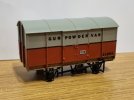
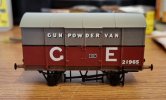
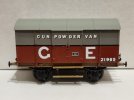
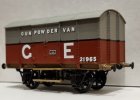
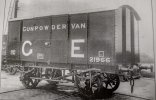
    The subject of this entry is the Dia.62 gunpowder van. 18 of these were built between 1909 and 1914 and they were finished in a rather colourful livery (as many gunpowder vans seem to have been - E.g the GNR vans).

    Screenshot_20230912_160645_WhatsApp.jpg

    These vans bear a striking resemblance and dimensional similarity to the later RCH design as produced by Rapido and so it made sense for me to see what I could make of one...

    20230324_105808.jpg

    Initial work would include removing the buffers, removing the brake gear on one side of the wagon, removing the lamp irons on each end, removing the wheels, sanding off the lower door locks, sanding off the surface detail of the axleboxes and reprofiling these so they angle inwards towards the top (I had no way of representing an X type oil axlebox but I figured removing the offending features and getting the profile correct was good enough), removing the printed bodyside detail (bar the warning notice which is a raised feature and a detail I'd like to try keep) and sourcing some GER buffers from the spare sacrificial Oxford Rail van:

    20230329_161044.jpg

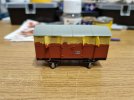
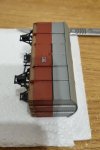
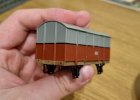
    I then masked off the bodyside in order to repaint the lower half. The building of the Dia.62 vans coincided with the GER changing their livery for gunpowder vans. This was now to feature a "light grey" upper half and a red oxide lower half, separated by a black line, with chocolate solebars and bufferbeams. I struggled to pinpoint what constituted as "light grey" given contemporary photographs show this to be much darker than the usual GER light grey (French grey as used on ventilated stock) and so I simply kept the original colour used by Rapido:

    20230403_204511.jpg

    I then began to line the bodyside:

    20230413_210141.jpg
    20230417_214230.jpg

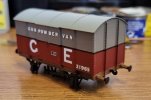
    Another interesting aesthetic feature (and something new to me from a modelling perspective) is that the words 'GUNPOWDER VAN' and the running number were white, shaded in black (whilst the G E was done in the standard white style). In order to replicate this, I started by lettering in plain black and then adding white lettering over top, offset to achieve the desired affect:

    20230424_215310.jpg
    20230513_160831.jpg20230513_160657.jpg

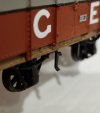
    By this point I had also fitted the buffers. The next challenge was the footsteps that adorned either side of the van; step brackets were made by folding thin strips of brass and the footboards were made using cut down planks from a plastic fence kit. the planks however had a triangular shape to the rear and so the brackets had to be shaped suitability so that the uper face of the footsteps would sit on the level:

    20230910_203042.jpg
    20231005_203750.jpg

    And with that, the project was deemed complete!

    20231005_205311.jpgScreenshot_20230912_160531_WhatsApp.jpg

    Hopefully mine bears enough of a resemblance to that which it's meant to represent! I would later use the lessons in shading to tackle a quirky private owner wagon that had been on my wishlist for some time, but more on that in a future update!

    - James
     
    A loco for the L&FR
  • Liver & Fry

    Western Thunderer
    Whilst I'm busy populating my thread with GE modelling projects, some of you are probably wondering "But aren't you called Liver & Fry? Where's the Lynn and Fakenham modelling?". Well, for starters, there is little to no L&FR stock available on the market, meaning most things would have to be scratch built or at the very least designed on CAD for etching or 3D printing. And secondly, my soldering skills are currently non-existent and so the ability to competently built from scratch is, well... Let's just say it's going to be a little while before you see anything that meets the L&FR criteria.

    That said, I do have one item in my collection that qualifies and its actually a locomotive!

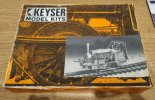
    20231009_215349.jpg20231009_215445.jpg20231009_215654.jpg

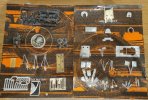
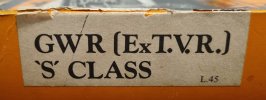
    It's a TVR (later GWR) S class by Keyser Model Kits. What's the relevance to the L&FR I hear you ask? Well, time for a history lesson!

    In 1878, Wilkinson and Jarvis, the contractors of the L&FR, took delivery of Hudswell, Clarke & Rogers No.183. This was followed by Works No.192 in 1880. The former was named 'Alpha' whilst the latter was named 'Vici'. These locos were used by the contractors during construction of the line until 1881 when they passed into L&FR stock proper, becoming Nos.4 & 5 respectively, but retaining their names (the only locos to do so after the L&FR was amalgamated into the Eastern and Midlands). The link? The S class (as depicted here) were almost identical to the L&FR pair, bar a different smokebox (circular on the L&FR engines) and different buffer casings. This means that, remarkably, I effectively have a kit for an L&FR loco! I'm yet to decide if this will become 'Alpha' or 'Vici', but I'm leaning towards 'Alpha'. Aside from the interest of it being the first loco on L&FR metals, I've found there are far more photos of that loco than that of 'Vici'.

    Both were delivered in "green" with black lining, bordered on both side by white. This is the same as later locos built for the L&FR and so it is fair to assume that the green used was also the same shade, especially as the first locos built for the L&FR, the 4-4-0 tank engines ("B Class" under later M&GN parlance), were also built by Hudswell, Clarke & Rogers. The L&FR shade has been described by R.S. McNaught, and latterly Bob Essery and Nigel Digby, as "Great Central" green - I.e a mid chrome green. The only uncertainty is whether the contractor engines carried what was to become the full L&FR livery by having brown underframes (a shade described by Alan Wells as approximating to "Venetian Red" as used by the Midland, who called said shade "Chocolate"). I've found no reference to confirm or deny the use of brown frames for 'Alpha' and 'Vici', only what later (L&FR proper) locos carried. Discussion on this is welcomed!

    And so, whilst not yet built, I can claim to have something in the pipeline that fits with the intended criteria! Now to work out how to source the rest of the fleet...

    - James
     
    Last edited:
    English Oilfields Ltd
  • Liver & Fry

    Western Thunderer
    Continuing on from the lessons learnt in shaded lettering (see #28) I decided to model a quirky footnote of local history.

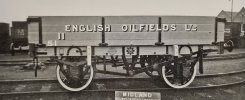
    Did you know there used to be an oil refinery in Setchey, Norfolk? In 1918 'English Oilfields Ltd' was established to mine a known seam of oil bearing shale on a site bordering the A10 in the vicinity of what is now 'Beers of Europe'. The venture, fronted by a Dr William Forbes-Leslie, saw its capital increased to a ridiculous £1.5 million by the AGM of 1919, based on positive initial samples and promises of a further 2,000 million tons of shale in the ground. However, the whole venture was a massive fraud; the initial samples had been "salted" with Pennsylvania crude-derived oil and the shale oil later extracted in 1921 was found to have a sulphur content of 8-9% vs the industry accepted 0.25% meaning it had no commercial value whatsoever. Understandably the company rapidly saw a massive decline and the shareholders lost their money. That is except for Dr Forbes-Leslie who ran away to Somerset with his new found fortune... (He was later arrested for trying the same scam again).

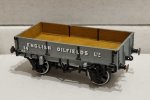
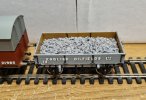
    So what of the wagon I've modelled? Well, to serve the new refinery, a long siding was built from Clarks Drove on the mainline to King's Lynn, across the fens to Setchey. 10 wagons were built by the Midland Railway Carriage and Wagon Co. and numbered 11-20 (a common practice made to make wagon fleets look bigger than they were). It is believed that these were to serve the refinery by moving freshly mined shale from the pits into the facility. In the end, it appears the majority of their use within E.O.L was for the extraction of gravel, which is all the site became good for following the collapse of the oil extraction side of the business!

    20230905_212557.jpg

    My interpretation is based on a Mousa Models kits of a Midland D.305 3 plank wagon, as the nearest "that looks the part" 3 plank wagon I could source. This was built as intended but painted and lettered to represent No.14 of the fleet. I also added the battens to the solebars that prevented the doors hitting the running gear beneath, aswell as a removable gravel load.

    20230905_212005.jpg
    20230912_200448.jpg

    It's a quirky addition to the collection that I couldn't resist given the story behind it and the fact it is also a local tale.

    Until next time...

    - James
     
    Highland Railway open wagons
  • Liver & Fry

    Western Thunderer
    For once I have a live modelling update!

    I'm currently working on a pair of Highland Railway Jones open wagon kits by Mousa Models and I figured I'd share my solution for adding weight to the wagons.

    20231109_203843.jpg

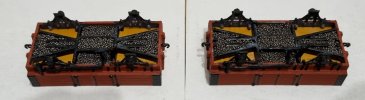
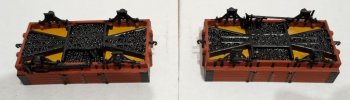
    Liquid Gravity! Poured into the recesses of the wagon's frame and doused in glue, this sets like stone and sufficiently increases the weight of the wagon in a balanced manner without affecting the appearance of the vehicle.

    For extra adhesion/sealing (and for aesthetic purposes if someone were to see the underside of the wagon) I then give a top coat of black paint to match the frame.

    20231110_182716.jpg

    This probably isn't revolutionary but I felt I ought to post an update about something I'm actually working on rather than going through my back catalogue projects!

    - James
     
    GNR open wagons
  • Liver & Fry

    Western Thunderer
    Time for a live update!

    Having finished the last of my Mousa Models Highland wagon kits, I felt like change was needed, so my next build brings me back south to Great Northern territory.

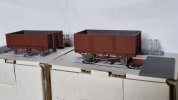
    These are another pair of Mousa kits representing a standard Dia.1 4 plank wagon and a Dia.24 5 plank mineral wagon. I find if I have wagons from the same company, it's easier to batch build them and do all the painting in one go; that and I've got quite adept with these kits and so am able to build them quickly and efficiently, meaning I can clear two more off the long list of things to build!

    20240114_122904.jpg

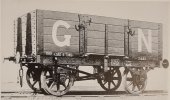
    The Dia.1 was an integral part of the GNR wagon fleet and so it made sense for me to own at least one but my acquisition of the Dia.24 was accidental and I had to refer to Tatlow to identify it. Thankfully, there is a nice clear photo as seen below:

    20240114_164649.jpg
    (LNER Wagons Volume 1, page 33, credited W.O.STEEL CTY. R.J.ESSERY)

    If nothing else it adds some variation!

    Now, it's my understanding that the entire bodyside of GNR open wagons was painted brown, with only the ironwork below the solebar (and buffer casings) being painted black, but the photo leads me to question if mineral wagons were an exception this rule? Or if it's simply the effect of a metal surface reflecting more than wood? Any thoughts or discussion on that would be appreciated!

    In the meantime, I'm off to paint the first coat of the interior/floor...

    - James
     
    Great Central D.8 wagon
  • Liver & Fry

    Western Thunderer
    With the GN wagons temporarily on hold and me finding myself with a little bit of free time in the coming week or so, I've started another wagon build. This time its a GCR D.8 5 plank open wagon, again by Mousa Models (I'm nearly at the end of my Mousa kit pile...)

    20240227_203552.jpg20240227_203716.jpg

    This should be a quick and easy build so watch this space in the coming days!

    - James
     
    GER covered goods vans
  • Liver & Fry

    Western Thunderer
    OK, so I might have found something else to do instead...

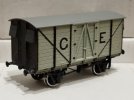
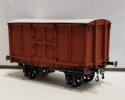
    There's a photo that was posted on the GERS members forum a while back showing GER van No.32379 in what appears to be a staged ex-works view. The van has been embellished with white tyres and black ironwork on the bodyside - Not a common feature on the standard livery for these vans, but, an excuse for me to make something of the final Oxford Rail van I've yet to find a use for...

    This'll be quite a quick job (well, until I have to pick out the ironwork...) and so far this afternoon I have already corrected the Morton brakes, repainted the solebars on the chassis, removed the bodyside numbers and repainted the ends of the van as seen below (glistening because the paint is still wet)

    20240312_221042.jpg

    Oh and I've also been working on something else today alongside this, but more on that tomorrow!

    - James
     
    Last edited:
    GNR open wagons
  • Liver & Fry

    Western Thunderer
    Another job done!

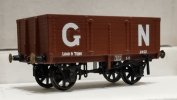
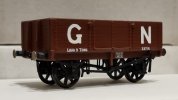
    With the most welcomed assistance from @Overseer (thank you once again!) who kindly made up and provided me with a set of correct/appropriate GNR wagon transfers, I have finally been able to finish off my pair of GNR wagons:

    20240313_201125.jpg
    20240313_201258.jpg

    I'm really pleased with how they've turned out and the correctly proportioned GN on the Dia.24 really makes the difference compared to my, er, bodge that I'd attempted previously!

    - James
     
    GER covered goods vans
  • Liver & Fry

    Western Thunderer
    Progress has also been made on No.32379 since yesterday, with the chassis being refitted, the tyres being painted white and a start made on the fiddly task of picking out the bodyside ironwork in black... One side has been done so far, but I couldn't resist a photo!

    20240313_213306.jpg

    I'll do the other side tomorrow and then I'll likely do the numbers on Saturday.

    - James
     
    HR Jones 8T Goods Van
  • Liver & Fry

    Western Thunderer
    Hi all!

    I was taking a short pause from modelling after my run of wagon building previously, thinking I'd start something new after the York show, but, I found myself with little to do last night and so I've started on something I've been keen to build - A HR Jones 8T goods van.

    This was a fortuitous find on a well known auction site, consisting of a resin body, some MJT W-Irons and some white metal components (HR buffers and axleboxes). The resin body is, I believe, a product of the Highland Railway Society.

    So far I have cleaned the body and painted it in an undercoat of grey:

    20240326_211253.jpg

    It seems to be a straight forward build, but I'm also in no rush to finish this one. I want to take my time learning how to put W-Irons together and making sure I get it right. Probably sounds silly, but it's all new to me!

    - James
     
    Midland D.299
  • Liver & Fry

    Western Thunderer
    Whilst digging out the soldering iron the other day, I managed to find the box for the Slaters D.299 I previously built which contains the transfer sheet with Midland numberplates on. As such, one of my Bank Holiday Monday modelling jobs has been to finish off the Mousa kit I recently built:

    20240401_201127.jpg

    The number was selected on the basis that that's the one they used on the box!

    - James
     
    HR Jones 8T Goods Van
  • Liver & Fry

    Western Thunderer
    The main focus for the day however has been Highland stock - plural!

    I've made a good amount of progress over the weekend on the Jones van, having picked up some wagon springs and (cosmetic) drawhooks at the York show on Saturday. These have been fitted, along with the axlebox covers provided in the kit. I've then painted all the ironwork black accordingly:

    20240331_210625.jpg
    20240401_211354.jpg

    It's really starting to look the part I think! There's just a few areas to work on:

    - A roof (presumably plasticard curved to shape)
    - Brake gear, which I will source from the Highland Society once I'm able to sort my membership
    - Buffers; a set were supplied with the kit but these are the later Drummond type. I'm not sure if buffer shanks would have been swapped during a wagons lifetime so I'm trying to source something that looks representative of the earlier Jones style, and then I'll compare and decide which I prefer. I had brought some buffers with this in mind at York but they weren't quite right.

    All this talk of buffers made me realise I may have made a mistake on my open wagons - It would appear buffer shanks are meant to be black, not red like the body (and not red like I'd painted them...) so all six came out today for correcting!

    20240401_200926.jpg

    It was nice to have them all out and to see the van beginning to look the part alongside them. Still need to source a brake van though...

    - James
     
    GER C53
  • Liver & Fry

    Western Thunderer
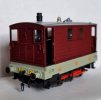
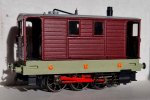
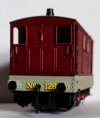
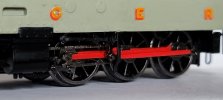
    After hinting at this project, having borrowed the spare safety chains from its detail pack for the HR Jones van, I figured I'd best share my repaint of a Rapido J70 as a GER C53:

    20240407_183452.jpg
    20240407_175802.jpg20240407_180552.jpg20240407_181944.jpg

    This is, as you can tell, GER No.126. One of a batch of three C53s built in 1921 and therefore released into traffic carrying the unusual combination of a crimson body and grey tanks/bufferbeams. The GER switched to using French Grey (previously an undercoat colour) as their topcoat for locos during The Great War, whilst carriages switched to crimson post-war. As the bodies of the trams fell under the carriage and wagon department, these were painted crimson, giving this unusual combination which, I confess, despite preferring the blue era of the GER, I couldn't resist modelling...

    The grey used is GER light freight grey by Phoenix (which was the same French Grey as the loco departments undercoat) whilst the crimson is actually Phoenix's North British carriage crimson, but I feel it captured the desired effect. Transfers are by Fox and are of the later GER styling.

    The only thing missing is a pair of etched numberplates for the bodyside but these are a work in progress.

    - James
     
    L&Y Dia.1 Low Goods Wagon
  • Liver & Fry

    Western Thunderer
    A brief interlude whilst I look at something different!

    A few weeks back I had a strangely specific and targeted advert on one of my social media pages for 'Three Peaks Models' - A company that appears to specialise in 3D printed products, but I confess I had never heard of. The advert was for an L&Y Dia.3 covered van, available to pre-order. I sat on this for a bit, intrigued but wanting to see more once the product released at the start of April I've since decided said kit isn't for me, however, I had also noticed that they produce kits for a Dia.1 "low goods wagon".

    Approximately 9000 of these were built and they were by far and away one of the most common wagon types on the L&Y network. It makes sense to have at least one... (Is what I tell myself!).

    At £10 (plus P&P) I figured it was worth a shot. You get the option of pre-1903 and post-1903 brake arrangements - I went with post-1903 (both brake levers right hand end). Upon placing the order I was informed that they were currently out of stock, but more would be printed so allow a few extra days for delivery. This was Sunday night, so imagine my pleasant surprise yesterday morning when I received an e-mail informing me the kit had been shipped and today when I arrived home from work to see it had been delivered! Can't knock them for quality of service...

    This is what I have received:

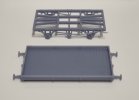
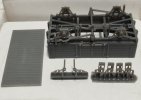
    20240409_201831.jpg

    The kit comes in two parts - A body and a chassis. Both sections are neatly printed and slot together beautifully!

    My job tonight is to clean them with IPA and then tomorrow I shall begin...

    I must stress, I'm not affiliated or sponsored, but I wanted to highlight how impressed I am so far! It'll be a quick build, but I'm looking forward to it. Later this week I should receive parts to make brake gear for the HR Jones van so this will fill the gap between nicely!

    - James
     
    HR Jones 8T Goods Van
  • Liver & Fry

    Western Thunderer
    I've had a busy week or two so there's not been a huge amount of progress until now, however, parts for brake gear assembly did arrive and I was able to, ahem, bodge a solution...

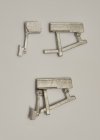
    20240414_201537.jpg

    The brake shoes are Highland but the brake pushrods are a North British design, however, these were the closest match to what I could turn into something that looks Highland in style. Some cutting, bending and glueing later and I had what I needed. The finished item is slightly longer than would be prototypical, but it still works for me.

    20240419_201318.jpg

    Fitted, painted, and finished with a 51L brake lever, this marks the wagon as done, as they don't appear to have carried H R lettering.

    I have to say, this one was a fun build!

    - James
     
    L&Y Dia.1 Low Goods Wagon
  • Liver & Fry

    Western Thunderer
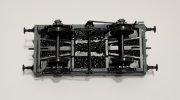
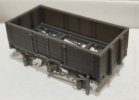
    Progress has also been made on the L&Y Dia.1, with the two halves being fitted together and weight added underneath, as seen below:

    20240419_202133.jpg

    There was, however, a heart stopping moment whilst fitting the wheels. I figured I'd try fit bearings to the model to make it run smoothly, but it seems the waisted bearings didn't sit fully home in the axleboxes, as when I tried to fit the axle, the extra stretch required to get the axle in past the rim of the bearing caused on of the W-irons (and a portion of the solebar) to snap off!

    I cautiously attempted to fit the other axle without bearings (just hear me out here...) and it went in much better. I then test fitted the broken portion of solebar and it fit so well that I took the decision to glue it back in place, but with the axle fitted (again with no bearing).

    Such was the fit of the broken portion that you now cannot tell it was ever damaged:

    20240419_202419.jpg

    And more remarkably, despite a lack of bearings and the aforementioned incident, the wagon probably runs smoother than some I've seen that have! I do question the longevity of the model, but then again, I'm unlikely to run this so frequently in the future that I wear out the mould...

    Finally, I've finished the painting by doing the wood planking inside:

    20240419_205931.jpg

    All that remains is to add lettering!

    - James
     
    Top