Liver & Fry's workbench

GER Dia.1 Brake Vans
  • Liver & Fry

    Western Thunderer
    How are we halfway through January already?!

    I'd hoped to start the year strong and crack on with some modelling but I've found motivation to be lacking until now.

    That said, I've made a big step with both brake vans, getting all the handrails and lamp irons fitted!

    20260118_220105.jpg

    All that remains is to paint them. The question is, what colour?

    - James
     
    L&Y Dia.49 Meat Van
  • Liver & Fry

    Western Thunderer
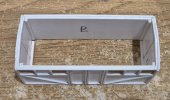
    Resurrecting the project I started at Workshop Wise in October, as a recap, my intention has been to scratch build an L&Y Dia.49 meat van, to had to the colourful array of special traffic vehicles I'd already amassed.

    Where we'd left off, I had essentially made up both sides and (partial) ends, and designed them to go together like one may build a kit.

    Well, after a day or so of re-familiarisation with what I had done (note to self: leave clearer notes on things!) I finally tackled getting the body and floor together!

    20260128_214825.jpg20260128_214842.jpg20260128_220645.jpg20260128_220718.jpg

    I made a point of adding additional bracing internally as I went and the resultant body is surprisingly sturdy!

    I'm feeling enthused to get back into the hobby again, so stay tuned for more updates!

    - James
     
    Lewis Merthyr Consolidated Collieries Ltd wagon
  • Liver & Fry

    Western Thunderer
    Just after midnight on 4th April 1912, the White Star Line's newest vessel, the RMS Titanic, arrived in Southampton to prepare for it's maiden voyage to New York on 10th April.

    When she left Belfast on 2nd April, she carried 1880 tons of coal, but would require considerably more to make the voyage.

    At the same time, between 28th February and 6th April 1912, the UK was undergoing its first national coal strike which had resulted in several other transatlantic crossings being postponed, and vessels laid up. As such, a good portion of coal was transferred from other White Star vessels, such as Adriatic and Oceanic, but Titanic would go on to take 4427 tons on 5th April, giving a total of 5892 tons when it departed on 10th April (allowing for that burnt on the voyage from Belfast and whilst stationary in port).

    The White Star Line sourced it's coal from Lewis Merthyr Consolidated Collieries Ltd in the Rhondda Valley, Wales, and Titanic was no different, with the rest of the coal coming from here. As such, coal would have been supplied to Southampton in the collieries own wagons.

    Research has shown these to be a mix of six and seven plank end door opens with internal strapping, matching designs by Gloucester. In particular, one very clear photo from 1909 shows a 15' seven plank example.

    Screenshot_20250615_131055_Chrome.jpg

    (Source: Lewis Merthyr Colliery, photograph - Collections Online | Museum Wales ).

    Having had a fascination with Titanic for almost as long as I have railways, it seemed like an appropriate crossover to model such a wagon, with now, in the month of April and having just returned from a trip to Belfast to visit the Titanic Museum, seeming like an equally appropriate time to start this build.

    I have been planning this one for a little while, and when I first started researching this I sought to identify if such a wagon was available.

    That was when I discovered Meon Valley Models, who produce a range 3D printed wagon kits, with an apparent focus on Gloucester and Charles Roberts types.

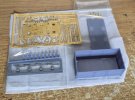
    So with that, here is their kit for a Gloucester 15' seven plank open:
    20260405_135714.jpg20260405_135747.jpg
    20260405_135800.jpg

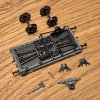
    These have been designed with Brassmaster chassis kits in mind, of which I have also acquired the appropriate etch.

    First impressions are positive. The print is very crisp and detailed, and I look forward to building it.

    - James

     
    Last edited:
    SR Dia.1541 'Road Van' New
  • Liver & Fry

    Western Thunderer
    Exactly a month later, again, and I figured I'd best show my face on my own thread!

    Some of you may have noticed I've taken a virtual vacation in Skeetsmere whilst I work on those cattle vans for @Herb Garden, however, things have been developing in the background (namely on the East Anglian private owner 'project' but more on that another time!) and today I actually did something of my own!

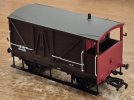
    You see, recently I went down a bit of a Southern themed rabbit hole that concluded with the need to acquire a fitted Southern brake vehicle. However, at first glance, the only fitted brake vehicles on the Southern were either Queen Mary brake vans, or 'Van C' utility vans. The latter would certainly be interesting, but I'm not sure wholly appropriate for my needs, and the former meant trying to wrangle something usable out of Bachmann's now outdated tooling.

    Fortunately I was then made aware that six of the Dia.1541 'Road Vans' were fitted with vacuum cylinders in LSWR days for use on traffic out of Southampton, with one of these, SR 54885, being preserved.

    So with that, I purchased the Kernow model (of which many have sold out, bar the variant I was after which is in plentiful supply!).

    20260717_175031.jpg

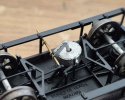
    To this, a vacuum cylinder and bufferbeam pipes need fitting, as well as renumbering.

    Today saw the vacuum cylinder going under:

    20260717_191334.jpg

    20260717_191500.jpg

    The bufferbeam pipes and renumbering will follow this week between painting the cattle vans.

    As a side note, Kernow's rendition of these vans are quite nice; they are detailed but sturdy vehicles and certainly the better of the aforementioned options.

    - James
     
    Top