Mickoo's BR modelling

Yorkshire Dave

Western Thunderer
I liked them all, 81-87 but roarers were always a good bag, plenty of them around in 79-82, managed to see the last two 84's, not sure if that was operational or at Crewe works on one of the many visits I did there.

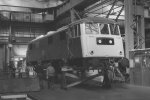
I remember seeing quite a number of the 82s, 83, and 84s stored at Willesden depot back in the early 1980s.

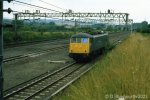
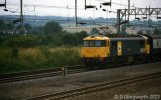
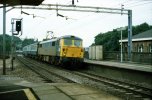
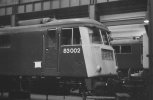
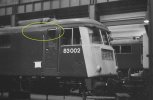
Your photos were taken a year or two after mine. Here are a few taken at Northchurch Tunnels and Berkhamstead back in 1980-82. Some have the GEC(AEI) crossarm pantograph.

82 006
82 006 Northchurch Tunnels 1980-1982.jpg

86 214
86 214 Sans Pareil 1980-2 Northchurch Tunnels.jpg

Berkhamstead.jpg
 

mickoo

Western Thunderer
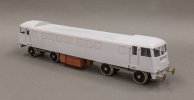
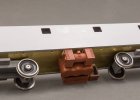
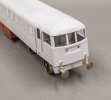
Then there were two, I've squeaked some more time to expand the AL electric fleet, primarily just focusing on the bodies, jointing and workflow to get consistent smooth and straight sections. So far it's not too shabby.

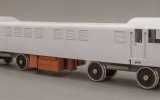
The AL3 has gained some bogie cores, in this case it'll be a rolling chassis or more as likely a paint pig in due course as the cab roof is wrong at the rear end and needs, and has already been modified but not printed.

The AL1 is a much bigger machine and probably the more important to progress, it migrates to the AL5 very easily and then the AL6 and ultimately the 87. The AL1, 5 & 6 also use the same basic bogie side frame with detail differences, another big simplification.

Despite Slaters catalogue, the AL3 and 4 do not have solid wheels, they are eight spoke wheels due to both using the BB-SLM spider drive; prongs on the wheel engage between sprung plates in the gear wheel, it would be their downfall and a high maintenance factor throughout their lives.

The AL1, 2 & 5 all used the Alsthom torsion link drive and have solid wheels with holes in for the pegs from the gear ring; the slaters wheels have nice deep recesses so that detail can be added as a 3D overlay dropped into the recess.

I've currently modelled the Al1 a little later in life, they seemed very prone to gutter rot and the original was replaced by two simple strips over the cab doors and side windows. Toward the end of their working lives the original gutter repair was often rotten through and patched as best possible to keep them going to the end.

Other than remodeling the cab roof (for earlier engines) for the original gutter I'm happy with the AL shell as it stands, perhaps maybe increase the roll under radius at the lower front a tad.

This shell will get a good dollop of Milliput on the joints and smoothed over before a coat of primer.

Next up some blocky bits between the bogies I suppose would be a good idea.

IMG_7822-WT.jpg

IMG_7823-WT.jpg

IMG_7824-WT.jpg

IMG_7826-WT.jpg
 

mickoo

Western Thunderer
Both are in the new resin, the lighter one has primer on, both buffer beams are currently FNG but I'll work up etched versions later for strength.

The cab door glazing recess is 1.0 mm wall thickness but that's fine as the sliding window is slightly recessed, there's no recess on the cab front windows or side windows as they'll have etch overlays at some point.

The body side windows are 0.6 mm around the glazing recess, I could perhaps go 0.5 mm but you only need one edge to fail and blow out and the whole section is in the bin. I'd rather have a model in my hand with slightly thicker recesses than 100% failures with thinner recesses, it's a compromise I'm happy to accept. An alternative would be an external recess with a dropped in etched panel with the window opening on it and blend in.

To go thinner you really need an etch body and even then that'd be 0.4 mm minimum or 0.5mm preferable over that expanse. To be fair, 3D printing is probably not the right medium for the body, it only works in this instance as there is no surface detail so you can get the big boat modelling tools out to smooth it all flat.
 
Last edited:

Clarence3815

Western Thunderer
City of Birmingham in the museum has a damaged beading on the nearside top of the tender. If I modelled that would I be ridiculed? I know the real tender is not perfect.

Bernard
 

Dave Holt

Western Thunderer
I agree with Mick. Photos of real locos show various types of wear and damage, rippled flat surfaces especially, but I think one needs to be very careful about modelling these features. That said, I did represent the sagging small bore lubrication pipes along the boiler of my WD 2-8-0 which the prototype exhibited at the time being modelled, but I wouldn't try to represent rippled tender or diesel body sides however much they show on the prototype.
Dave.
 

mickoo

Western Thunderer
Whats the difference Mick between you modeling the Loco in service, warts an all and the Military modeller doing the exact same thing to an AFV

Gary
Because in service AFV is something to strive for and applauded, in service model trains is often questioned as to what cock up is the modeller trying to hide.

To my mind, damaged or care worn metal work does not scale well and to some extent very heavily weathered models jar for me also.
 

Kev T

Western Thunderer
Both are in the new resin, the lighter one has primer on, both buffer beams are currently FNG but I'll work up etched versions later for strength.
What have you changed to Mick and why? I've recently managed to dial in FNG with Tough at 80:20 and find that a good compromise between dimensional stability and strength. It takes a long time to print though and it starts to separate over a lengthy print.
 

mickoo

Western Thunderer
What have you changed to Mick and why? I've recently managed to dial in FNG with Tough at 80:20 and find that a good compromise between dimensional stability and strength. It takes a long time to print though and it starts to separate over a lengthy print.
You've already answered why :thumbs:

FNG is great for small detailed objects and maybe 10-20hr prints but more than that and it starts to marble and on a print 47 hrs long is very high risk. I've also found that no matter what I do on three machines I still get micro layering (mind I'm trying some new AA settings which seem to help greatly) which only shows up once you begin to paint, it can be mitigated by using a filler primer paint to some extent.

The new resin is SunLu ABS, it's a softer resin, also more viscous so I really need a heater now as I'm just at the bottom end of the temp range with 25°C, having said that, increasing the rest after retract time helps. It's smoother overall but has less bite on the details, having said that, the AL3 grills and air tanks are in the same resin and once painted it's hard to see any loss of detail. It also a faster print time by a good 30-40% and more importantly half the cost of FNG and it doesn't separate or need mixing everyday.

I'm not sure on any shrinkage just yet but the body sections are well and truly bonded together with 2 mm brass floor plate and internal bulkheads to the result of 34 8BA nuts and bolts....overkill?....just slightly ;)

I still run FNG in one machine so it's a balance between the two for each application and it's still my go to resin for replacement parts on models and casting masters. I do have a third resin to try which is supposed to have great detail and smooth surface and minimal shrinkage, however it's twice the cost of FNG and I suspect an even longer print time.
 

Kev T

Western Thunderer
You've already answered why :thumbs:
Interesting.
I tried the Sunlu ABS because of the price I could get it from AliExpress, much much cheaper than ST resins. At the time I'd just bought an Elegoo S4U so two variables [I know :headbang:] and loads of heartache.
I eventually found that the settings in the S4U are very different to my Mars and I ended up with more supports, 4s rest after retract and a longer exposure with a reduction of LED power to 80%. That is now giving me reasonably consistent results but I still get failed prints for no obvious reason. I think I'll knock the S4U on the head, I just can't be bothered to mess about with it.
 

mickoo

Western Thunderer
This is exactly why I keep my two S2's going, not the greatest, fastest or newest but they just keep grinding away on day after day. I've read of woes about the S4 to be fair, I've also read good but the balance is toward the negative side. I'll keep chugging on with the S2's until they can't be repaired anymore and then have a good look around at what's available when the time comes.

I run 4 second delay on FNG and 6 on SunLu and might push that up a bit more on the next AL body to see if it helps with the slight pressure waves, they're not bad but it'd be nice if they were better.

I tend to over support my work anyway and happily prepared to post process parts with sacrificial edges etc to get the final result; it means there are virtually no failures and bare minimum warping, plus time to print is irrelevant. For me I'd rather it took two hours longer and came out fine than two hours shorter and it goes in the bin, especially with 10-20+ hr prints.
 

RichardG

Western Thunderer
I completely agree, but to model that risks ridicule and finger pointing to poor craftsmanship ;)

Because in service AFV is something to strive for and applauded, in service model trains is often questioned as to what cock up is the modeller trying to hide.

To my mind, damaged or care worn metal work does not scale well and to some extent very heavily weathered models jar for me also.

DSC_0861.jpeg
I looked at this yesterday when I was tacking the tank side into place, and decided to leave it there. I think, this is a reasonable wobble for an industrial or light railway loco; and it looks better than the dead-straight, dead-flat surfaces we see on RTR models. The other corners and edges and surfaces in the model are true and square.

If this sort of wobble is to be denigrated, so be it (it's too late to put it right now!) but I don't think it is at all "bad".
 

mickoo

Western Thunderer
View attachment 248819
I looked at this yesterday when I was tacking the tank side into place, and decided to leave it there. I think, this is a reasonable wobble for an industrial or light railway loco; and it looks better than the dead-straight, dead-flat surfaces we see on RTR models. The other corners and edges and surfaces in the model are true and square.

If this sort of wobble is to be denigrated, so be it (it's too late to put it right now!) but I don't think it is at all "bad".

If you did that commercially you'd get a slapping, or you should do anyway; unless of course you're modelling battered industrial stock and that is the specification, in which case then that is fine.

If you're modelling premier express stock or well maintained main line stock then that would not be acceptable, it's also never too late, blow touch it off and start again.

Let's be clear, what's acceptable to those who model for themselves is often not acceptable to those paying four figure sums for their toy trains.

Model whatever your happy with, but be aware, others may have differing criteria.
 
Last edited:

mickoo

Western Thunderer
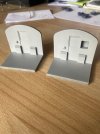
Here and there a little more AL1 work, primarily filling in the blanks with the biggest blocky bits, most are low rez form and fit test pigs.

The chokes are the later force ventilated variant under Tops numbers, I'll work up the older vertical drum ones for earlier periods later.

Also defined the cab interior floor and bulkhead design but still need to add more details, the draught shields will be a laminated etch with glazing dropped into a slot. Seats will be part of the floor but control desk a stand alone item to allow for provision and access to lighting.

Note the cooker recess is at one end only and the heaters are full depth, some had shorter ones with a gap underneath, in reality the tall ones had a gap of a few inches but I've closed it up to ease printing I may revise this and the basic design for even easier printing (3 hrs instead of nine) at a later date.

IMG_7876.jpg

IMG_7878.jpg

IMG_7879.jpg

IMG_7880.jpg

IMG_7881.jpg

IMG_7882.jpg

IMG_7883.jpg

IMG_4378.JPEG
 

Kev T

Western Thunderer
Those flat sides look flat :confused: Is this the Sunlu resin and were they printed flat?
They're quite the best looking prints I've seen for large flat surfaces.
Kev
 
Top