2mm Modbury

Ian Smith

Western Thunderer
" ... Two for Joy ..."

Being extremely pleased with myself for managing to produce something that (to me at least) looked like pheasant, I decided to see what else I could produce ...

6.JPG
The outcome is a pair of magpies !!! Once again, the core of these is a piece of brass wire, this time a piece of 0.3mm with some much finer wire wound around to bulk out the body. Once again, solder is used to blend in the body to the bare wire necks. Once happy with the general shape, a bit of bending and careful filing produced a body, head and beak. A small flat was filed on the rear of the back and a tail was added from a short narrow strip of green Rizla cigarette paper. Once happy, the birds got a wash of white enamel all over, then a blue-black was mixed and applied to head and neck and tail - the tail being slightly bluer. A hole drilled in a couple of fence posts at the front of the layout (near a pair of cows so that the public can be more easily directed as to where to find them), a touch of canopy glue on their mounting pegs and "Bob's your uncle!". Incidentally, I perhaps should mention that each bird is just under 3mm long (tip of beak to end of tail).

Thanks for looking.
Ian
 

Joe's Garage

Western Thunderer
Always something amazing to see when you post Ian but these are quite something....nearly constitutes a "murder" of magpies!!!!
Lovely
Julian
 

Ian Smith

Western Thunderer
Edwardian Modbury gets dragged kicking and screaming into the 21st century!!!!

No, I've not got baulk road track with overhead electrification! However, we do now have available some fancy electronics!

But first a bit of background. While Modbury has now been to several exhibitions, one problem does regularly recur - the fiddle yard operator (at the Newton Abbot end) gets involved in talking to the punters and as a result the trains stop moving. Obviously, with Modbury having a total length of only 10' it is not impossible for the main operator (at the control panel at the Plymouth end) to go to the other end of the layout and service himself as it were, however at busy periods (usually the very time that the fiddle yard operator gets involved in such conversations), trying to get from one end of the layout to the other and back again is problematic.

So to the solution (hopefully). My good friend and fellow Midland Area Group member, John Russell, being and electronics guru has devised and developed a couple of boxes of electronics to allow end-to-end communication. At Tuesday nights meeting he kindly demonstrated said gubbins, and sent me away with the bits and bobs to complete the project.

1.jpg
Firstly, a pair of identical circuit boards (this one is the "slave" for the Newton Abbot end). After making up the box for the "master" and following a conversation with John I removed the rotary switch on the slave as it is currently surplus to requirements for that end. The "master" also has a pair of power leads coming off the socket to allow connection to a 12v power supply.

2.jpg
A couple of small boxes into which I had to fit the electronics gubbins were also supplied, as was a cable to connect the two circuit boards together and allow them to talk to each other.

3.jpg
After an hour or two drilling and filing, I had holes in the relevant places to match the rotary switch (only on the "master"), the display and the button on the circuit board. I also found it necessary to drill some holes above the buzzer to help let the noise out!

With the two boxes connected and power supplied to the "master" box, the rotary switch can be turned clockwise to select 0, 1, 2, ...8, or 9, or anti-clockwise to select P(assenger), F(reight), or E(mpty road). As the knob is rotated (on the "master") the selections are shown on the display in red, when the display shows the required selection the button can be pressed which will instigate communication between the two boxes, causing the "slave" box to illuminate it's display with the selection from the "master" (also in red) and sound a buzzer to alert the fiddle yard operator that he needs to do something. Once the fiddle yard operator has set up the request, he can press the button on his box which will change the displays on both boxes to green and sound a buzzer on the "master" to let the control operator know that everything is ready.

4.jpg
The knob on the "master" has been rotated anti-clockwise to request a P(assenger) train to be made ready at the other end, the button has been pressed causing the request to show up (in red) on the "slave" and sound the buzzer at that end.

5.jpg
The fiddle yard operator has made a passenger train ready and has pressed the button which has sounded a buzzer on the "master" (control panel) end and set both displays too green.

The next phase will be to dream up what the 0 - 9 indications might be used to request, eg. 0 - Cattle Train, 1 - Stream Railmotor, 2 - Pick-up Goods, etc. Although I think for our next outing at Loughborough in August I might just stick to using the P, F, and E indications to see how effective the concept is.

Thanks for looking,
Ian
 

Ian Smith

Western Thunderer
Well, it's been quite a long time since I added any updates to my thread here. Since the last post, Modbury has attended the Manchester exhibition in mid-December, and the Southampton exhibition almost a fortnight ago. Both exhibitions went well, and great use was made of the electronic communication that John Russell had devised and built that allows the operator at the control panel to request various train types or suitable empty roads with the fiddle yard operator at the other end.

On the stock front, very little has been done although the Duke is progressing at a snails pace...
19.JPG
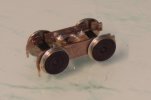
The functional parts of the leading bogie has built (although I have decided to file off the guard irons and add them to the cosmetic outride frames and front piece). Because there will be outside frames to be added, I have elected to make the wheelsets removable by opening out the axle holes into U slots, and have added a top keeper plate with light springs retaining the wheel sets. Hopefully this will work, if not I will have to rebuild it more conventionally!

20.JPG
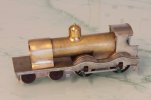
The smokebox has also been "completed" - last time I posted anything about the Duke, the smokebox was simply a piece of boiler tube that had been slit along the bottom and opened out to slide over the boiler. Since then, I have formed a smokebox saddle by fly-cutting and milling/filing a lump of brass. Once formed, the saddle and smokebox tube were united by silver-soldering the pair together. Finally, a sleeve of 0.005" brass was rolled to be a sliding fit on the saddle and tube then soft soldered in place, with the ends being filed back flush when cool.


21.JPG
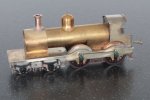
Here is a view of the current state of play with everything loosely plonked on to give an idea of how things are going. The dome was turned in the lathe with hand gravers after the base had been fly-cut. The flaring being completed with various round and half-round escapement files.

22.JPG
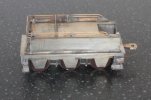
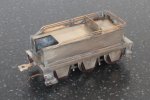
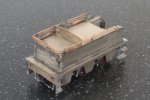
A start has also been made on the 2000 gallon tender, again body is loosely plonked on chassis for this photo. The upper works are actually the second one made as after forming the tank on the first version I decided that it looked too wide when compared to the cab of the engine. Sure enough when I measured it I realised that I had formed a tank that was 1mm too wide by mis-reading the size of the tank on the drawings I have! The frames have just been fretted and files to shape (but still need separating).

Thanks for looking
Ian
 

Joe's Garage

Western Thunderer
Hi Ian
I just showed my wife the photo of the cow and magpie. She said "is that a real cow?". That is how realistic your modelling is!!
I tried to explain how small the Duke was and she was amazed.
Likewise the loco is progressing well.
Nice to see you back.
All the best
Julian
 

Ian Smith

Western Thunderer
A little more progress on my Duke. The tender frames have been added, a cordon shaft has been formed to transmit power from motor in tender to driven wheels, and a suitable drawbar fixed to the tender to facilitate joining engine to tender :
23.JPG

24.JPG

25.JPG

The dome is currently just plonked on (and retained with a little blu-tac. Currently, she limps along rather poorly but I hope that when I've added weight to the tender (which the drawbar will transfer some of to the rear of the engine), and added current collection wires from engine to tender to enhance current pick up things will improve.

Thanks for looking.
Ian
 

Ian Smith

Western Thunderer
A little more progress on my Duke project...

Firstly, the leading bogie has been completed - a pair of cosmetic outside frames were fretted/filed to shape and separated. A small brass spacer block was made and a representation of the "cross-wise spring cups" formed from brass rod and sections of brass tube soldered each side of the spacer, the spacers were then soldered centrally amidships of the cosmetic frames. The axle boxes and springs are cut down 2mm Association 3D printed GWR 2500 gallon tender parts. The "spring cups" were dispensed with and new ones fabricated from rod and tube super-glued in place. Finally, the cosmetic frames were themselves super-glued in place on the functional inside frames.

The photos below show the completed bogie :
26.JPG
The bogie with the cosmetic outside frames secured in place.

27.JPG
The component parts of the bogie - wheels, main bogie (functional inside frames and cosmetic outside frames), and the top keeper plate which holds the wheels in place and provides a little springing to the axles.

28.JPG
The bogie with the wheels and keeper plate installed. The central hole takes a turned and tapped pivot and coil spring (which bolts through the footplate into the underside of the smokebox).

29.JPG
The engine with the bogie in place. It was only after I'd added the cosmetic frames that I realised that the footplate frames were set too far inboard completely restricting any rotation of the bogie!! A little work with the soldering iron was required to carefully move the frames out towards the edge of the footplate, obviously it wasn't quite as simple as that as one of the leading splashers became unsoldered as did another one below the cab, and cab steps also came adrift!

Further work has also been undertaken since the last instalment - the boiler fittings (chimney and safety valve casing) have been turned (with gravers), the (phosphor bronze) chimney being soldered in place on the smokebox while the dome and safety valve a simply pegged in place until after painting. One thing I did discover was that I'd originally mounted the smokebox too far backwards!! A 12BA plug was soldered into the bogie pivot hole in the smokebox base and a new hole drilled allowing the smokebox to be mounted about 1mm further forward.

With the smokebox now in the correct place, the frame extension pieces that appear above the footplate were cut and soldered in place around the smokebox saddle (the smokebox and boiler being a couple of separate assemblies that are bolted in position to aid painting and lining later).

30.JPG
The loco in its current state. As can be seen, the handrail knob holes have been drilled ready for the handrails, and also representation of the wash-out plugs have been added on the firebox. The latter are simply formed by drilling a 0.45mm hole into the firebox, then those holes are opened up with the very tip of a 0.8mm drill, the plugs themselves being some short lengths of 0.4mm diameter copper wire with the end squashed to a square profile in pliers then forced into the 0.45mm holes. Finally, the ends are filed flush with the outside of the firebox.

31.JPG
I'm not completely happy with the tender frames, so will be removing them so that I can re-profile them as they look far too beefy! The next task will be to make the buffers and smokebox door I think.

Thanks for looking.
Ian
 

adrian

Flying Squad
I'm not completely happy with the tender frames, so will be removing them so that I can re-profile them as they look far too beefy! The next task will be to make the buffers and smokebox door I think.
That's looking brilliant work. Fascinated in the effort to introduce as much weight as possible in the details. I'd agree with the tender frames looking a little beefy. I hope you don't mind but the other little detail that stands out for me is the chimney position. I know on the loco they were positioned unusually far back on the smokebox but this seems a like a whisker too far. A quick scan of the photos suggests that the rear of the flair lines up closely with the rear handrail knob location.
 

Ian Smith

Western Thunderer
That's looking brilliant work. Fascinated in the effort to introduce as much weight as possible in the details. I'd agree with the tender frames looking a little beefy. I hope you don't mind but the other little detail that stands out for me is the chimney position. I know on the loco they were positioned unusually far back on the smokebox but this seems a like a whisker too far. A quick scan of the photos suggests that the rear of the flair lines up closely with the rear handrail knob location.
Adrian,
Thank you for that. I think you’re right, I will have to rectify it otherwise it will bug me forever and a day!!
Ian
 

Ian Smith

Western Thunderer
You could almost fit the motor in the dome…

Are you going to make a Dean single?

Tim
Tim,
With Modbury being west of Exeter, a Dean Single would in theory be inappropriate (although rule 1 is always extant).

However, members of the Midland Area Group have been trying to get me to build a mixed gauge layout, so a Broad Gauge Rover wouldn’t be out of the question!
Ian
 

Ian Smith

Western Thunderer
A little bit more progress on the Duke ...

Firstly a smokebox "face" has been fabricated - a couple of pieces of 0.028" nickel silver were sweated together then mounted on an arbour with super glue, and the plates turned to be a sliding fit into the end of the smokebox, before the deployment of gravers to turn the door ring and the dished face of the smokebox door itself. A central hole was made while in the lathe for the door handles. A further turning of a 0.35mm spigot protruding from a door handle plate with a mounting peg behind was also made. With the embryonic smokebox door removed from the arbour, the central hole was opened up to suit the mounting peg of the door handle plate/spigot, and the latter soldered in place. The handles themselves are just 2mm Association etched handrail knobs with their tails cut to length. The hinge straps are just shaped strips of 0.004" nickel silver with their hinge ends formed around a short piece of 0.009" guitar string and the whole lot carefully soldered in place on the door.

32.JPG
Smokebox front and door.


33.JPGThe smokebox door temporarily pushed in place in the smokebox. Also evident in this view are the handrail knobs which have been soldered into place along the smokebox and boiler sides.

34.JPG
And finally, araldited in place after the little steps (just over 1mm wide!) had been added to the sides of the smokebox. Now that the araldite has set, I still need to add the handrail knob above the smokebox door and the lamp socket housing on top of the smokebox.

Things have also progressed with the tender too. As alluded to in a previous post, I was not happy with the tender frames, feeling that I had made them rather too chunky, so files have been deployed to reduce their size and I am now much happier with their appearance. I did this in situ which found out some of my dodgy soldering as both came slightly adrift as they were being attacked with needle files!!

The pair of handrails on the rear corners of the tank have been added using 2mm Association etched handrail knobs and short pieces of guitar string. The two little steps have also been added to the tank rear but don't show up very well in the photo.

Coal rails have been added from 0.3mm brass wire - two pieces of wire were taped to a board and narrow (over length) strips of 0.006" nickel silver were soldered in place where I calculated they should be for the supports. Obviously once I had made the two bends to go around the rear of the tender only two of those supports were actually in the right places, so as the rails were soldered in place the supports had to be drifted slightly to get them in the right places. I should have mentioned of course that before the rails were soldered in place, the leading ends had to be trimmed to size, bends formed and the wire ends flattened. The rear bulkhead was shaped and added from 0.008" nickel silver.

Finally, the footplate valances were added from 1mm wide 0.005" strips and 0.010" step supports cut and shaped and soldered in behind the valances. The steps have been added from pieces of 0.004" nickel silver strip bent to 90 degrees to form the step and rear mounting plate, and the ends of the step bent up to form the little up stands so that the enginmen feet don't slip off the ends of the steps.

37.JPG
35.JPG

36.JPG

The next items on the list will the the front bulkheads on the tender top (and their adjacent coal rail supports), and the tank filler, etc for the rear of the tank. While I have the lathe out for the latter, I should really make the buffer housings and buffers themselves!

Thanks for looking.
Ian
 

Grahame Hedges

Western Thunderer
Very impressive. And apart from the brilliant modelling it looks like, in earlier photos, that you've also done a great job in polishing the huge dome.
;-)
 

Ian Smith

Western Thunderer
Some more progress on my Duke ...

Firstly, she has obtained some buffers - these are simple brass turnings for the housings (mounted on little squares of 0.004" nickel sheet which were filed back to size), and even simpler turnings for the heads and shanks turned in silver steel. This morning I have completed adding the lamp sockets on the leading edge of the engine footplate.

38.JPG
An embryonic lamp socket for the leading edge of the footplate - a length of 1mm square brass has been filed down to 0.75mm square at one end, a flat has been filed on the end to represent the mounting plate, a 0.35mm hole drilled (as centrally as I could get it) to represent what should be a square hole for the peg of the lamp, and a saw cut most of the way through to delineate the socket.

39.JPG
The socket was then soldered in position on the leading edge of the footplate, before the "handle" was waggled up and down to break off the socket - this has the benefit of ensuring that the solder joint is a good one as if not the socket will come away as the waggling is performed!! Finally a few wipes with a fine file will clean up the broken edge.

40.JPG
The tender has also benefitted from the addition of lamp sockets (the one attached to the rear of the coal rail was a tricky little devil as it came away after the handle had been broken off and was being cleaned up! So a few minutes were spent trying to hold it in position with tweezers while making a good solder joint in the right place ensued! As can be seen the tank top has received a tank filler (another simple turning, with a couple of holes drilled in the top and a bit of bent wire soldered in place for the handle), and the (3'0") tall domed pipe (don't know what it's called) is also a simple turning soldered in place. As can be seen a brake standard has also been fabricated - another simple turning for the main column, with a 0.35mm hole drilled in the top, a short length of phosphor bronze wire soldered in said hole, a little collar of 0.6mm outside diameter tube soldered on the end of the wire, a little groove filed across the collar/end of wire and an over length piece of 0.25mm n/s wire soldered into groove before being bent and cut to size to represent the handle.

Finally a few photos of her in her current state :
41.JPG
42.JPG

43.JPG

44.JPG
The buffer heads, dome, safety valve casing and brake standard have just been plonked on for her photoshoot. As may be seen, I have finally got round to fitting the crank pin washers to replace the bits of pvc sleeving on the over length crank pins. This was necessary to allow her to pass the platforms on Modbury, as all previous testing had been restricted to the goods yard entrance! Not in itself a bad thing as I was able to prove that she could get through pointwork happily and my design for the bogie pivot and springing could hold the rails on anything she was likely to encounter.

Thanks for looking.
Ian
 
Top