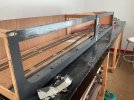
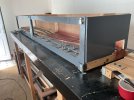
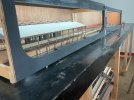
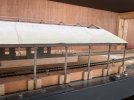
Whilst my wife took advantage of some glorious sunshine tending the flower beds and nursing a malaise clematis, I turned my attention back to the signals, removing mould lines and such ready for priming.
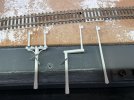
Following the briefest of instructions to a tee (or at least I thought) I attached various bits together to form the skeletons of a signal post or two. A slow process which saw me repetitively putting on the kettle whilst I tried to familiarise and re-familiarise myself with the ink diagrams and accompanying jottings. In the case of the bracket signal, I went further and began attaching the cranks as per the instructions, or at least so I understood. The orientation of the clamps on the diagram had me confused, so fiddling with as many parts as possible involved in the operation of the arms, I eventually worked out that while the cranks were correct in the accompanying diagram, the clamps weren’t and required mounting at ninety degrees to the positions shown. Biting the bullet but fairly satisfied that I was now along the right path I began cutting the wire pivots and threading on the cranks and clamps in the correct sequence. At one point, I happened to check one of the cranks for freedom of movement: good job I did as stray glue had begun to bond it to its clamp/cramp. I managed to free it somewhat, but realising it would always be a pronto smooth motion, I freed them from the trimmer and replaced both with parts from the sprue. Luckily, I didn’t bin them!
Whilst cutting one of the cranks from the sprue, it pinged off and as I was working on one of our glass topped garden tables, the lack of friction seemed to add to its acceleration, a quiet rumble nearby acknowledging its achievement of Mach 1. I shrugged it off. I’m certain there were more on the sprue and in any case there were sufficient to complete the bracket signal, any remainders being surplus to requirements as they weren’t required. Then I realised I’d forgotten about the shunt signal which required two. Panic!. Abandoning her patient, my wife generously joined me on hands and knees scouring the environs of the table, but trying to find a 3mm long black part on a grey resin path and patio formed of grey and black aggregate ………. B*gg3r!! I can salvage the bonded parts just mentioned but I’ll still be one short. I searched the spares box in vain as was a brief search on the Bay of E….. Then I reconsidered an idea I’d had for working the arms on the dolls originally as Iveasnt sure about using the fragile plastic ones in the kit, an idea I’d tried years before on a gantry using brass brackets soldered to brass tubing turning on a wire inside:

I had some fine tube which still looked a little clumsy to mine eye so dismissed it. As beggars can’t be choosers, it would perhaps be a case of Hobson’s here but required. I even thought about using some brass handrail brackets to enclose the fulcrum to make it more signal like, but I need to take a rain check on that. Perhaps; perhaps not. Latest thinking is to fabricate one from one of the signal bases in the kit. Jury’s out.
Then, turning my attention to the single post and its mechanism, a thought suddenly struck me which made me reexamine the instructions relating to the bracket signal. I went cold: whilst I was correct in fitting the cramps/clamps to their pivots which could be glued to the rear to keep them in place, the cramps shouldn’t have been glued to the trimmers, thereby enclosing the cranks, until AFTER the control wires to the arms and weighted arms had been attached. Whilst the crank holes leading to the arms can be accessed before the landing goes in place, the same can’t be said for the lower crank hole leading to the balance (weighted) arm. I’m just hoping there will be sufficient give to slide them in betwixt trimmer and rear of crank, otherwise I’ll be purchasing a new kit.
So there we go. Yet another typical day in my modelling journey. I’ll get it right one day. Perhaps……
I’ll leave you with a picture of state of play up to this point:
Apologies for boring you all with this.
jonte