TFW’s workshop & Copenhagen Fields

Tim Watson

Western Thunderer
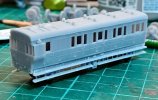
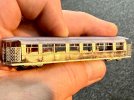
The Coronation continues to make progress. The sides of the carriages are from Worsley works and are etched in nickel silver.
1871bae7-510a-455e-b805-9d5d52e69879.jpg
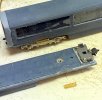
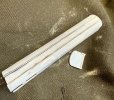
Getting the tumble home neat and tidy needs a bending jig. I made this decades ago from a couple of bits of aluminium with alignment dowels and three bolts and wing nuts to tighten it up. I think it was originally used on my 7mm scale Finney A4 and certainly used when making the Silver Jubillee set on CF. It’s critical that the bend starts in the correct place and so a witness mark is made on the back side of the etched side using a simple brass jig to mark it out. This is laid down over the windows and the line scored.
6cec0f12-2f35-49b2-a0c1-54b307e60e6c.jpg
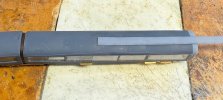
This was then clamped in the bending bars with the scribed line just visible on the jaws of the bending bars and the brass jig; most importantly with the windows securely held. The tumble home was achieved by pushing a long brass rod firmly against the inside of the carriage whilst leaning on the outside with a coarse file - which gives a better grip on the sheet metal and bends the metal over.
6baa1b00-aece-4dab-a22a-6ffc1272043f.jpg
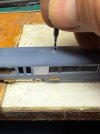
The bodies were designed so that sacrificial pillars would be removed wherever they interfered with any windows. This was easily achieved with a fine diamond disc running at moderate speed; so avoiding any untoward crack propagation within the relatively brittle plastic. The original concept was that the glazing strip would be a simple strip held between the residual pillars and the etched sides. Unfortunately, due to an oversight, the rebate was made on the wrong side of the pillars: I had failed to notice this early on. That meant that the glazing strips had to be made in variable lengths to fit between the pillars but, fortunately, I have a guillotine which speeded up the operation. The close-fitting individual glazing components were held in place with model aircraft canopy glue, applied as a bead around the periphery of the opening.
32f58d86-1b0b-4608-8c89-0ee1ec256449.jpg
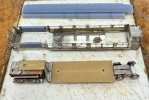
Here we have the production line for coaches E & F - one of which has an extensive kitchen component as shown by the opaque windows.
9643100e-4f52-49b1-a27c-97d92e4dc2f1.jpg
So that’s four down, four to go…
Then I can think about the steps, buffers, ventilators and interiors.

Tim
 

Tim Watson

Western Thunderer
As a bit of a break from carriage construction I have indulged in some bridgework. The gauge plate steel substructure and bridge deck has been made for the ramp line to Mrs W’s yard.

48013398-cfce-493e-a4e1-fcb9b88fcbd3.jpg

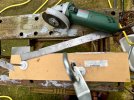
The original temporary bridge deck was used as a pattern for the new one, in 1mm thick gauge plate. The question was, how do you cut it?
e2d6a4f8-66b1-4eab-8916-89ccc83db70d.jpg

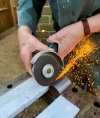
The answer of course was that well known finescale device, the angle grinder. After about 10 minutes the main shape had been whittled out of the sheet.
567e34c0-2263-444b-ba4c-a66010e308e3.jpg

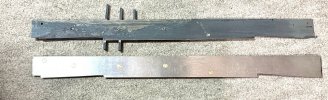
Transferring the position of the 5mm thick bridge spine (the bit with the pointed end) was achieved by making it fit on the layout, then spot-gluing the old deck onto it in situ. Some 3mm diameter holes were drilled through both of them. These holes were then used as guides for drilling the new steel bridge deck as well, with all three clamped together.
a6d42473-3f8e-490a-9372-8780d069f249.jpg

The 3mm holes in the bridge spine were tapped 4BA and the bridge deck countersunk to take some brass bolts. Eventually the two pieces will be Araldited together.
afb3e5c9-5302-4957-906f-cba9aa8d9eab.jpg

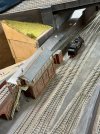
There is quite a bit of further work to do, with the electrical connections, bridge locating arrangements, boarded track bed and fiddle yard spur. Simon can be seen happily working under the layout…
e38b3db9-ae43-4348-9262-6a6578654f8d.jpg

We are making steady progress, racing across the prairies with the new extended loops for the Down Main, whilst Mark’s turnouts should hopefully be ready to splice in on our next Sunday working session. Much of this fiddle yard work will not be seen by the viewers at Ally Pally, of course, but we are always happy to show interested visitors round the back if they wish.

Tim
 
Last edited:

Tim Watson

Western Thunderer
We had a lovely surprise yesterday when Justin turned up with an amazing 3DP of a charabanc, the files for which he had downloaded from the internet.
35be4b6a-ad81-4af0-84ec-88ae7b473db9.jpg
He also brought along some examples of GNR six wheel coaches, printed from Mike Trice’s GNRS files and ammended to use Association W irons. This is a perfect match for our Denys Brownlee injection moulded GNR stock, it being a really excellent use of subtle 3DP technology: state of the art 1980’s vs. 2020s?
65ed4bc0-b49a-45fd-9962-317bb7714524.jpg
Work on the Coronation continues, with the footsteps made by filing the local streamlined fairing back to what would be the solebar and using a short piece of unequal length brass angle as the steps, super glued onto the flat surface. This is a fair representation of how the real thing was configured, it is also reasonably strong and consistent.
8cf6097a-29f8-4fa5-a5b9-e5fc1e801b10.jpg

e91157ec-5dab-4493-b7dd-a2e85fb57df9.jpg
Meanwhile, Mark’s turnouts are now both cut into place on the Down Relief fiddle yard tracks, the DM is now complete and being fettled - the Coronation set is an ideal testing train… The ramp line flyover track has been laid, with the end rail alignments half way complete. Looking to the future, a local section of the baseboard in the goods yard has been levelled up with the big fiddle yard board, so that rails can be laid across it, cut, and eventually allow more loops in the down goods direction. This sort of forward planning is needed because the large goods yard board has to be worked on in isolation: we don’t get that many long opportunities to work on CF, as a whole, to allow this sort of preparation.

Ally Pally is effectively two weeks away, before the layout comes down for transport…

Tim
 

Tim Watson

Western Thunderer
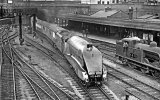
The large kitchen cars on the Coronation sets were well provided with ventilators as can be seen on the carriages emerging from Gasworks Tunnel.
607d0960-7f8e-473c-b618-5ad5bb020d18.jpg
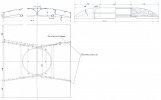
Mike Trice kindly sent me this drawing of the prototype arrangement (the Isinglass drawings are a bit ambiguous for the shape of these streamlined vents).
a494cb7a-d237-4d37-aa38-b6e33f11ddaf.jpg
A very straightforward solution for sourcing the correct curvature and depth of styrene was to slice out a section of roof from one of the prototype coaches.
36f7d831-7c4d-48ec-8e3c-5346998b0f1f.jpg
This was then dressed with a large file to the correct width.
392fcd44-408f-46f4-8985-fc1ce7fee521.jpg
The ventilators were then trimmed for length and the end curve formed for the streamlined profile with a few strokes of a file.
09ee50f1-a638-4377-a4e2-5ef9717ade79.jpg
Mike very kindly designed and made the small ventilators as 3DP (visible in front of the carriage). These have a spigot to locate them. Drilling the holes in the roof is straightforward using an ultra-sharp 3mm-shank 1.5mm diameter drill turned between the fingers.
59effbeb-7434-4401-a680-301064fab1a1.jpg
So I now have twelve more vents to fit and the bodies of the Coronation are complete, excepting the interiors. With all the dusty filing and cutting of the 3DP resin I now need to give the workshop a good clean up before spraying.

Back at the Club, the tail (hidden) end of the ramp line is well advanced. What is more important is that Justin has 3DP a very appropriate hand crane for the S&T yard behind the ramp.
54116d08-a946-40b7-b2c4-229baeadfbf2.jpg

Isn’t it incredible what can be made using modern technologies?

Tim
 
Last edited:

Tim Watson

Western Thunderer
After enjoying a very relaxed weekend at Missenden Abbey tutoring with Tony Gee & Jerry Clifford, the new 1907 Gate Stock for York Road has now been fettled. The heroic construction to-date is by Jim Watt and Graham Roberts, arriving from Scotland towards the end of last year. The 3DP roofs needed a bit of careful warming and adjustment to sit passively on to Jim’s etched bodywork, but really capture the atmosphere well
c6d4cf90-76f8-42f1-b3dc-5b989cf8b666.jpg
The roofs will be held down with studding either side, bolted through to the chassis, next to the two sides, so should be quite inconspicuous.
c2f8a194-6498-47fd-85e5-c0c4195ea9a8.jpg

4d4a1ca9-cf28-4a68-9a96-071a10ee8cbe.jpg
I think I now have a solution for the internal lighting on the three-car train, without impinging too much on the interior details.

On returning from Missenden, the set was given a run on the test track (the centre car roof was slightly displaced)

Next stage will be to make the body fixings and fit the battery clips and light circuitry. The bogies can now be painted and oiled up. The set will hopefully be running on YR at our MRC Open Day on Sunday 6th April (along with David Eveleigh’s superb Yen Long St) and at Railex, Stoke Mandeville on May 24/25th. It should be painted by then. I am minded to paint it crimson lake, as I think that was the colour used on these in the 1920s. Not sure what lettering it would have carried post war.

Tim
 
Last edited:

Yorkshire Dave

Western Thunderer
I am minded to paint it crimson lake, as I think that was the colour used on these in the 1920s. Not sure what lettering it would have carried post war.

I think you may be correct - there are postcards of the GN P & B R in the LT Museum collection:

https://www.ltmuseum.co.uk/collections/collections-online/ephemera/item/2002-15268

When delivered, the stock was two-tone and Great Northern Piccadilly & Brompton Railway was lettered in full rather than abbreviated as seen later.

And of course there's the section of one of the original cars at the Acton Depot. https://www.ltmuseum.co.uk/collections/collections-online/vehicles/item/1981-543

And this image from Newcastle (NSW) University archives will provide a clue on the lettering.

259464-max.jpeg


Perhaps you need a GN P & B battery loco to add some interest... https://www.ltmuseum.co.uk/collections/collections-online/photographs/item/1998-70780
 

Tim Watson

Western Thunderer
I think the GNP&BR was dropped after the war, Dave.
The battery loco is cute, but I don’t think our motor bogie would fit as it is probably slightly too long.

Tim
 
Last edited:

Tim Watson

Western Thunderer
Does this count as a tube railway?
6b0c5f9f-290e-4c89-a040-087d457c947c.jpg

4e23041a-ef52-452e-aed8-93787e11ea1f.jpg

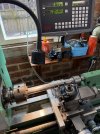
The lengths of steel car exhaust tube were parted off on the Myford.
c7ea64f1-7b41-4a0a-af05-9785a98bf14a.jpg
The supports for the tubes & headwalls will be laser cut in MDF.
Now for the angle grinder.
d51a26d9-700a-4304-ab53-9086c5f8dd68.jpg

Tube bores settling in at the correct height.
a94171d1-2faf-41a5-a4bd-b5ee30c59c5d.jpg

Supports will need to be made and then the fronts of the tube sections removed to taste.

Tim
 

Attachments

  • 39ae2171-4016-445e-89e3-1094ee76636b.jpg
    39ae2171-4016-445e-89e3-1094ee76636b.jpg
    108 KB · Views: 65
Last edited:

Tim Watson

Western Thunderer
There is a certain satisfaction in using steel pipe to represent the cast iron segments of the tube tunnels.
Most appropriately, I was sent this picture of the crossover tunnels today.

7d0357cf-feeb-441e-9fcd-9ab3ad0234be.jpg

As the project ‘matures’ I will probably have more of the tops of the tunnel segments visible to show the construction more clearly.

Tim
 

Tim Watson

Western Thunderer
With Railex at Stoke Mandeville in just over five weeks time, work is continuing apace on the tunnel construction at the north (eastern in Piccadilly Line terms) end of York Road. The so-called ‘tuba box’ / diorama is being modified to improve the view of the new works whilst the head wall of the station has been cut back and curved to visually lead into the steel tunnels.
14343387-ab8a-4a0e-ba35-d16bcfff37b4.jpg

440512fb-e796-4ac3-962a-054f87ea2fce.jpg

The steel tubes will have the head walls modelled, so filling in the empty ends. The track work is still the brass strip; this will of course be replaced with correct tube track, including one end of the crossover, maybe in time for Railex - but I have a train to finish before then as well - so track making may well be demonstrated at the show.
b697291d-d4da-412d-ad06-f552f5afc73a.jpg

When the YR section is displayed with the main layout, the 1” thick ‘pelmet’ that sits above the tunnels will not be present, as that is part of the rigid structure making up the base of the display / diorama box. The appearance is already a bit more elegant, compared to the rather clunky looking original set up: it also gives an idea of how the west bound tube line will follow the front of the main Belle Isle layout boards, when extended.

Tim
 

Tim Watson

Western Thunderer
After a lot of fiddling, the lighting unit is now made up for the motor car in the 1907 Gate Stock tube train. There are quite a few components, made much more complicated by the electrical pathways between the motor and rear bogie (removed in these images). The other cars will be far simpler to make. The CR1220 battery should give quite a decent endurance.
846be4e6-8878-4303-8585-bb7929fa1c77.jpg
The battery is very simple to remove and inconspicuous, allowing the interior to be well represented by Graham Robert’s excellent 3DP seats.

Power is transmitted from the battery to the roof beams in the eaves by two 14BA bolts - which also hold the roof down.

Tim
 

Tim Watson

Western Thunderer
As a further observation I didn’t know how I was going to set up the lighting until I started and there isn’t going to be a second one! Jim Watt & Graham Roberts design has actually worked out very well and the battery is easy to swap out. The whole train will simply be inverted in its stock box and a pair of fine tweezers will slide them out.
cf917a63-92d2-4a9a-941a-84d9a5cbcdfb.jpg
The big cuckoo in the nest is the 12.5mm diameter battery in the chassis. I now have about 90 of the CR1220 clips going spare if anyone wants one. I also wanted to have the battery separate from the Tramfabriek circuit board, sensor and light, which is in the roof and clerestory.
16ebaee3-2c28-45b8-ac0d-50bca3521056.jpg
I could have used the smaller CR927 battery but that has a much lower capacity. Just two more to do…

Tim
 
Top