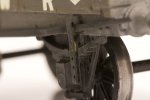
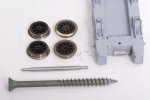
. . . the ABS model is to scale, and I am struggling to find free space to allow running on my 31.5 as well as 32 mm gauge tracks. So I will be grateful for an air gap to let the wheels go round and round.
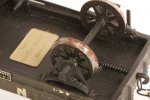
I couldn’t face working up a second decking screw so I had a go with some Meccano axles. I broke three when I tried to reduce them below 1.7 mm. I got fed up with making 2.5 mm rod so I went back to the brass (already the right diameter) and made two new axles at the first attempt. So I have had a go at making eight axles in all, and ended up with two and a spare.
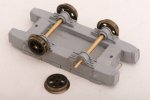
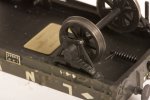
The diameter of each end is unique (they vary by a few thou) so each wheel hub got opened out to match. Hence the marks on the axles to allow fairly foolproof disassembly and reassembly.
The shoulder of the axle shows the amount of space I had to spare for running on 0-MF tracks. With a fairly thin wheel flange, the B2Bs are 29.7 mm. There isn't really any room to play with.

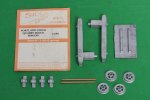
I have persevered with the Hornby wheels too. In case you don’t know, these are a bit cheap and cheerful - brass tyres on plastic centres, with shiny plating on the brass to give a sort of chrome effect. A positive is they have a part number (X8084) so they can be had without rummaging through boxes at swapmeets.
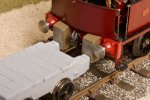
The initial track test for all of my wagons is to propel the model at maximum speed over every track in both directions; and then reverse the model and repeat. A pass is achieved if the wheels stay on the track.
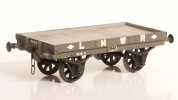
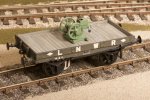
The test for this wagon has been made easier by ‘Lady Marion’ being my only loco with suitable buffing gear, and her maximum speed is about a scale 15mph. Nevertheless, the test was a complete success and I think cheering to see for a model with a wheelbase less than the track gauge.
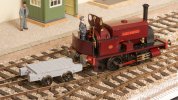
The wagon weighs 130 grams, which should help its stability. I can sort out some coupling chains when I do the painting.