The Heybridge Railway, 1889 to 1913

RichardG

Western Thunderer
Might get a print on later, see how it goes,

This looks very impressive. I guess you can adjust the width to make a 0-MF or a S7 model?

Pressed steel wheels appeared on cars in the mid-1920s (link). I don't know when they were first used on a railway trolley but I want to go for spoked wheels on my 1890s model. I am going to try some Gibson Lomac ones for 00. In theory at least, this could be a working model.
 

simond

Western Thunderer
This looks very impressive. I guess you can adjust the width to make a 0-MF or a S7 model?

Pressed steel wheels appeared on cars in the mid-1920s (link). I don't know when they were first used on a railway trolley but I want to go for spoked wheels on my 1890s model. I am going to try some Gibson Lomac ones for 00. In theory at least, this could be a working model.
It's S7, as it won't ever be "run", so I figured, there is no point in doing 0F.

I shall do the Bideford version next. Spoked wheels are very do-able.
 

simond

Western Thunderer
 

Mike W

Western Thunderer
Regarding brakes, one of the LNWR drawings I have states that brakes will only be fitted when the trolley is intended to be used on gradients more than a certain amount (can't remember the amount). Sounds like that restricts its use somewhat, but then the LNWR was always a bit backward when it came to brakes.
Mike
 

Osgood

Western Thunderer
Has anyone seen any evidence of those dropped handles?
All the pictures I’ve seen (and all the trolleys I’ve ridden on :cool: ) have had straight handles.
 

RichardG

Western Thunderer
I think that the ‘instructions’ are actually a scenic description of how in reality it would be stored when not in use. The sleepers would avoid damage to the axle slots.

I think the trolley lifts off its wheelsets for ease of handling. The wheelsets are chained together and stowed beside the trolley.

There is a note about lifting a trolley off its wheelsets in the blog of Jan Ford:

Usually, no 'underkeeps' were provided on the axle bearings, allowing the trolley to be quickly removed from the track by lifting the wooden base off the wheelsets and then removing the wheelsets clear of the line.

Railway Trollies

There are many pictures of different trolleys here too, but not one shows the dropped handles.
 

RichardG

Western Thunderer
Has anyone seen any evidence of those dropped handles?
All the pictures I’ve seen (and all the trolleys I’ve ridden on :cool: ) have had straight handles.

I have exchanged correspondence with Daryle Tomey proprietor of John Day Models. They have the brass masters for the sides, but no information about a prototype. We both feel, Adrian would have based his kit on a real trolley, but we don't know which one.

I can keep an eye open but I haven't found any photos of prototypes with dropped handles.
 
Last edited:

Osgood

Western Thunderer
I only asked because although the dropped handles appear to be an ergonomic design, the strength of the handle is compromised due to the handle profile being at an angle to the line of wood grain.
One would imagine an ABS design to have been copied an original, but where can one be found recorded?
I imagine the angle of the dropped handles might be advantageous for two people wheeling a trolley (one axle at a time), but other than that I can’t see them being used for general trolley movements.

All that said, I do find the design much more aesthetically pleasing than the straight handles, and would probably choose it for a model.
 

James Spooner

Western Thunderer
Is that really what i think it is ???????
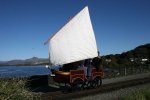
Well, as my wife tells me I’m a rotten mind reader, I’m not sure what you might think it is! . It is a replica of Spooner’s boat, which was a four wheeled trolley used by Charles Spooner, then manager of the railway, as a means of transport down the line. The bow, allegedly, was to enable it to push its way through closed crossing gates, although there is some serious doubt as to whether that was true. The sail is to enable it to cross the cob under its own power (it would go up the line on the back of a train and gravitate back down, but the cob is a mile of flatness). The original came to grief when Spooner and guests decided to gravitate down without a token and met a train coming the other way. No one died, but there were some serious injuries and it pretty much put paid to Spooner’s career.

Nigel
 
Top