The Heybridge Railway, 1889 to 1913

. . brake hangers

RichardG

Western Thunderer
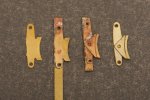
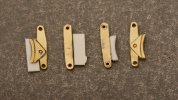
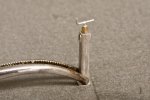
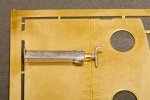
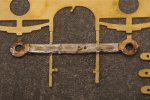
The brake hangers in the kit looked a bit undernourished so I have fattened them up with scrap brass and styrene.

DSC_0421.jpeg
(L-R) An original hanger, laminated onto scrap etch, brake shoe added, and tidied up.

DSC_0423.jpeg
(L-R) Pieces of styrene glued onto the backs of the original hangers, and then profiled to match.

DSC_0436.jpeg
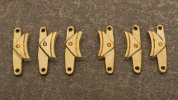
My new background is the piece of steel plate I use with the RSU. If I put the flash head in the right place the light brings out the texture in the metal.
 
. . cab roof, floor and brake standard

RichardG

Western Thunderer
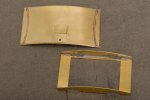
The kit lets you build the cab roof as a lift-out subassembly, and this seems really useful.

DSC_0438.jpeg
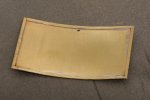
When built, these locos had a wooden cab roof with a distinctive rebate around the edges. I filed down the four edges of the roof panel and added strips of brass to create the rebate. The strips are from Nairnshire Modelling Supplies (eBay), I find them useful for all kinds of detailing.

DSC_0440.jpeg
I tried to use some rolling bars to form the roof but I ended up using fingers to make the final shape.

DSC_0441.jpeg
The ventilation hatch is scrap brass, and the rain strips are tinned copper wire filed flat to suggest wooden battens. Maybe they should be straight but I doubt I will ever find a photo looking down onto a roof.

I have guessed the size of the notches in the supporting frame. These are to let the frame clear the window frames inside the spectacle plates. I must set these parts aside now and see how well the frame fits into the cab before I fix them together.

Having an RSU is like cooking with gas. It is quicker and easier than the iron, and the results are neater and need less cleaning up.
 

RichardG

Western Thunderer
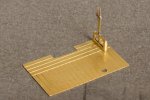
The cab floor carries the reverser lever and (eventually) the brake standard

DSC_0472.jpeg
Some time ago I was pondering whether there are ever any etched parts where I will not remove the cusp. I didn’t remove the cusp from the ratchet on the quadrant.

DSC_0474.jpeg
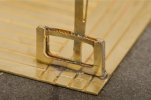
I dressed up the lever with some shim brass.

DSC_0453.jpeg
The casting for the brake standard had a boss at the top, which was off-centre just enough to annoy me. Even though it would be hidden inside the cab. So I filed this off, bored out the standard for a length of tube and then put the handle on top.

DSC_0459.jpeg
The assembly is tall enough to let the handle appear to clear the ledge at the back of the cab.

I fancy painting the floor separately and then fixing it into the model with glue, but whether this is practical I will find out later. Time will also tell me whether the floor fits at all; I may need to enlarge my cut-out to clear the gearbox.
 

spikey faz

Western Thunderer
You could also arrange for the brake standard to be attached to the floor with a nut and bolt in its underside. Makes painting a bit easier.

Mike
 

RichardG

Western Thunderer
DSC_0478.jpeg
I am going to try hanging the brake standard from two pegs in the cab back. There are oversize holes in the back of the brake standard, and I can fix it onto the pegs with epoxy glue after painting.

DSC_0480.jpeg
But will the fireman bark his knuckles on the window frame?

Probably, yes. If the handle could rotate, the clearance will be a scale 20 mm. Yes I could put a 1 mm shim behind the brake standard, or fabricate a shorter handle, but I'm not sure if anyone will notice the effort!

The Z-fold remains unsoldered so I can tweak it when I put the superstructure together.
 
. . train brake and drawgear

RichardG

Western Thunderer
And now, the honeymoon is over. I have worked up most of the subassemblies where I have wanted to customise things. I have got to decide which loco I am trying to make.

The NER built just three of these locos. They are all different in one way or another; and the kit caters for only some variations . . .
  • Number 407 was rebuilt in 1907 with taller side tanks, and had different cab steps
  • Number 1787 had smaller sandboxes
  • Numbers 407 and 1787 received the Westinghouse brake in 1907
  • Number 1662 had parallel-sided buffer stocks (similar to GER ones) but never received the Westinghouse brake
Numbers 407 and 1787 were built in 1897; number 1662 arrived in 1907. If I want a loco to serve the Heybridge Railway from 1897 through to beyond 1907, I need to do some creative modelling i.e. fudge things. The best compromise for me is a fictional fourth member of the class, supposedly built alongside the first two in 1897. To do this I am going to build a model of 1662 in its original condition, but giving it a Westinghouse brake and screw couplings.

This way, a future owner can readily convert the model to represent 1662, in its NER or LNER condition or even being used in industry. I am making something which can be useful in the future as well as now.

DSC_0484.jpeg
I have given the cab front two offcuts of tube to hold the Westinghouse pump. The idea is to glue the pump into place after painting. Also a rebate for the gearbox driving onto the rear axle.
DSC_0448.jpeg
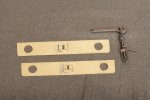
The couplings will be screw couplings from Premier Components.

I have never worked out a decent way to open up this sort of narrow slot. My approach is to find a drill bit with a diameter to match the desired slot width. Run the bit through the slot in a few places, and then work the part backwards and forwards, using the flutes of the bit as if it were a milling cutter. This works using a soft brass part and a pillar drill, but the brass does hurt if you lose your grip on it. There must be a better way.

 

RichardG

Western Thunderer
Coupling Slot. Drill central hole same diameter as your coupling shank is thick and open out with your piercing saw!

The piercing saw . . . well there's a thought!

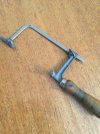
I have found it, at the very bottom of my toolbox for modelling. Unused for years. The blades have 17 teeth per inch . . . I'll try to find something finer. I am getting by with tin snips, craft knife blades, a razor saw blade, drilling rows of holes and joining them up, and slitting discs in the mini drill. The piercing saw would be good.
 

Ian@StEnochs

Western Thunderer
Richard,

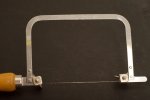
That doesn't sound like a piercing saw that you have there, far too coarse, more like a fret saw or coping saw, both of which are aimed at cutting wood. What you want is one of these. The blade fitted is a number 0 with 50 teeth per inch, my general purpose one for most platework up to 22thou.

piercing saw.jpeg
 

paulc

Western Thunderer
The brake hangers in the kit looked a bit undernourished so I have fattened them up with scrap brass and styrene.

View attachment 245732
(L-R) An original hanger, laminated onto scrap etch, brake shoe added, and tidied up.

View attachment 245733
(L-R) Pieces of styrene glued onto the backs of the original hangers, and then profiled to match.

View attachment 245734
My new background is the piece of steel plate I use with the RSU. If I put the flash head in the right place the light brings out the texture in the metal.
Looks like a cork mat so I'm glad you told me it was steel .
 

RichardG

Western Thunderer
My piercing saw frame was a present from my father, around 45 or 50 years ago. I expect I asked for a piercing saw for my birthday, and he would have discussed this with the shop keeper. They would have wanted to see me get a result. Dad knew I would get frustated with breaking blades, and so I received a piercing saw frame and a packet of compatible fret saw blades. This was decades before the Internet and we would have used the terms piercing saw and fret saw interchangeably.

I await the delivery of my “gross”, which won’t be as many as it sounds because I have bought a packet of mixed sizes.
 

RichardG

Western Thunderer
I put off assembling the side rods because I wanted to get some practice in with the RSU. I will need them soon to let me build the frames.

DSC_0488.jpeg
Each rod has three layers. I assembled them on the fret to help me hold them and to provide the electrical path for the RSU. This kit was drawn by hand, the minor discrepancies are now hidden with filing and extra solder.

DSC_0491.jpeg
I inserted the dummy pivot pins from the back. The plain washer makes a clearance to let the pin sit proud of the front of the rod.

DSC_0494.jpeg
The rods are articulated at the middle crank pin. The tinning top-left is hiding some minor rippling on the overlay on this rod. I am sure it is best to get the various layers together before trying to remove the nibs.

All of the etches in the kit are brass, and so the side rods are brass. It may be, the rods turn out to be the weakest part of the kit. Then again, they are simply not going to wear during a lifetime on a small shunting layout with occasional excursions along other people’s test tracks.
 
Top