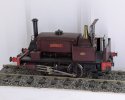
The Heybridge Railway, 1889 to 1913

RichardG

Western Thunderer
There is only ONE position where the frames are straight, free of twist, with the wheels spaced exactly the correct distance apart and the axles square to the frames.

I agree, but the tolerances to which we work do allow an inifinite number of valid solutions - even if our techniques, materials and measuring devices can create and detect only some of them. Given techniques including jigs, graph paper and long steel rods, and experienced modellers getting results using these, I do think there is no single best practice and I need to stop looking for one.

This afternoon I assembled a flat pack coffee table while a concert pianist worked through Rachmaninov's piano concerto no.2. In fact we both finished simultaneously. The flat pack was a doddle and I would hate my model train hobby to be so simple. It has to be difficult to bring some satisfaction and the confidence to try for more next time. If this were not the case I'd go to a Chinese takeaway.

I have decided to buy a perfectly satisfactory kit, and alter it to make a model different and perhaps a bit better. If I pull it off, then I will have done something reasonably intelligent by writing about it here. I will have benefitted, and so should people contemplating something similar. If it turns to failure then I will feel a bit stupid for spoiling a good kit and wasting everyone's time and interest, but having had a day away from it I am now quite contented with what I have done to far.
 

simond

Western Thunderer
Yes but…

simply, you will not fail (Unless you choose to give up, and that does not seem at all likely)

There are enough experienced amateurs and some very capable pros who will surely offer support and advice (though having in mind the “two engineers” joke, you may have to choose the most applicable advice!) to ensure that you will, eventually, have a chassis that works properly.

Worst case, you might scrap it and start again. You have a gross (less one or two) of fretsaw blades, and can buy the NS or Brass at Stafford.

And the thread will contain the problems, the suggested, and the eventually chosen, solutions and the outcomes of applying those solutions. Which is great because the next person walking this road will have yet more guidance from which to choose.

atb
Simon
 

RichardG

Western Thunderer
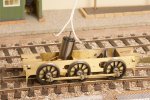
I have decided to install the motor and wheels temporarily, to get an idea of how good or bad this chassis is going to be. Before I finish building the frames.

DSC_0553.jpeg
This is my method for filing down the crankpin bushes.

DSC_0555.jpeg
The offcut of brass guarantees a clearance for the side rod beneath the crankpin washer.

DSC_0561.jpeg
With all six crankpin nuts loose, running is near perfect. With four tightened, it is just as good. I have tight spots on one, possibly two crankpins . . . I want to leave well alone for now, because when I start fettling parts then individual wheels and crankpin bushes have to go back in the same place. I can leave this until later, even after painting the frames.

DSC_0564.jpeg
This has not been without event. Muggins left enough space for the motor/gearbox but not for the final drive gear, so a slot had to go into this frame spacer. This photo shows the amount of endplay I have on the axles, I have some shim washers to sort this out.
 
Last edited:

RichardG

Western Thunderer
DSC_0569.jpeg
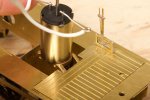
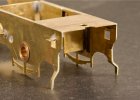
This is the space where the gearbox will fit in front of the footplate and underneath the backhead.

The motor is going to have to lean forwards a little so it doesn't touch the cab front. I expect I will have to shorten the motor spindle so it doesn't foul against the top of the boiler, but fundamentally the Slater's SG38 is going to fit into the model without intruding into the cab. This clears up the last big doubt I had about the build.
 

RichardG

Western Thunderer
simply, you will not fail (Unless you choose to give up, and that does not seem at all likely)

I gave up on 'River Pant' because I felt I was building the wrong model. I will be much happier tackling models of real locomotives, even if (as with the H2) I have to fabricate some of the history behind them to make them fit the project.

I think I got a bit too close to the H2 last week. This happens when you are retired and there isn't much reason to put things down and do something else. I am happy with everything I have done on the loco so far, there is nothing I want to dismantle and re-do.
 

RichardG

Western Thunderer
Adjust the bushes‘ diameter, rather than that of the holes!

I agree entirely but I ask for a concession here because one side rod is (effectively) that tiny bit too long.

DSC_0580.jpeg
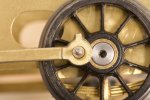
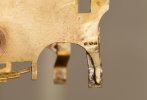
This is my tight spot, this is on the leading axle.

I suspect the cause of this is the extended axles supplied with the Poppy's builder box being an obviously sloppy fit into the side rods. I have a lathe, maybe I should make up a set of new extended axles with tapers on their ends. Like the extended axles from Premier but longer.

Given that the side rod needs to pull as well as to push the wheel around, I think it is better to adjust the rod by giving it a mildly oval hole, i.e. move the centre of the hole. I have run a fine rat tail file inside the rod, taken off just enough to make a clearance. I now have a beautifully-running chassis, very happy with this.
 

alastairq

Western Thunderer
Excellent work....nice close up photo, too.

I have run a fine rat tail file inside the rod, taken off just enough to make a clearance. I now have a beautifully-running chassis, very happy with this.

Does this mean, your sound chip will contain the very obvious clank of a worn rod too? :)
 

RichardG

Western Thunderer
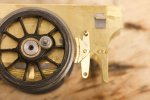
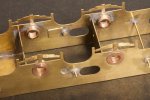
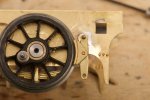
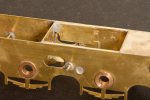
Adding the pivot rods for the brake hangers has taken more work than I expected.

DSC_0584.jpeg
The original placement lets the builder use coarse-scale wheels, and also allows easy removal of the wheels. I want something a little more realistic.

DSC_0596.jpeg
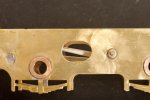
I have moved all of the brake hanger rods backwards, to be closer to their associated wheels. A more skilled person might fill the old holes and drill new ones, but it seemed easier for me to elongate the existing holes (piercing saw!) and hide the worst of the surgery under small washers. I did all of this twice because I was unhappy with the brake/wheel gaps the first time round . . .

The front suspension is a simple rocking axle as described in the kit instructions. I used a 3/16 inch milling cutter to elongate the holes in the bushes.

DSC_0598.jpeg
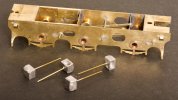
On the prototype, one rod passes below the ash pan. This is where I am putting the gearbox, so I reinforced the joints onto the frames with brass nuts and then cut away the middle part of the rod.

DSC_0586.jpeg
I will now have to paint the frames and install the wheels before I fix the brake hangers into place.
 

RichardG

Western Thunderer
That looks much better.

Mike

Yes I did contemplate simply bending the rods backwards to get the brakes into alignment but I knew I would never be happy with this.

I suppose, what I am doing here is rebuilding a coarse scale chassis (1989 vintage) as a finescale one. Only the two frames have escaped rebuilding or complete replacement. It is giving me a good insight into what I might find myself doing if I try for a ScaleSeven loco.

I have now worked through most of the frames assembly as intended in the design of the kit, so I can have a think about representing the ash pan, some better springs and possibly the connecting rods and motion. The apparently innocent act of cutting a rectangle out of the running board "to make the model more realistic" has somewhat snowballed into a succession of further work! Though a pair of strategically-placed toolboxes could hide the lack of detail between the frames very easily.
 

RichardG

Western Thunderer
DSC_0601.jpeg
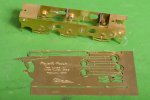
Most of three years ago, @Martin Shaw sent me a parcel of his scrap frets and etches. This was ever so kind, they have been repeatedly useful but the best bits so far are the two connecting rods from a Majestic Models J36.

DSC_0611.jpeg
I have arranged these in the space revealed by opening up the running board.

DSC_0609.jpeg
This has got to be better than having an empty space, and I have something to paint red (or cream).

DSC_0610.jpeg
The rods are visible looking through the cutouts in the frames too.

DSC_0606.jpeg
I have also had a go at representing the ash pan. I have put lengths of 1mm square brass along the tops of the frames, and hung some partial ash pan sides from these. The frames are a lot stiffer around the motor/gearbox space now.
 

RichardG

Western Thunderer
DSC_0610.jpeg

The rods are visible looking through the cutouts in the frames too.

Looking more critically at my effort, I am sure the connecting rods should be diverging towards the cranks not the cylinders. I can live with what I have done, I doubt many people will notice unless they have read this post :oops:
 

RichardG

Western Thunderer
Experience shows guard irons and sand pipes get knocked and then bend or fall off far too easily.

DSC_0626.jpeg
I have doubled-up the thickness of the guard irons to beef them up a bit. It is important, to form the profiles of both layers before sweating them together. Otherwise they will never move.

DSC_0630.jpeg
Then file to shape after soldering up. These should stay put forever.

DSC_0635.jpeg
I have drilled right through the sandboxes so the "pipes" (brass wire) pass right through them.

I will put off attaching the sandboxes because I want to try for some better springs first. So this post wraps up the assembly of the frames for a short while.
 
( Diversion : K&ESR and the Colonel Stephens Railway Museum )

RichardG

Western Thunderer
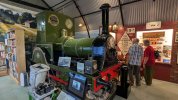
We went to the Colonel Stephens Museum at the K&ESR yesterday. This might be the best railway museum in the world, it is so well laid-out and the displays are just right for the subjects portrayed.

2025-09-07 10.59.50.jpeg
The smell of steam spread across the car park to welcome visitors.

2025-09-07 11.45.40.jpeg
I thought this looked like a model.

2025-09-07 12.16.18.jpeg
One of many real models complementing the historic bits and pieces in the museum. All of the models are behind glass, some photograph better than others.

2025-09-07 13.08.57.jpeg
'Sankey' built by @Allen M doesn't seem to have moved since my last visit, this model was really useful when I built my 'Lady Marion'.

2025-09-07 12.16.54.jpeg
'Gazelle' was blue the last time I saw her.

2025-09-07 13.30.29.jpeg
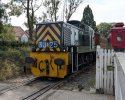
The railway's "vintage train" as it was running yesterday.

The gift shop is selling a new book by Brian Janes, "Colonel Holman F Stephens, The Man and His Railways". Published in June this year by The Colonel Stephens Railway Museum. This looks like a good read, it describes the man himself as well as his railways.

A great day out.
 

Simon H

Western Thunderer
Coincidentally, I almost popped in there yesterday myself, as I drove from Herefordshire to our old house not far from Tenterden.
As it turned out, I visited Pendon Museum instead, but I quite agree, the Colonel Stephens Railway Museum is excellent.
 

AllenM

Active Member
Thanks Richard.
It's nice to know some of my work is still there. I also built Hesperus from the WCPLR and a few wagons and a couple of display boards.
I would like to visit again but it's a long way from Kidderminster and seams much longer since I'm in my now 84.
Regards
Allen
 

RichardG

Western Thunderer
It's nice to know some of my work is still there. I also built Hesperus from the WCPLR and a few wagons and a couple of display boards.

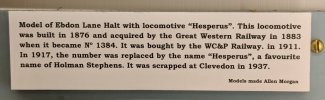
Ah ha! Mention of Hesperus takes me to these photos. I was rather attracted to the model of Ebdon Lane Halt. It seemed like the sort of model I could build for myself, maybe keep in the living room to display my latest wagon or whatever. So I took a few photos . . .

2025-09-07 12.23.58.jpeg

2025-09-07 12.23.33.jpeg

2025-09-07 12.23.51.jpeg

2025-09-07 12.24.07.jpeg

2025-09-07 12.24.38.jpeg
(The lamp is a ghost reflection from outside the display case)

2025-09-07 12.26.44.jpeg
The model is still in perfect condition, no obvious dust or fading.

I am rather sorry to say, I was so taken with this diorama I walked away thinking about possibilities for my Heybridge Railway and so I didn't take photos of the models nearby.
 
Top