
You are using an out of date browser. It may not display this or other websites correctly.
You should upgrade or use an alternative browser.
You should upgrade or use an alternative browser.
Threadmarks
View all 208 threadmarks
Reader mode
Reader mode
Recent threadmarks
GER sand wagon ( Diversion : railbuses at the Middy and elsewhere ) ( Diversion : soldering white metal to brass with the RSU ) New The Heybridge Railway goes DCC . . converting the locos New . . controller usability, and reclaiming old decoders New . . first steps with JMRI New . . Sprog installation New Workbench power and lighting New

RichardG
Western Thunderer
Solder it all up, nobody will notice that there are no left hand threads.
how about 4mm scale screw couplings?
I have a Hattons P class with its factory screw couplings, and they are going to be much too short - around 11 mm while I want about 17 mm. But, supposing I forget all about screw threads, I have a solution using handrail knobs and tube . . .
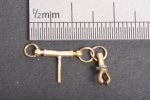
Some adjustment to the overall length is possible - I can flatten the rings to make them oval and longer; or make smaller ones.
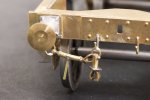
During assembly I found the holes in the two handrail knobs need to be roughly at right angles to each other, not parallel as in the last photo. I have soldered this assembly solid to help it to survive, but in such a way as to make it look like the parts are hanging loosely.
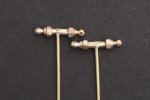
A mate suggested this would even better if I included some hex nuts at the ends of the tube. So these are the "deluxe" turnbuckles for the other end of the chassis.
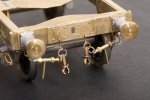
Again, I let the links hang loose and soldered them up where they came to rest.

I think, this is my first modelling which is subjectively and objectively better than something RTR out of a factory. I mean, it looks better; and really it is more protoypical than having identical moulded parts for each clamp assembly. Thank you especially to @Brian McKenzie for getting me started on these.
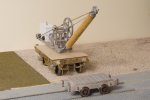
Compromises mean, I now have a model which cannot run in train (fixed jib) and cannot be used for lifting (rail clips stowed). Still, the overall effect is okay. I like the proportions, and a coat of paint will bring the different finishes together.
RichardG
Western Thunderer
Going back to the magnets . . .

My test rig is two lengths of n/s wire attached to brass tubes. The tube with the hook contains four magnets, the tube on the left contains three. Stacking the magnets doesn't create a stronger pull but it does make them easier to see and pick up and glue into place.
The piece of extra tube makes a small socket. So the two parts will only pull apart in one direction rather than sideways as well. I doubt the socket makes much improvement. There is a loose magnet here to complete the picture.
Using the kitchen weights, the hook copes with a load of 14 grams with the tip of its tube hanging from a piece of mild steel; and 21 grams hanging from the tip of the second tube. Not 28 grams.
If I make two assemblies like this for the crane (one each side) then the jib will hold itself up but will not carry a load as well. So I want to leave the model alone and save the magnets for something else. If anyone would like some magnets to experiment/play with then PM me and I can post some across. Maybe they would be useful for getting model people to stand up on suitably ferrous surfaces.
I have bought a hundred tiny magnets to experiment, these are 1 mm diameter x 1 mm long. An appeal of these particular ones is they come with a performance specification, which is a pull of 15 grams. Yes the specification is theoretical not measured, but it is at least a guide..............unless you cut the jib stays just at the 2 links...and lower the jib to its travelling position? Then maybe use a couple of tiny round magnets attached to the links themselves, to join them, for posing the jib in the raised position?
Choices? Decisions, decisions?
My test rig is two lengths of n/s wire attached to brass tubes. The tube with the hook contains four magnets, the tube on the left contains three. Stacking the magnets doesn't create a stronger pull but it does make them easier to see and pick up and glue into place.
The piece of extra tube makes a small socket. So the two parts will only pull apart in one direction rather than sideways as well. I doubt the socket makes much improvement. There is a loose magnet here to complete the picture.
Using the kitchen weights, the hook copes with a load of 14 grams with the tip of its tube hanging from a piece of mild steel; and 21 grams hanging from the tip of the second tube. Not 28 grams.
If I make two assemblies like this for the crane (one each side) then the jib will hold itself up but will not carry a load as well. So I want to leave the model alone and save the magnets for something else. If anyone would like some magnets to experiment/play with then PM me and I can post some across. Maybe they would be useful for getting model people to stand up on suitably ferrous surfaces.

Dog Star
Western Thunderer
Thank you for solving a problem that has been bothering me for some time.Maybe they would be useful for getting model people to stand up on suitably ferrous surfaces.
The late Bob Alderman had removable figures on his show layout "St Martin's Wharf" and after several shows the holes in the platform tended to be oversize... I do not recall Bob having an answer to leaning peeps. However, if I put a thin sheet of tinplate under the platform surface and a magnet in each foot of a figure then I han position the figure with some freedom and no unsightly holes in the ash surface.
Rgds, Graham

magmouse
Western Thunderer
However, if I put a thin sheet of tinplate under the platform surface and a magnet in each foot of a figure
Experiment needed - the force of the magnet will drop off rapidly as the distance increases between the magnet and the metal plate. The thickness of the scenic finish over the tinplate will be critical, I suspect. An alternative would be to put a round nail of a suitable size into a hole in the platform surface, and chemically blacken and/or paint its end. Less flexible than the sheet, as figures have to go in specific places, but possibly easier to disguise in the midst of the scenic surface of the platform.
Nick.
RichardG
Western Thunderer
Why not just put a hook on the end of the stay rod? Hook onto jib top or the midway lug on crane A-frame.
We have a similar crane preserved at Shildon with its jib lowered, and lots of photos by @Rob Pulham:
The stay rods detach beyond the A frames, and I wanted to represent this.
To be honest, the kit claims to be "a general purpose model based on prototype practice but amalgamating ideas from several prototypes".
The instructions for routing the stay rods through or onto the A frames are vague, and the weight box is a bit peculiar, so I took a few details from the Shildon crane when I built my model.
RichardG
Western Thunderer
Experiment needed - the force of the magnet will drop off rapidly as the distance increases between the magnet and the metal plate. The thickness of the scenic finish over the tinplate will be critical, I suspect. An alternative would be to put a round nail of a suitable size into a hole in the platform surface, and chemically blacken and/or paint its end. Less flexible than the sheet, as figures have to go in specific places, but possibly easier to disguise in the midst of the scenic surface of the platform.
Nick.
Yes I don't want to raise hopes unnecessarily. These magnets aren't going to cope with anything more than a sheet of thin paper or a coat of paint over the tinplate. If I had a go I would try embedding steel panel pins into the station platform and disguising them with paint. If they worked I would put some extra pins to allow flexibility in placing the figures. Spare figures could be stowed on a sheet of tinplate or steel, instead of the usual block of wood with holes to take the leg pins.
GER gunpowder van (1909)
RichardG
Western Thunderer
I took the mobile crane along to NEEGOG on Saturday, where it ran well. It’s always cheering to receive compliments and someone from WT told me “the model looks better than it does in the pictures”. So I guess it is best to not put up any more pictures of it for a while!
Moving swiftly on to Sunday (yesterday) I took ‘Lady Marion’ and the unpainted ‘Quintus’ along to the Kloggie’s Christmas event at Runcton Holme. Our host’s test track has received a substantial overhaul since the summer time, and so guard irons no longer bottom-out while traversing the dips at rail joints.

Seeing the Manning Wardle near to mainline locos always reminds me, the space I have at home will always restrict me to light railway and similar subjects.
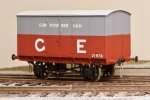
This van was far too good to pass by. It is from the estate of a modeller who reached the age of 94. Built from the Ragstone kit.
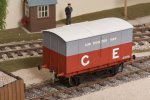
The GER applied this livery from 1909. A back story will need some imagination . . . at the moment I am thinking of munitions testing off Osea or Northey Island. This practice being short-lived because of the nuisance to shipping.
Moving swiftly on to Sunday (yesterday) I took ‘Lady Marion’ and the unpainted ‘Quintus’ along to the Kloggie’s Christmas event at Runcton Holme. Our host’s test track has received a substantial overhaul since the summer time, and so guard irons no longer bottom-out while traversing the dips at rail joints.
Seeing the Manning Wardle near to mainline locos always reminds me, the space I have at home will always restrict me to light railway and similar subjects.
This van was far too good to pass by. It is from the estate of a modeller who reached the age of 94. Built from the Ragstone kit.
The GER applied this livery from 1909. A back story will need some imagination . . . at the moment I am thinking of munitions testing off Osea or Northey Island. This practice being short-lived because of the nuisance to shipping.

Osgood
Western Thunderer
Good job it isn't coupled to a match truck then.It is a rather striking livery…
RichardG
Western Thunderer
The colour certainly clashes with my interpetation of GWR red!It is a rather striking livery…
Putting this wagon on the layout says to me, Edwardian times have arrived. The railway is in its heyday, but it won't last.
Dog Star
Western Thunderer
Undoubtedly if there is a visit from Tony's match truck.The railway is in its heyday, but it won't last.
RichardG
Western Thunderer
Happy Christmas
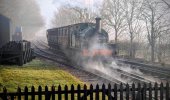
"Illingworth" propels a Santa special out of Brockford earlier today.
We hadn't booked tickets, we just drove to the railway to see some steam and visit the bookshop.
I doubt I will manage much modelling next week, so a very Happy Christmas to everyone at WT

RichardG
Western Thunderer
Yes I remember when Marion showed me a stained glass box she had bought from the charity shop in Boreham. This was designed to be placed over a lighted candle and had stood on my mantlepiece for years. She had bought it as a present for a friend. I had donated it two days before . . .
RichardG
Western Thunderer
What an evocative image...
What is better than steam, sunlight and a branch line scene...
Yes the lighting was really good, and it stayed useful later in the day after the mist had lifted.

The budget lens in the mobile phone probably did this better than a "proper" lens on the DSLR would have managed.
I have a Slater's kit to make something similar for the Heybridge Railway.
RichardG
Western Thunderer

Compromises mean, I now have a model which cannot run in train (fixed jib) and cannot be used for lifting (rail clips stowed). Still, the overall effect is okay. I like the proportions, and a coat of paint will bring the different finishes together.
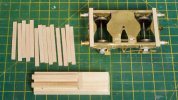
Back to the mobile crane, the planks for the wagon deck are coffee stirrers. The cutting jig worked best with the piercing saw.
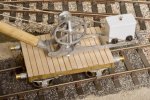
I could find space for 16 or 17 strips. I went for 16 so I had gaps between them like on the crane at Shildon.
My method of assembly was to spread slow-setting epoxy glue onto the chassis, and then shuffle the strips around over and over again until the gaps were right. This took ages but Araldite gives a full three hours.
The nice thing about using coffee stirrers is the cut ends look like solid wood not plywood.
One of the many wonderful things about Western Thunder is the way that people do not merely encourage me along (for which I am most grateful) but also suggest additional features and details for a model after I think the darned thing is finished

I think it really is finished now
Threadmarks
View all 208 threadmarks
Reader mode
Reader mode