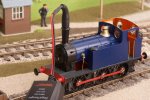
The Heybridge Railway, 1889 to 1913

RichardG

Western Thunderer
I forgot to post the credits for the H2:
  • Jim McGeown (Connoisseur Models): kit, dummy springs, clack valves
  • K&S Metals: strip brass for wider frame spacers
  • Light Railway Stores: nameplates
  • Micron Radio Control: radio transmitter and receiver, power switch
  • Nairnshire Modelling Supplies: nickel-silver wire for handrails and sand pipes
  • Premier Components: screw couplings
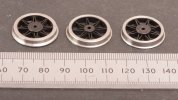
  • Slater’s Plastikard: wheels, motor/gearbox
  • Walsall Model Industries: buffers
Such a short list of suppliers is surely a testament to how good the kit is. Thanks Jim :thumbs:
 
. . at NEEGOG (9 May) and battery endurance New

RichardG

Western Thunderer
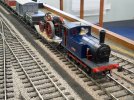
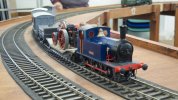
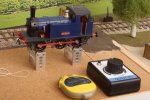
'Quintus' has finally run at NEEGOG in a self-contained sort of a way, without needing a service wagon to carry its batteries and control gear and indeed with paint.

2026-05-09 11.21.56.jpeg
The lighting here is a mix of daylight and fluorescent tubes. I will stop whingeing about my paint job, its only my better camera which brings out the faults.

2026-05-09 11.18.21.jpeg
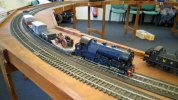
The red light is from the LED on the Micron receiver. It's one of those things which I probably ought to hide, but will doubtless find essential as soon as do. It is not (as someone suggested at Albury) a firebox glow. Truly.

2026-05-09 11.44.03.jpeg
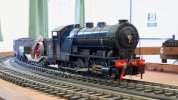
After a while the batteries expired so a GER A55 took over the train. Somehow, this is quite an appealing consist despite the Decapod being a passenger loco.

2026-05-09 11.47.05.jpeg
I would never want to own or build one of these but it was good to watch.
 

alastairq

Western Thunderer
Ahhhh! The Wootten firebox.

Didn't the USA design & use camelback locomotives with such a firebox, to burn anthracite..[Or was it, poor coal?]
 

Ian@StEnochs

Western Thunderer
The latter, I think. Anthracite burns hot and quite clean. And if my childhood memories serve, cost quite a bit more.

I can confirm that! I got some Anthracite beans to fire my first 1/4 scale traction engine and melted the cast iron fire grate. Made lots of steam though.
 

RichardG

Western Thunderer
A few people have asked me about the life (endurance) of the batteries in the H2, and I have replied I don't really know.

I do know a couple of things:
  • The batteries became substantially depleted yesterday at NEEGOG, after perhaps two hours total running spread between there and at Albury and on test at home
  • Charging back to full capacity yesterday evening took barely an hour
I suspect the capacity of the two-thirds AAA batteries is substantially less than the 400 mAh claimed by their manufacturer, simply because the recharging was so quick.

To keep the maths simple I will say the radio receiver/controller consumes 30 mA, and the loco motor averages 90 mA. These figures are about 10% high to keep my estimate conservative.

Suppose the loco runs constantly, like at NEEGOG

  • The model consumes 30 + 90 = 120 mA
  • Battey capacity appears to be around 240 not 400 mAh (because 2 hours x 120 mA = 240mAh)
Suppose the loco runs with a 1:5 duty cycle on my shunting layout
  • The model consumes an average of 30 + ( 90 / 5 ) = 48 mA
  • Battery endurance will be about 240 / 48 = 5 hours
Suppose I leave the loco switched on and forget about it
  • The model consumes an average of 30 mA
  • Battery endurance will be about 240 / 30 = 8 hours
Five hours is less useful than the seven hours I predicted, but the one-hour recharge could be helpful. I need at least one more locomotive to provide cover if I want to operate for a seven-hour show, but the railway does now have access to six more locos apart from this one!

The Micron MR603 receiver offers a substantially reduced power consumption over the MR601 I used here because the board is large enough to hold a more sophisticated power regulator. I had to choose the smaller receiver to fit it into the model.

Maybe this is useful to someone, though I don't know whether the people who asked me are on WT.
 

RichardG

Western Thunderer
Suppose the loco runs with a 1:5 duty cycle on my shunting layout
  • The model consumes an average of 30 + ( 90 / 5 ) = 48 mA
  • Battery endurance will be about 240 / 48 = 5 hours

Of course, the loco does not consume 90 mA all the time when it is running on a shunting layout. It has to start, build up speed, slow down and stop; and on 'Heybridge Basin' it can hold its maximum speed for only a few seconds at a time. Its average motor current consumption whilst moving might be closer to 75 mA. The model will thus consume 30 + (75 / 5) = 45 mA, and predicted battery endurance increases to about 240 / 45 = 5 hr 20 min.

In fact, things are probably even better. I have been running the loco on rollers at about half its maximum speed. The motor will be consuming 60 mA (measured) so 60 + 30 = 90 mA in all. The predicted run time is 240 / 90 = 2hr 40 min.

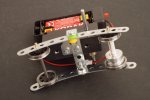
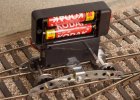
DSC_2462.jpeg
Starting with a fully-charged set of batteries, the loco eventually stopped after about three and a half hours. I will say, 3 hr 20 min to keep the numbers easy. This suggests the true battery capacity is nearer to 3.33 x 90 = 300 mAh.

This lets me suggest some better answers to the original question:
  • Standing stationary: 300 / 30 = 10 hr
  • Shunting with 1:5 duty cycle: 300 / 45 = 6 hr (looks useful)
  • Light engine, continuous running at half speed: 300 / 90 = 3 hr 20 min
  • Eight-wagon train, continuous running at maximum speed: 300 / 150 = 2 hr
"About two hours on a roundy roundy, six hours on a plank".
 
Top