
You are using an out of date browser. It may not display this or other websites correctly.
You should upgrade or use an alternative browser.
You should upgrade or use an alternative browser.
4mm Ivatt Class 2, 2-6-2 tank in P4
- Thread starter Dave Holt
- Start date


Lyndhurstman
Western Thunderer
Lovely work. Steps in the right direction 
Cheers
Jan
Cheers
Jan

Dave Holt
Western Thunderer
Thanks for the kind comments.
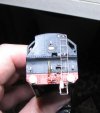
The ladder and a couple of other detailing parts have been fitted to the bunker rear. The other parts include the electrical connector block, its protective hood and the plug and holster for the motor train bell code system.
Rear view:
and slightly blurred rear three quarters view:
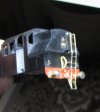
Now I have to remember not to put the body down the right way up as the bottom of the ladder protrudes below everything else. OK with the chassis fitted.
Dave.
The ladder and a couple of other detailing parts have been fitted to the bunker rear. The other parts include the electrical connector block, its protective hood and the plug and holster for the motor train bell code system.
Rear view:
and slightly blurred rear three quarters view:
Now I have to remember not to put the body down the right way up as the bottom of the ladder protrudes below everything else. OK with the chassis fitted.
Dave.
Apologies to Dave for the sales pitch in the middle of your build topic - but the ladder (as well as the etch of other detailing that Justin did from Dave's designs, which has been available for a while) have now had the production version released.
I look forward to seeing more of your build as you get to it, I appreciate you're busy with the C13 currently!
I look forward to seeing more of your build as you get to it, I appreciate you're busy with the C13 currently!
Dave Holt
Western Thunderer
No problem, Pete. The Ivatt work stalled because I couldn't successfully drill the 0.25 mm diameter oil pipe holes in the lovely 3D printed lubricators that Justin produced for me. I've now got some drilling jigs to try and help but moved on the Brassmasters Black Five in the mean time and now, of course, the C13. I will get back to it some time.
Dave.
Dave.
Dave Holt
Western Thunderer
To fill a lull in the C13 project, thoughts have returned to the Ivatt. One of the outstanding jobs is sorting out the mechanical lubricators (and oil pots). These have been 3D printed to represent the two quite different lubricators fitted to these locos, especially the push-pull fitted examples.
Early prints included the hexagonal pipe union nuts (mainly 0.6 A/C) but it proved impossible to reliably drill these out to 0.25 mm (my smallest drill bit size) for the "pipes". Replacements have been made that had rows of holes along each side. Unfortunately, these holes were not very deep so it has been necessary to drill through, progressively going from 0.35 to 0.5 mm. Lengths of 0.5 x 0.3 mm brass tube were then inserted to represent the nuts. Black Loctite 480 has been applied to outside face with the hope that capillary action will draw some in and fix the tubes. Once cured, the bores will be cleared so fine brass wire can the fed through. Scale diameter is 0.125 mm (3/8" full size).
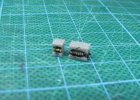
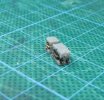
Here are the two lubricators. The very short one is the RH, 8 feed mechanical lubricator and the longer one, with bolted flat cover and filling spout is the LH, 14 feed cylinder lubricator. This latter also has steam heating coil connections in the end.
The piping up of these is going to be a challenge to get a neat arrangement.
Dave.
Early prints included the hexagonal pipe union nuts (mainly 0.6 A/C) but it proved impossible to reliably drill these out to 0.25 mm (my smallest drill bit size) for the "pipes". Replacements have been made that had rows of holes along each side. Unfortunately, these holes were not very deep so it has been necessary to drill through, progressively going from 0.35 to 0.5 mm. Lengths of 0.5 x 0.3 mm brass tube were then inserted to represent the nuts. Black Loctite 480 has been applied to outside face with the hope that capillary action will draw some in and fix the tubes. Once cured, the bores will be cleared so fine brass wire can the fed through. Scale diameter is 0.125 mm (3/8" full size).
Here are the two lubricators. The very short one is the RH, 8 feed mechanical lubricator and the longer one, with bolted flat cover and filling spout is the LH, 14 feed cylinder lubricator. This latter also has steam heating coil connections in the end.
The piping up of these is going to be a challenge to get a neat arrangement.
Dave.
Dave Holt
Western Thunderer
The RH mechanical lubricator has been "piped"-up and fitted. Have to say, the result is not quite as neat as I would like but I'm going to live with it and doubt I could do much better with another attempt. Perhaps a bit too much solder was used on the front run of 4 pipes.
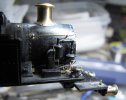
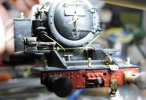
Bearing in mind the photo is about 5 times full size, perhaps it's not too bad after all.
The LHS has seven pipes, each side, rather than the four here, so is a bit more of a challenge.
Dave.
Bearing in mind the photo is about 5 times full size, perhaps it's not too bad after all.
The LHS has seven pipes, each side, rather than the four here, so is a bit more of a challenge.
Dave.


Dave Holt
Western Thunderer
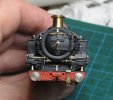
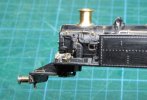
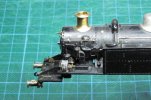
Taking a diversion from The Diversion, whilst my repaired drill stand returns, I've done some work on the cylinder lubricator and its associated four feed atomiser. The prospect of trying to get a neat arrangement of the seven oil pipes across the front was quite daunting but I'm fairly pleased with the result.
Here are the cylinder lubrication arrangement on the LHS running plate.
Dave.
Here are the cylinder lubrication arrangement on the LHS running plate.
Dave.

Mike Garwood
Western Thunderer
Fair play Dave! Wonderful stuff.
Mike
Mike

P A D
Western Thunderer
Dave,The RH mechanical lubricator has been "piped"-up and fitted. Have to say, the result is not quite as neat as I would like but I'm going to live with it and doubt I could do much better with another attempt. Perhaps a bit too much solder was used on the front run of 4 pipes.
View attachment 232345View attachment 232346
Bearing in mind the photo is about 5 times full size, perhaps it's not too bad after all.
The LHS has seven pipes, each side, rather than the four here, so is a bit more of a challenge.
Dave.
A circular steel wire brush spun in the mini drill with care should shift the excess solder.
Cheers,
Peter
Dave Holt
Western Thunderer
I really do seem to have hit a brick wall (or should that be "buffers"?) with this loco. A shame because there's not that much to do, but it's all very fiddly. In fact, apart from finishing off the C13, I just don't have any motivation for active modelling right now.
However, yesterday I forced myself to start on the oil pots mounted on the supports at the front of the footplate. The Bachmann moulding is very poor in this area, with the brackets the wrong shape and size, very crudely moulded footsteps and the prominent hole in the wrong place. Apart from that, it's perfectly modelled!
The moulded version is seen in post 111, above. The brackets should look like this.
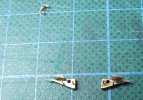 The two wire pegs sticking out are the mountings for the front oil pots.
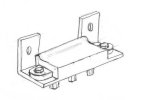
Originally, I had these 3D printed but i think it was pushing the technology too far and the prints could not have holes up the bottom gland nuts for the pipes and I just couldn't reliably drill 0.25 mm holes in them either.
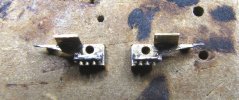
Recently, I designed a slightly simplified version as a fold up etch, which uses 0.4 mm O/D tube to represent the gland nuts. Yesterday I made up the first one and, keen to see how the finished item would look, I cut of the excess tubes using the etched jig to set the length. Oh no!!! I'd forgotten to fold over the cutting jig etch to double the thickness so had very precisely and neatly cut them to half the correct length - a purely self inflicted error that has left me rather despondent and not inclined to start on two more. Hopefully, that will come before too long. The ruined pot (mounting tabs not bent up) is seen near the top of the bracket photo.
Dave.
However, yesterday I forced myself to start on the oil pots mounted on the supports at the front of the footplate. The Bachmann moulding is very poor in this area, with the brackets the wrong shape and size, very crudely moulded footsteps and the prominent hole in the wrong place. Apart from that, it's perfectly modelled!
The moulded version is seen in post 111, above. The brackets should look like this.
The two wire pegs sticking out are the mountings for the front oil pots.Originally, I had these 3D printed but i think it was pushing the technology too far and the prints could not have holes up the bottom gland nuts for the pipes and I just couldn't reliably drill 0.25 mm holes in them either.
Recently, I designed a slightly simplified version as a fold up etch, which uses 0.4 mm O/D tube to represent the gland nuts. Yesterday I made up the first one and, keen to see how the finished item would look, I cut of the excess tubes using the etched jig to set the length. Oh no!!! I'd forgotten to fold over the cutting jig etch to double the thickness so had very precisely and neatly cut them to half the correct length - a purely self inflicted error that has left me rather despondent and not inclined to start on two more. Hopefully, that will come before too long. The ruined pot (mounting tabs not bent up) is seen near the top of the bracket photo.
Dave.
Seriously impressive work Dave - I’ve struggled to make decent lubricators and support brackets for my 16mm Double Fairlies….and you’re showing me how it should be done, but in 4mm scale. I think the modern expression I should be using is ‘chapeau’. I love the way that you have been upgrading the Bachmann model - I remember reading in one of Peter Smith‘s S&D books how an Ivatt Class 2 tank romped up the 1:60 of Parkstone Bank on the LSWR main line with eight coaches in tow. That first opened my eyes to what impressive machines they were, and your model is going to be a cracking tribute to a great design.
Dave Holt
Western Thunderer
Not much to show for quite a bit of work. Attention has turned to the tank fronts, with their oil boxes and foot steps.
Again, 3D printed oil boxes proved to be unusable so boxes have been fabricated from 0.8 mm thick brass and 0.4 mm diameter brass tube to represent the pipe glands. They are now fixed to the etched tank front overlays, ready for the pipes to be added from 38 SWG (0.16 mm) copper wire. There are also etched lids to fit. I intend to glue these on after the foot steps have been solders on above the boxes.
 Dave.
Dave.
Again, 3D printed oil boxes proved to be unusable so boxes have been fabricated from 0.8 mm thick brass and 0.4 mm diameter brass tube to represent the pipe glands. They are now fixed to the etched tank front overlays, ready for the pipes to be added from 38 SWG (0.16 mm) copper wire. There are also etched lids to fit. I intend to glue these on after the foot steps have been solders on above the boxes.
Dave.