Stevers' Stall of Shame

Stevers

Western Thunderer
DSC03264.JPG
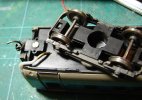
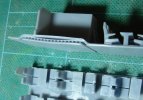
This bogie was a bit draggy and benefitted from squeezing the bogie axleboxes with the axles in place using a pattern makers' vice, an approach that also worked wonders for my HST coaches. A Kadee no. 5 has been mounted through a slot cut under the corridor connection rather than at the correct height for an operational Kadee coupling. Also a repair to the Hurst 3D printed exhaust that was only partially formed. I did contemplate a halving joint, but luckily some 1/16" tube came to hand first and I decided to (very carefully) drill a hole in the end of the 3D printed part and use some 1/32" wire as a dowel. The exhaust looping under like that, is another reason to permanently secure body to underframe!

DSC03265.JPG
Some lead paving to thow a little more weight on the middle bogie. The trailing coach now runs very smoothly with one of my HST cars that have the same style of coupling. The Ebay seller of the spare Class 156 bogie that I want to use to mount the Black Beetle, waited until the penultimate day of the delivery window only to post it second class, thus blocking progress on the powered coach.
 

Stevers

Western Thunderer
This model sets the bar for a super detailed Lima Class 156:
DCC Fitted & Detailed Lima Class 156 Super Sprinter BR Provincial Livery - The Locoshed, WhiteField, Manchester


DSC03269.JPGDSC03268.JPG
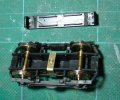
Meanwhile the trailing bogie of the motor coach has been fitted with Black Beetle wheels running in brass bearings, with current collection from all wheels with phosphor bronze wipers all similar to the Black Beetle motor bogie. The brass carrier for the pick-ups (wipers insulated via double sided copper fibreglass sheet) is in two pieces so that they can be removed from above. A plastic push mounting as per the trailing coach has been borrowed from a spare HST bogie, but had to be pinned in place due to the slippery nature of the plastic used.
 

AJC

Western Thunderer
That's a very nice model in the link - some subtle work to the body hides the 'LIMA-ness' very nicely and captures the look. It's a bit clean below the turnunder, however! If you can match that - and there's no reason why not - then this will be excellent.

I'm not sure when I first actually set eyes on, still less rode on, a 156. Apparently they operated out of Cardiff and I assume that was post-155 (which I remember well); it might easily have been the 2000s when I lived in Norwich.

Adam
 

Stevers

Western Thunderer
That's a very nice model in the link - some subtle work to the body hides the 'LIMA-ness' very nicely and captures the look. It's a bit clean below the turnunder, however! If you can match that - and there's no reason why not - then this will be excellent.

I'm not sure when I first actually set eyes on, still less rode on, a 156. Apparently they operated out of Cardiff and I assume that was post-155 (which I remember well); it might easily have been the 2000s when I lived in Norwich.
My thinking is that it will be a useful guide to starting colours, ones that I can grubby up, but allow to grin through. Considering the end result and the work that must have gone into it, that's a snip at £189!

156s were used on Pompey - Cardiff trains fairly briefly when there were teething troubles with the 155s, but that was 1989 - you'd just have been a nipper then! In hindsight this was the most modern incarnation of UK railways that I can feel any nostalgia for, with loco hauled trains, Speedlink and Red Star parcels all still clinging on. We might well have caught one, or seen one when travelling to the ExpoEMs that were then I think held alternately in Portsmouth and Bournemouth.
 

Stevers

Western Thunderer
DSC03284.JPG
My trailer coach cab bogie finally turned up today - very well packed, though long delayed. I had to rework the Black Beetle (again) to slightly reduce the wheelbase by another 1mm to exactly match the Lima frame. With both worms slighty further inboard it's running even better than before. One reason for picking the bogie from a trailing coach was that it was designed to take pin point axles, and this proved to be sound reasoning, because having knocked the points off the normal length Black Beetle axles, they were the perfect length for the Lima bogie. Once I'd removed nearly everything inside the frames, only the bearings are locating them albeit in exactly the right place. It's astonishing how a little bit of weathering can bring a lump of slippery black plastic like this to life.

DSC03271.JPG
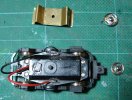
That brings us to the finescale elephant in the room, which is that the end framing of the bogies is something the real thing doesn't have. I am much less inclined to do doing anything about that now as the bogie sides would fall off without them. As can be seen neither the securing pip nor the wings provided to secure the bogie sides are centred on the wheel base. The brass bearer is the temporary mount for the motor bogie so that I can work out dimensions for a final mount. The metal poppers are what I'm planning to use to mount the motor bogie to the body. This Black Beetle has led an eventful life at the hands of my son, and I've patched a hole in the top with styrene and will file that flat later.
 

AdeMoore

Western Thunderer
Great work Steve, that link is a right rabbit hole! Not seen that website before already spent a while there!
The Lima 156 is a lovely bit of work as you say and no doubt a snip with the work.
Not for me though!
 

Stevers

Western Thunderer
Class 156 3D Motor Coach Printed Interior - with Supports.jpg
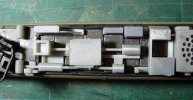
Supports have been added for the raised floor (2.5mm) to accommodate the Black Beetle on its clothes popper mount. I have curved the approaches to make it less conspicuous. Because I'm planning to print this on the bed without further support I've standardised any upward angle faces (under tables, seats and arm rests) at 19°. It seems outstands can be up to 1mm without slope but after that they become problematic. Incidentally my print bed is 135mm long and each half interior is 132mm!

As far as 3D printing these interiors flat to the build plate is concerned I've convinced myself that having a magnetic flexible build plate is absolutely essential. That arrives today, but will need several days for the glue to cure before use. To fit one of those I needed to adjust the Z stop. The Z stop is accomplished via a piece of metal sheet attached under the arm that interacts wih a light sensitive switch. To make that work as it should with the arm a little higher I had to fret (pierce) a new one of those 2.6mm longer in N/S sheet copying the Anycubic original in all other respects. The Anycubic ABS-like water washable resin is here, my 3D printer, wash and cure station and ultrasonic cleaner all on silicon slap mats are all now arranged on my solid built in Victorian floor cupboard ready for use. Getting perilously close to that first print!

DSC03287.JPGDSC03288.JPG
Mysteriously the ride height of the motor coach is 0.5mm too high and that's after burying the bearings into the inside frames of the the trailing bogie quite a lot further than originally - it's not clear to me how it managed to ride at the correct height before! I'll need to modify the second attempt at a motor bogie mount to drop it 0.5mm at that end too. Tails have been fitted to both bogies, but the jury is out on how and where they should plug into the body.
 

Stevers

Western Thunderer
Thanks Jim,

Have found them in the BrassMasters catalogue:

C121 8'6" wheelbase 12mm diameter wheels Pair (BR Mk2 onwards) - £10.00 pair.

That not only gets rid of the end frames, but puts the brake shoes where they should be - genius. Even if meant for 26mm axles I can pack the brass pin points for 24.5mm should I keep those. That sorts any difficult to resolve ride height problem with the Lima trailing bogie and is a really interesting way forward - I like it!

{Edit] There's a note on the BM website about these needing bearings with deep coning or the sides will splay - perfect!
 
Last edited:

Stevers

Western Thunderer
For complete transparency the brake shoes are designed to line up with p4 wheels not 00
Quite right too, and still nicely placed for big fat EM Gauge wheels!
:)

Ride height now sorted by soldering deeper sides on the motor bogie mount, coupled with some serious digging out* (~1.25mm) of the inner frame slots of the trailing bogie. I just need to add some levelling pips to the Black Beetle to prevent wobble.

*You have to wonder - I know I am!
 
Last edited:

Stevers

Western Thunderer
DSC03291.JPGDSC03297.JPG
After some trepidation at soldering onto a plastic floor inside a plastic body I decided that the best way to achieve end to current collection was to use 1/16" tubes and bent 1/32 wire to make plugs and sockets and to use 0.45mm wire to carry the electrickery through the floor where I could use adhesive copper tape to reach the other end - all very low profile. The trailing bogie required the very thin wire fitted to DCC decoders as the short lengths of thicker wire didn't allow quite enough bogie movement. There's a little more room at the motor bogie end (sockets further away) and the thicker wires were OK there.

DSC03296.JPG
The bright yellow interior and window surrounds will definitely have to go! Hidden under the N/S motor bogie mount, ears have been fitted to prevent wobble. The .45mm wire passes through a hole drilled in the end of the sockets and floor and is bent over onto the tape for soldering. Plastic is a poor conductor of heat and soldering onto it not as hazardous as feared. Current collection on four axles works better than two. Mechanically all is done now, and I'm off to very carefully fit the no-name flexible magnetic build plate to my AnyCubic Photon Mono 4K.
 

Stevers

Western Thunderer
DSC03306.JPG
First view of the Hurst Models cab interiors for BR period, currently in Rail Grey ready for me to pick out controls, dials, phone, seats etc. Also my first attempt at printing an interior, my 3D model having been modified to reduce the number of arms that are randomly down - slightly more so for the aisle arm rests. I'll need to double check the height of the partitions, but the model had the height of the Lima items. Happily I was able to print accurately right up to the edge of such a small bed. On the test piece I was inexplicably 0.5mm short on z-axis for the first 6mm, so I have beefed up the floor for the next attempt.

DSC03309.JPG
The resin is AnyCubics Water Washable ABS-Like v3.0. I dialled it in using TableFlip Foundry's Cones of Calibration, ending up with 0.1 second less than the 2s exposure recommended by AnyCubic for this resin on the Mono 4K. 'Light off' time was also increased from 0.5s to 1.0s to eliminate any 'blooming'. The delamination under the motor void and lost tables/seats suggest that I need to increase the exposure, there being a need to balance strength against accuracy, and in this case I need more strength. The print (on the flexible magnetic bed) took an hour; on checking it half way through I could hear the FEP slapping which may not bode well for extra exposure. On the plus side, no problems printing without extra supports, and I've now got some spare seats and tables to repair the next attempt. The interior seemed too small until it fitted the Lima body like the body was a glove.
 

Stevers

Western Thunderer
It semed likely that the problems with the motor void was inadequate support. The original supports were octagonal (0.18mm radius circles created with the OpenSCAD 'number of facets' function $fn). This puts the corners on the radius so the effective area was a bit less than it would have been as a true circle - so even sketchier.
Motorvoidsupportsv2.jpg.9ce780afdf64dfc5c156e8e8a0c76765.jpg
I've now made them square, still with corners on the radius. The foot 'radius' is 1.42mm which not surprisingly makes them roughly 2mm square. The 'radius' of the support is 0.4mm so these would be a 'heavy' 0.6mm x 0.6mm. Having square supports gives a nice neat edge. The suction forces from printing a large object on the bed are a recognised disadvantage, but I think these interiors are otherwise well suited to being printed that way, but did the revised supports work?

DSC03312.JPG
Well not really; a full set of seats printed on the cab end despite problems with the void supports - the super clean FEP (after a UV peel) perhaps being the key. I checked to see that the FEP still had nothing on it, and set the inner end to print. This time the middle seats didn't print, so the missing seats have been replaced by ones salvaged from my first attempt, but not yet glued down.

I had measured the Lima partitions (less base) and made the replacements the same height, but had then buried them in the base so they were a 1mm short. Altogether 1.5mm was added to also compensate for the missing 0.5mm resulting from printing on the plate. As I had also added 0.5mm to seats and tables for the same reason, I'll need to shim the replacement seats and table to match. The height of partitions is limited by the shelves of the glazing units - definitely not to scale at only 20mm high! Visible in the middle is a bit of spread that I think is termed 'elephants foot'. As an aside the shimming of seats and tables will be done with offcuts of ABS sheet that is astonishingly like this ABS-like resin!
DSC03313.JPG
Fresh off the plate it didn't look nearly as bad as this. The delamination was right across the raised floor but it only opened at the edges after washing and drying. Happily I have been able to remove the supports and file the area smooth. I'll do another UV peel today, and I might try doing two at once as these might release better nearer an edge on clearer FEP. Originally I planned to keep resin in the vats so have a brand new vat (or two) for resin changes that might be better reserved for ambitious prints like this. Not entirely straightforward this 3D resin printing game!

 

simond

Western Thunderer
I've not tried the resin you are using, but I doubt that cleanliness of the FEP is the issue, it either sticks to it, or to the build plate, and if it sticks to the FEP, you'll have a bath of trash to clean up. This appears to have stuck to the build plate, but distorted.

My guess is that when it prints the floor, it is trying to peel off a very large area in one go - and that puts a lot of load on the supports, possibly building in some stress that is coming out when you try to cure it, and that's something you could address by printing it at a slight angle. That will generally reduce the amount of resin in contact with the FEP at any given layer. Or you could print say 3 rows of seats on more, smaller bases?

The other thing that might make a difference is warmth - is it hot enough? The difference in viscosity between say 18 and 25 C is noticable.

HTH
Simon
 

Stevers

Western Thunderer
I've not tried the resin you are using, but I doubt that cleanliness of the FEP is the issue, it either sticks to it, or to the build plate, and if it sticks to the FEP, you'll have a bath of trash to clean up. This appears to have stuck to the build plate, but distorted.
Strangely no trash, just a thin layer of cured resin where seats and tables would have been. A UV peel was my friend to remove those.

My guess is that when it prints the floor, it is trying to peel off a very large area in one go - and that puts a lot of load on the supports, possibly building in some stress that is coming out when you try to cure it, and that's something you could address by printing it at a slight angle. That will generally reduce the amount of resin in contact with the FEP at any given layer. Or you could print say 3 rows of seats on more, smaller bases?
If printed at even a slight angle, there will need to be a lot of supports of the kind that aren't woking well in the motor void. Much more likely to work though, so it's a valid option. Perhaps 'least worst' (from a fairly narrow point of view) is all that is possible here.

The other thing that might make a difference is warmth - is it hot enough? The difference in viscosity between say 18 and 25 C is noticable.
The workshop is between 14C and 16C so another good point. Bottle says best above 20C, website says 18-35C, but I like to gather as much 'luck' around me as possible, so this resin has it dead cushy; warmed on a radiator before use, a Chitu H1 heater maintaining 30C in the printer enclosure, and no printing until the temperature strip on the vat is up to at least 28C.

Once up to temperature (again) I'm going to try to print a full interior in one of those new vats. Living dangerously perhaps, but what's the worst that can happen? If I don't try it, I'll never know!

Gentlefolk, place your bets...
 

simond

Western Thunderer
Strangely no trash, just a thin layer of cured resin where seats and tables would have been. A UV peel was my friend to remove those.
said thin layer is a dead giveaway, it came off the build plate and stayed on the FEP - More supports required!

If the supports are underneath, you can have LOTS!

good call on the temperature I have a reptile heater mat on which the bottles of resin rest, and the enclosure is at 25.
 

Stevers

Western Thunderer
More supports required!
Perhaps even too much of the wrong sort of support under the motor void!

The seats and tables all failed at the transition from floor to uprights. I'm speculating that the grip of the FEP is greater than the bond within the new resin layer. The FEP could happily release the floor, but not the bits just above. Could this be a lack of exposure where the used FEP has had more use in the middle? The layers are 0.05mm so there are 20 layers in the floor, there are 6 'burn in' layers and 6 'transitional' layers so it's not on the face of it at the boundary with the burn in layers.

Who dares wins? Well, one of the halves is complete and the other half has three pairs of seats and a table missing - bang in the centre of the screen/FEP/build plate. After I have UV peeled the FEP I'm going to try again at 2.2s exposure to try to compensate for whatever is amiss with the centre of the screen/FEP/build plate.
 
Last edited:

Stevers

Western Thunderer
DSC03320.JPG
Now it's all washed and cured, I can see that I have a different failure mode. This time it looks more like the delamination seen in the motor void, whereas before you could see the outline of the missing tables and chairs. Interesting that it's always the centre of the screen/FEP. I'm still minded to increase exposure and try again after UV peeling the vat.
 

simond

Western Thunderer
I have just realised, it looks like you are printing the whole thing direct on the build plate? I would definitely not do that for a large part.

I suggest that print your parts on rafts, with support legs. I'd make each raft around 100mm max length. I would try to avoid having all the rafts the same height - you can adjust that in the slicer - to ensure that on layers where there is a large area the FEP is peeling off one at a time, rather than trying to peel off the whole length of the build plate at once. A shallow angle will also reduce the amount of peel on each layer.

Make sure the FEP is taut, sort of "soft drum skin", and make sure the retract height is sufficient - I think mine is 7mm and I have not had any issues.

The UV peel of the FEP is only useful where you have a bits that did not stay on the build plate and are stuck to the FEP - it is to prevent the build plate punching scrap lumps of resin through the FEP next time you print (which leads to lots of mess, or worse, a broken screen). It won't affect the transparency of the FEP. Obviously you want both sides of the FEP, and the top of the glass, to be clean. Iso Propyl Alcohol and lots of loo paper are your friends for doing that.

HTH
Simon
 
Top