Tales from The Room of Doom. Dipping a toe in various bucolic backwaters.

Pete_S

Western Thunderer
Hi Rob.

Yes it is. Getting the ruler out, it looks like a difference of 1mm through the buffer centres.

Rob
An 8-compartment Third could be carrying 5 Tons of passengers (assuming 10st/pass & 10 pass/compt). That ought to flatten the springs a bit.

Flicking through what drawings I have (plus a dip into Russells Big Book of all Engines & That) suggests GWR C&W stock to have 3'5" to 3'5-1/2" buffer heights. Locos are 3'3" (850 class) and 3'4-1/2" (Star, 56XX). Tenders all seem to sit at 3'5".
 

Flaxfield

Western Thunderer
An 8-compartment Third could be carrying 5 Tons of passengers (assuming 10st/pass & 10 pass/compt). That ought to flatten the springs a bit.

Flicking through what drawings I have (plus a dip into Russells Big Book of all Engines & That) suggests GWR C&W stock to have 3'5" to 3'5-1/2" buffer heights. Locos are 3'3" (850 class) and 3'4-1/2" (Star, 56XX). Tenders all seem to sit at 3'5".

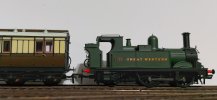
Noted, but.....these don't sag with added weight and wagons from Hornby and Rapido all share the same buffer height as the brake third. That said, I do see your point, Pete. and arguably the reletive buffer height of carriage and loco, based on your quoted figures, seems pretty prototypical......but it looks odd to these eyes.

Other locos checked all have the same buffer height as the coach.

This is my other 517 with the same coach.

1000032246.jpg


It's intriguing.

Rob
 

Simon H

Western Thunderer
Noted, but.....these don't sag with added weight and wagons from Hornby and Rapido all share the same buffer height as the brake third. That said, I do see your point, Pete. and arguably the reletive buffer height of carriage and loco, based on your quoted figures, seems pretty prototypical......but it looks odd to these eyes.

Other locos checked all have the same buffer height as the coach.

This is my other 517 with the same coach.

View attachment 261953


It's intriguing.

Rob
Intriguing indeed...oddly, differing buffer heights are quite common on continental H0 models; Märklin/Trix and Fleischmann often being noticeably taller than most others. I must say, 1159 is ever so tempting; just as well I don't model in 00!
Simon.
 

Heather Kay

Western Thunderer
I think we often forget that buffer heights were affected by loading. A loco with a full load of coal and water would be a bit lower on the springs than when things were used up. A fully laden wagon or coach would also vary.

I suppose there was a defined range, but I’ve never really thought about it, generally going with the "standard height for a model" route.
 

RodneyS

Member
In a Scalefour Society newsletter many years ago there was a short article by Don Rowland concerning buffer heights.
This seemed to be mainly about wagons as he quoted the 'Regulations for the guidance of Train Examiners and Oilers 1962'.
This gives the minimum buffer height of a loaded wagon in service as 3' 1'' and the maximum buffer height for a repaired wagon passing out of the shops as 3' 6''.

On the LBSCR the buffer height of locos increased over the years. The Terriers as built had a buffer height of 3' 3 3/4''. Later on the Richmond class were 3' 4 1/2'' and even later the D3 were 3' 5 1/2''.

Perhaps this was a similar story on other railways.
Rodney
 
Top