Prototype Tim Mills' Photos

Yorkshire Dave

Western Thunderer
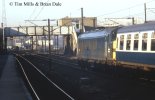
Three unidentified HSTs believed to be at Hornsey at an unknown date.

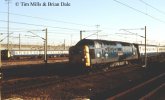
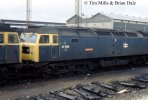
Four photos of unidentified Deltics believed to be at Hornsey although unconfirmed. Date unknown. The final shot shows Class 313 EMU units in the background.

These are all going to be between 1976 and October 1980.

KX to WGC was electrified in 1976 and the HST sets have a TS (Trailer Second) next to the power car. From October 1980 the TS next to the HST power car were replaced by a TGS (Trailer Guard Second) which I believe was due to the noise in the guards compartment in the power cars.

The Deltics were withdrawn between January 1980 and December 1981.

Dual voltage pioneer class EMU 313 063 probably at Hornsey on an unknown date. Some high level digging suggests that the last went for scrap in 2023 although I’ve found no detailed information about this particular unit

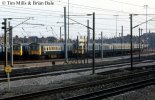
This particular unit was initially used as the test train in Liverpool for the Merseyside services prior to its return to the south. The 313 units were developed from the prototype 4-PEP and 2-PEP (Prototype Electro Pneumatic) units from the early 1970s. The prototypes were used on the Southern Region and it is said that commuters nickname for the PEP designation was Pack 'Em Perpendicular as there were fewer seats than the units they replaced.
 

oldravendale

Western Thunderer
Your info about the location is much appreciated, Martin @Martin Shaw and will be incorporated in the descriptions of further photos from this series. Your info about dates, Dave @Yorkshire Dave will be similarly included in the description and the wider most valuable info will be attached to the file for each photo. All the info is most helpful. Thank you.

Unidentified EMUs – not Class 313 but I have no knowledge of the correct designation. The photo appears in a set dated between 1976 and October 1980 at Hornsey but I'm a bit cautious about the date as the Class 313 units are not present.

img147 TM Unidentified EMUs Date Unknown Guessing Hornsey yard copyright Final.jpg

On an unconfirmed date probably between 1976 and October 1980 HST 254 009 passes through Hornsey. Despite research I can find no details regarding build date, allocation or disposal. Again I'm cautious about the date as that's clearly not a Class 313 unit on the right of frame.

img149 TM HST 254 009 Date and location Unknown poss Hornsey copyright Final.jpg

At Hornsey is an unidentified Class 45 or 46 diesel, probably between 1976 and October 1980.

img151 TM Unidentified Class 45 or 46 Date Unknown poss Hornsey copyright Final.jpg

Three photos between 1976 and October 1980 of Deltic 55 022, Royal Scots Grey, photographed at Hornsey, accompanied by EMU 313 034 in the third photo. The loco went to Haymarket when introduced on 28th February 1961 then Finsbury Park in November/December 1967 and back to Haymarket in June 1968 where it was withdrawn on 2nd January 1982. It was introduced in two tone green, became green with full yellow cab front or nose in January 1967 and became blue with full yellow cab front at the beginning of November 1967. When introduced it was D9000, was named on 18th June 1962 and became 55022 on 10th April 1974 and then went in to preservation in 1983. It’s now associated with Locomotive Services TOC Ltd and is often based at Crewe. (BR Database and UK & Ireland Heritage Railway Locomotives Database, includes both steam locomotives and diesel engines. )

I don’t have specific details for 313 034.

img153 TM Class 55 022 Deltic Location and Date Unknown poss Hornsey copyright Final.jpg

img154 TM Class 55 022 Deltic Location and Date Unknown poss Hornsey copyright Final.jpg

img157 TM Class 55 022 (again!)  with EMU 313 034 Location and Date Unknown poss Hornsey copyr...jpg

Brian
 

Yorkshire Dave

Western Thunderer
Unidentified EMUs – not Class 313 but I have no knowledge of the correct designation. The photo appears in a set dated between 1976 and October 1980 at Hornsey but I'm a bit cautious about the date as the Class 313 units are not present.

img147 TM Unidentified EMUs Date Unknown Guessing Hornsey yard copyright Final.jpg

The 312 class EMUs (as identified above) were introduced with extension of the electrification from WGC to Hitchin and Royston in 1978. This narrows the date window by two years from 1976-80 to 1978-80.
 

oldravendale

Western Thunderer
A question to bottom this out, please chaps. Did the 313 and 312 units work alongside one another? And were the 312 units based at Bounds Green and the 313s at Hornsey?

Thanks for all the info though. You are filling out all the details to make the photos much better understood.

Brian
 

Yorkshire Dave

Western Thunderer
312s and 313s worked alongside each other but never coupled to each other. The 312s were used on the outer semi-fast suburban services from KX to Royston via WGC, Stevenage and Hitchin i.e. down the main line. The 313s were used on the inner suburban stopping services From KX and Moorgate (GN & City) to Stevenage either via the main line or the Hertford Loop.

As the 312s and 313s were suburban units they were based at Hornsey. HSTs were based at Bounds Green while the diesels were based at Finsbury Park which was downgraded in 1981 and closed in 1983. Any remaining diesels moved to Bounds Green.
 

oldravendale

Western Thunderer
Arun @Arun Sharma , Tony @76043 and particularly on this occasion Dave @Yorkshire Dave my thanks for all the info and further clarification of the potential dates for these photos. As for Royal Scots Grey, @Jordan or Plymouth Mad I understand the confusion but I was used to seeing the name on a Royal Scot which it suited much better (diving for cover).

The only identification on the slide box is “Cardiff” but, while there are some shots which probably are indeed at Cardiff others appear to be on the Midland main line. These are examples. First is a DMU, the class of which I’m unaware, with “Luton” clearly displayed on the front blind and at what I believe to be Elstree Station. The second photo is of Elstree Station (assuming I am correct) and the third an unidentified Class 45 or 46 diesel at the same location. Date is unknown.

img158 TM Poss Cardiff actually Elstree Note LUTON on train blind Date Unknown copyright Final.jpg

img159 TM Poss Cardiff actually Elstree Date Unknown.jpg

img160 TM Class 45 Poss Cardiff actually Elstree Date Unknown copyright Final.jpg

I believe this is a location somewhere near Elstree - possibly the site of the goods yard - and possibly on the same unknown date as the three photos above. The first is unidentified Class 45 or 46 double heading and the second an unidentified DMU. The last is probably looking back at Elstree Station from the location where these two photos were taken.

img162 TM Double headed Class 45 or 46 Poss Cardiff actually Elstree Date Unknown copyright Fi...jpg

img163 TM DMU Poss Cardiff actually Elstree Date Unknown copyright Final.jpg

img164 TM Poss Cardiff actually Elstree Station Date Unknown copyright Final.jpg

I feel more comfortable suggesting that this may well be Cardiff, although the date remains unknown. It’s Class 47 47089 Amazon and possibly on Cardiff Canton Shed. It was new to Cardiff Canton as D1675 on 10 April 1965, moved to Bristol Bath Road in April/May 1966, Old Oak Common May/June 1969 and back to Cardiff Canton in September/October 1976 where it was withdrawn on 21st June 1987. It was cut up at Coopers Metals, Attercliffe, in the month ending March 1989.

The loco was named Amazon in November 1965 and was renumbered 47089 in January 1974. As built the loco was two tone green with a yellow warning panel and was painted blue with full yellow cab front in September or December 1970. (BR Database)

img161 TM 47089 Amazon Cardiff Date Unknown copyright Final.jpg

Brian
 

Roger Pound

Western Thunderer
Brian,

Re #5523 and #5531 - Class 45/46 locos.

If my old memory serves, the loco at Hornsey would almost certainly be a Class 46 from the extensive Gateshead allocation of the class. The 45's were relatively rare beasts on the southern end of the ECML. The pictures at Elstree would equally be more likely to be Class 45's which were the prevalent power at the time for MML passenger services, the Class 46 being less common although the class 46 were allocated roughly half to Derby the remainder to Gateshead according to the scant information I have to hand. I confess it is quite difficult to identify the sub-classes of the 'Peak' series, as they were known, without a clear view of the fleet number, although no doubt someone may have an answer.

A further point, which muddies the water further, is that the rarity of double headed 'Peaks' usually meant one was either on a running in turn after a works visit to Derby, or that the trailing loco had failed...............! I would suggest the latter case in #5531 as running in turns were usually done with the ex-works loco leading the train engine on a late morning St.Pancras train as for as Leicester where the said loco was detached and returned light to Derby works. I saw this working many times and it was a good chance to 'cop' a rarer loco, say from the Gateshead 46's.

It gets rather confusing doesn't it? Nevertheless I hope it may help to some extent.

Roger.
 

Yorkshire Dave

Western Thunderer
These are examples. First is a DMU, the class of which I’m unaware, with “Luton” clearly displayed on the front blind and at what I believe to be Elstree Station. The second photo is of Elstree Station (assuming I am correct) and the third an unidentified Class 45 or 46 diesel at the same location. Date is unknown.

All the MML (Midland Main Line) photos are at Elstree. All pre-1976 as construction had started on electrification of the St Pancras/Moorgate - Bedford section completed in 1982.

The DMUs are BR Derby class 127 built in 1959 specifically for the Bedford-St Pancras services with no first class accommodation. They outwardly similar to and easily confused with the BR Derby class 115 DMUs built in 1960 for the Marylebone - Aylesbury, High Wycombe and Banbury services which also included first class accommodation.

Incidentally the Viva was first registered in 1964.

EDIT 20hr08 - the date of the MML photos are between May 1974 (Elstree and Borehamwood renamed to Elstree) and 1976 (electrification construction commenced). The station sign in the photos reads Elstree and the date is evidenced by Elstree station name history:
13/07/1868 - Elstree
01/06/1869 - Elstree and Boreham Wood
01/04/1904 - Estree
21/09/1953 - Elstree and Borehamwood
06/05/1974 - Elstree
05/05/1988 - Elstree and Borehamwood

Must be overdue for a name change now. :)
 
Last edited:

hrmspaul

Western Thunderer
Elstree & Borehamwood was a delightful MR station. Other stations on the line had lost those very characteristic hipped roof platform canopies. Ted Trotter had a nice drawing of the station building published in Model Railway Constructor July 1964 p183 - 5. Living in Harpenden I can remember it well, although I didn't return to photograph it after the excursion made to the line in May 1967. Midland Railway and Midland Lines in BR times | D5401 at Elstree & Borehamwood 67.05.31 The drawing and photo in the MRC shows the footbridge to have been all one design, whereas the one at Harpenden (that I never photographed!) clearly showed the tracks were spanned by two very different designs as the line had been increased from 2 to 4 track after the first footbridge was built. From Google maps Elstree station is now a modern reconstruction.

In all those years living in Harpenden - 1975 to 1995 I have no recollection of ever seeing a train double headed by class 45s. And I did go to the station very regularly, dropping off and collecting Julie from her commuter trains, and we had a child minder who lived alongside the line.

Paul
 

76043

Western Thunderer
Definitely Elstree, I think many of the original buildings on the whole line to Bedford got swept away by the electrification works. I recall Harpenden and Harlington kept some, along with a canopy at Radlett.

The double headed 45 train could be a failed 45 being rescued by a 45?
Tony
 

Yorkshire Dave

Western Thunderer
I think many of the original buildings on the whole line to Bedford got swept away by the electrification works. I recall Harpenden and Harlington kept some, along with a canopy at Radlett.

As far as I can find out only three stations were swept away and rebuilt as part of the electrification with possibly a fourth and fifth - although a number of awnings disappeared.

Kentish Town - Original street level building demolished (electrification?) although the original structures remain on the platforms
West Hampstead - Cannot find much about the history but possibly rebuilt with electrification. New building opened in 2011.
Cricklewood - Original station building still in use.
Brent Cross West - New station opened in 2023.
Hendon - Original station building demolished and replaced with a new structure in 1959 when M1 was built.
Mill Hill Broadway - Original station building demolished and replaced with a new structure in 1959 when M1 was built.
Elstree - Original station building demolished and replaced in 1982 - electrification.
Radlett - Original station building demolished and replaced with a new structure in 1979 - electrification.
St Albans City - Original station building demolished and replaced with a new structure in 1973.
Harpenden - Original station building still in use.
Luton Airport Parkway - New station opened in 1999
Luton - Original station building still in use (LMS pseudo 1939 art-deco).
Leagrave - Original station building still in use.
Harlington - Original station building still in use.
Flitwick - Original station building still in use.
Ampthill - Closed in 1959.
Bedford Midland - Original station building demolished and replaced with a new structure in 1978 - electrification.
 
Last edited:

hrmspaul

Western Thunderer
As far as I can find out only two stations were swept away and rebuilt as part of the electrification with possibly a third and fourth - although a number of awnings disappeared.


Elstree - Original station building demolished and replaced in 1959.

Harpenden - Original station building still in use.
Do you mean 1959 for Elstree? My impression/memory is like those photos with all the original canopies

Harpenden - certainly no canopies by 1975. The Footbridge was replaced sometime in the later 1970s by a structure with double stairs on the island platform - and this has been removed to replaced by a hideous combined lift and steps.

Paul
 

Yorkshire Dave

Western Thunderer
Do you mean 1959 for Elstree? My impression/memory is like those photos with all the original canopies

Thanks for this Paul. The data source I initially used (Wikipedia) had an incorrect date and now found the correct date from the Borehamwood Times website. Elstree was torn down in 1982 and replaced with a new structure which has since been rebuilt again. I have corrected my note above.

A lot of the canopies disappeared with the electrification. I used to thunder through Elstree and Borehamwood when I commuted in the 319s from Luton to the City back in the 1990s. At that time there was still one loco hauled (class 47) and Mk1s evening service from St Pancras to Derby, the rest being HSTs to Sheffield and Leeds.

The best train home though was the first stop Harpenden service. Quite a number of passengers boarded this train at KX Thameslink without listening to the announcements or looking at the screens. They would get up at St Albans to alight only to watch, rather embarrassedly, the station whizz by which I always though was funny. All other fast commuter trains were first stop St Albans.

The same thing occurred relatively recently on an evening Marylebone - Aylesbury service where the first stop is Great Missenden. The Harrow-on-the-Hill, Rickmansworth, Chorleywood, Chalfont and Amersham passengers had to wait until they reached Great Missenden before that could alight and get a train back. All other Aylesbury trains call at Harrow and the stations above.
 
Last edited:

hrmspaul

Western Thunderer
Thanks for this Paul. The data source I initially used (Wikipedia) had an incorrect date and now found the correct date from the Borehamwood Times website. Elstree was torn down in 1982 and replaced with a new structure which has since been rebuilt again. I have corrected my note above.

A lot of the canopies disappeared with the electrification. I used to thunder through Elstree and Borehamwood when I commuted in the 319s from Luton to the City back in the 1990s. At that time there was still one loco hauled (class 47) and Mk1s evening service from St Pancras to Derby, the rest being HSTs to Sheffield and Leeds.

The best train home though was the first stop Harpenden service. Quite a number of passengers boarded this train at KX Thameslink without listening to the announcements or looking at the screens. They would get up at St Albans to alight only to watch, rather embarrassedly, the station whizz by which I always though was funny. All other fast commuter trains were first stop St Albans.
The warning about use of Wikipedia and AI from the West Midlands police should heeded!

Oh the Harpenden commuters; the scrummage to clear the island platform when those Harpenden 1st stop arrived. That is why they needed to have a footbridge which looked quite out of place for such a small town. Not all commuter towns are on the SR! When we moved in (1974) house prices were much lower than similar towns c25 miles from London down south! But electrification changed some of that. I was fortunate being able to go home for lunch, but Julie had an annual season ticket. A memory of the town was the railway car park full of Minis and other small cars (the wives cars), whereas the town was full of Volvo estates - bought as a perk for the middle managers that had no need of a car and left for their ladies to use, struggling as power steering hadn't been invented, but good for moving kids to school (pre-SUVs). And not a traffic light or roundabout in the entire area.

It was always a town with a lot of railway modeller interest. There were 11 HMRS members when I went there, and the HMRS had only well under 1000 members. Bob Essery had just moved out.

During the electrification they laid in a ladder across the tracks south of Harpenden station and I simply asked if I could take some photos. No one took any notice of me, For example DR-811-- CCE HD DM Cranes, runners, match | 18b_DRT81118_DM1418__m_ DR-811-- CCE HD DM Cranes, runners, match | 20a_DRT81120_DM1420__1m_ Years later our child minder lived in one of the flats behind these scenes.

Paul
 
Top