
You are using an out of date browser. It may not display this or other websites correctly.
You should upgrade or use an alternative browser.
You should upgrade or use an alternative browser.
7mm F*** Parkinson's - Occasional 7mm Workbench
- Thread starter James
- Start date

James
Western Thunderer
Interested to see what you do with the tarp, James. I wasn't really satisfied with my own efforts on a china clay wagon.
So am I!

I think I'm going to use Gordon Gravett's method from MRJ 227 using Martyn Welch's dimensions in MRJ 65.

Pencarrow
Western Thunderer
Next steps...
View attachment 246276
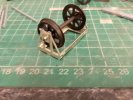
First unit assembled.
View attachment 246277
I'm making them rigid, despite my liking for springing in P4 I'm looking long term and keeping things simple.
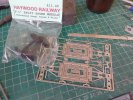
What's the source of the etch please?
James
Western Thunderer
It's an Ambis etch via Hobby Holidays -What's the source of the etch please?
They can be built rigid, compensated or sprung.
Tarpaulin
James
Western Thunderer
Interested to see what you do with the tarp, James. I wasn't really satisfied with my own efforts on a china clay wagon.
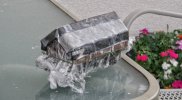
First step wrap the wagon in cling film a la Gravett. My wife helped me today as I'm having a bit of a wobbly day today
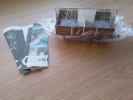
Apply PVA soaked newspaper strips; four 40mm x 140mm strips and one 30mm x 140mm strip for the top.

Leave to sit for a little while and then the ends can manipulated to shape.
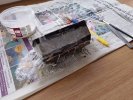
Now to leave it a few days to dry.
Last edited:

smgee
Western Thunderer
Thanks James. That’s very interesting, as it’s more-or-less what I did here, having never seen the MRJ article you referenced!First step wrap the wagon in cling film a la Gravett. My wife helped me today as I'm having a bit of a wobbly day today
View attachment 246316
Apply PVA soaked newspaper strips; four 40mm x 140mm strips and one 30mm x 140mm strip for the top.
View attachment 246317
Leave to sit for a little while and then the ends can manipulated to shape.
View attachment 246318
Now to leave it a few days to dry.
View attachment 246320
Newspaper sounds like a better choice than the tissue paper I used, which shrank as it dried.
James
Western Thunderer
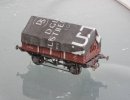
To my surprise this PVA has dried out very quickly today so here's finished but unpainted tarpaulin in place.
You got very nice results!
Weren't the clay hood covers plastic too?l
Thanks James. That’s very interesting, as it’s more-or-less what I did here, having never seen the MRJ article you referenced!
Newspaper sounds like a better choice than the tissue paper I used, which shrank as it dried.
You got very nice results!
Weren't the clay hood covers plastic too?l

Pencarrow
Western Thunderer
First step wrap the wagon in cling film a la Gravett. My wife helped me today as I'm having a bit of a wobbly day today
View attachment 246316
Apply PVA soaked newspaper strips; four 40mm x 140mm strips and one 30mm x 140mm strip for the top.
View attachment 246317
Leave to sit for a little while and then the ends can manipulated to shape.
View attachment 246318
Now to leave it a few days to dry.
View attachment 246320
So, are there 2x strips on each sloping side and then the narrower stop on the top? Making the sloping sides 2 strips thick and the top 3 thick??
James
Western Thunderer
It works out a maximum of two strips thick following Martyn Welch's dimensions/widths.So, are there 2x strips on each sloping side and then the narrower stop on the top? Making the sloping sides 2 strips thick and the top 3 thick??
James
Western Thunderer
Why not a single piece, say scale 14 x 21 feet, and if that’s too floppy, double up? Why do it in panels?
It replicates the panels seen on traditional wagon sheets and I think two thicknesses will aid handling; when off the wagon they're very fragile.

simond
Western Thunderer
Thanks James, I guess they didn’t use broadloom fabrics in that case.It replicates the panels seen on traditional wagon sheets and I think two thicknesses will aid handling; when off the wagon they're very fragile.
The figure you quoted, 40mm, is just shy of six feet, I guess they’d need an overlap. The width I suggested of 14 feet came from the ICC website, I don’t know how accurate it is.
Do you have any “known accurate” sizes for the panels and overall? Given that they were grubby horrible things to handle, I don’t suppose too many have survived.
best
Simon
simond
Western Thunderer
Thanks James, the ICC website agrees with 11x21 for later sheets, and suggests 14x21 for earlier ones. 11 feet would stitch up quite nicely from two 6 foot panels, but the seam would coincide with the sheet rail, that said, I guess it would be doubled just in the right place.Hi Simon,
A bit of searching suggests 11' x 21' as BR's standard size sheet, pre air brake LWB wagons.
The 40mm width comes from Martyn Welch's article, how it might relate to the prototype I've no idea! But the visible joins are in around the right places
I wonder if the 14’ ones were made from wider panels, or alternatively, three narrower ones? But unless they stitched on doublers, it would wear in the middle…
James
Western Thunderer
There must be an old standard describing it somewhere and their construction.
I remembered that the Quorn Wagon group have sheeted wagons which might be a useful source given their accuracy in their restorations, but they're modern plastic sheets.

It does give a method of tying the sheets down though.
I remembered that the Quorn Wagon group have sheeted wagons which might be a useful source given their accuracy in their restorations, but they're modern plastic sheets.
It does give a method of tying the sheets down though.
James
Western Thunderer

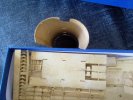
A bit of progress with the LNER van, mainly underneath with the Ambis chassis components - I'm really enjoying putting them together though for a decent sized fleet the time might be a bit too time consuming. Ambis components are beautifully designed.

In 4mm I've been used to being able to easily buy axle boxes and springs separately but in O gauge a combined axle box/spring/w-iron seems more usual. Are there any suppliers who supply just the axle boxes and springs?


Ian@StEnochs
Western Thunderer
Good box!