Monks Ferry: a layout for the Grandchildren.

John57sharp

Western Thunderer
That's a good result Jon - top - literally!

I'm wondering what the safety valve small cylinder was for on the prototype photo? Wiser heads than mine might know….

What's up next?

John
 

jonte

Western Thunderer
That's a good result Jon - top - literally!

I'm wondering what the safety valve small cylinder was for on the prototype photo? Wiser heads than mine might know….

What's up next?

John

Thanks, John:thumbs:

Sorry, but can’t help with your query.

Have traced the source of the photo but it’s just a general paper on the use of leaded rooves/history. No mention of the location of the roof either.

Next? Started gluing up some oversized strips of styrene and sticking them on a base of some more offcuts of styrene sheet and allowed them to dry overnight. Today, will start sanding and cutting them to size before dressing them with some more bits of offcuts. Their purpose? They’ll form the two chimneys to accompany the leaded roof above, and I’ll do my utmost to try and match them to the ones on the main building (crosses fingers, toes, arms, legs……………).

Jon
 

jonte

Western Thunderer
Hello again, John @John57sharp

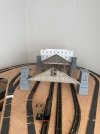
Just a quick one to demonstrate, during course of construction, what I meant by building the chimneys from bits of styrene. Seen posed alongside the leaded roof shown earlier in roughly the positions they’ll occupy:

IMG_4335.jpegIMG_4336.jpeg

The leaded roof has had two of its supports glued and weighted down to dry overnight. Only two of the four had been glued prior, as the frame has warped slightly due to the excessive amount of glue used during its construction (this was intentional and is explained in a previous post).

Hope this helps.

Best.

Jon
 

Pencarrow

Western Thunderer
Jon,

talking to @Pencarrow - Chris’ approach is to laminate or at least substantially thicken his walls and floors to prevent warping.

your building is quite large, and I wonder if the same approach might not be a good precaution?

best
Simon

Morning Simon, important to note that the laminations have spacers between them to allow glue vapour to escape rather than being lots of flat sheets glued on top of each other.

The alternative I use for bigger buildings is to have a mesh of 10mm wide strips glued edge-on to the frontage - a bit like an aircraft wing.

Both approaches are proving to be very resilient over time, which is the main test.
 

jonte

Western Thunderer
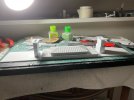
Enticed by today’s clement weather, I accompanied my better half into the garden to do a spot more gardening. Well, I just brushed up whilst my wife valiantly did a spot of weeding and tidying with the support of a wheelchair hastily purchased for her by my daughter.

Anyway, the point is that whilst I was out there, I decided to bite the bullet and see if the ‘new build’ actually fitted over the station roof as envisaged. Thankfully it did. It goes to show that these card board mock-ups are worth their weight:

IMG_0416.jpeg

Later this afternoon and early evening, I commenced and surprisingly finished my sheet leaded roof. Again, it’s just a suggestion.
I’m not sure what scale it is to this time. ‘S’ scale perhaps?:

IMG_4347.jpegIMG_4348.jpeg

Thankfully, like most of it, it won’t be seen apart from the chimneys.

With mention earlier of the garden, whist we were busy - or at least my wife was - I posed the question: ‘how long do you give it before it ends up in myriad pieces on the floor?’ :)

Thanks for looking.

jonte
 

John57sharp

Western Thunderer
With mention earlier of the garden, whist we were busy - or at least my wife was - I posed the question: ‘how long do you give it before it ends up in myriad pieces on the floor?’ :)
It’ll take a fair bit of abuse before then Jonte! My own Grandad would be pleased to know that while the teenage me did dismantle and to some degree destroy his efforts while trying to improve on them, he had had succeeded in imbuing me with enough enthusiasm for the subject to lead me here, now old enough to be a grandfather myself, and still modelling. Take heart!

Busy days here too, but some small steps forward. Some snaps later all being well.

It looks great to me by the way.

Cheers
 

jonte

Western Thunderer
It’ll take a fair bit of abuse before then Jonte! My own Grandad would be pleased to know that while the teenage me did dismantle and to some degree destroy his efforts while trying to improve on them, he had had succeeded in imbuing me with enough enthusiasm for the subject to lead me here, now old enough to be a grandfather myself, and still modelling. Take heart!

Busy days here too, but some small steps forward. Some snaps later all being well.

It looks great to me by the way.

Cheers

Grandad did a great job :thumbs:

I’m not sure whether my attempts will prove as successful as in your fond case, John, not with all the modern day distractions to tempt any prospective modellers in other directions, but at least for the time being it’s an excuse to enjoy some time with them while they’re little :)

Regarding the longevity of the models, I think my ‘concerns’ stem from the fact that neither of the buildings (nor the plinth on which they rest) are fixed due to a requirement to maintain the track. Thus, as is the case with fixed models, where a casual swipe might remove the odd chimney or finial, here the whole model will be sent into orbit!

Btw: I watched a video of a recent exhibition where the vehicles were ‘moving’. I’m sorely tempted ………I can only imagine the wonderment I’d felt as a child seeing that. Better wait until the boss is enjoying better health before proposing that one…..££££££££££.

Looking forward to seeing some photos of progress, John. I was really impressed with the canal transshipment shed you’d mocked-up :thumbs:

Many thanks for the compliment.

Jon
 

jonte

Western Thunderer
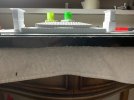
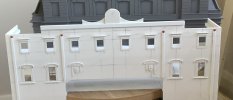
A start was made on the decorative parapet.

Two lengths of styrene were glued to a thinner section at the top, the lengths of styrene being separated by a couple of offcuts of styrene sheet of similar thickness to the sheet which formed the front of the building. In this way the parapet could be worked on away from the building and then slid over the parapet itself when finished.

A trial fit at an early stage of the build:

IMG_4227.jpeg

Back on the desk and a little more detail added:

IMG_0419.jpeg

A little more work required the permanent fitting of the item to the parapet:

IMG_0420.jpeg

……and with the roof on:

IMG_0421.jpeg

The amount of times I’ve dropped that roof onto the carpet after turning the building and forgetting that the roof isn’t attached…….shows it’s quite robust I suppose and fit for purpose.

Thanks for looking.

jonte
 

John57sharp

Western Thunderer
The grandchildren will find it real enough Jon, I mean kids these days believe that Anglias can fly… well mine never managed that, although Jim Clark may have flown a couple??

Great progress and that crest IS magnificent.

Cheers
John
 

jonte

Western Thunderer
The grandchildren will find it real enough Jon, I mean kids these days believe that Anglias can fly… well mine never managed that, although Jim Clark may have flown a couple??

Great progress and that crest IS magnificent.

Cheers
John

Thanks for popping in, John, and your kind compliment.

I recall Dad had an Anglia, along with Morris Travellers and one of those large Vauxhall estates with column change. As an older father, these are the ones owned during my youth, so no idea what preceded them. All I know is that they could also fly, or at least along the narrow winding lanes on the Isle of Anglesey. He’d career into blind bends without braking - and no doubt brakes in those days were cr*p in any case - with a token sound of the horn as the only defence against vehicles that couldn’t be seen :eek: Thankfully there were fewer cars around then…….but plenty of tractors!

I’m glad the crest idea has been well received by those of you kind enough to drop by and comment, however, I hasten to add that I might have let you all down for what I have planned :(

Cheers for now and thanks once again.

Jon
 

jonte

Western Thunderer
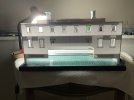
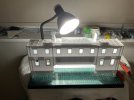
Apologies for the deluge of updates of late, but this morning was the first opportunity to take stock since I last posted.

It was also time to pose both sections of the build together and in daylight.

My thoughts:

Surprisingly for my seat of the pants approach, they seem to meld quite well; proportionately anyway:

IMG_4358.jpeg

For me, that’s where the optimism ends.

IMHO, they look like builds from different periods of the railway era: the front looks typically Victorian Gothic whilst the rear, positively Georgian. It’s like looking back at the history of a typical station: the latter replacing the former.

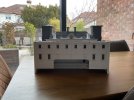
Additionally, the leaning towers are unfortunate (a consequence of using different materials and neglecting them by leaving them unsupported for a couple of years), and should have been addressed as proposed some time back (using Meccano sections). I regret that I pushed on blithely convincing myself it was necessary to meet an ethereal deadline. The phrase ‘cutting corners’ comes to mind. And to add insult to injury, that ‘stepped roof’….. I can add no more to my overwhelming disappointment expressed already:

IMG_4357.jpeg

So the way ahead?

Well, I think I can go some way to marrying the two awkward bedfellows by extending the decoration present on the existing building around to the sides of the newer:

IMG_4356.jpeg

The chimneys will also help in this respect as they are of a match, although the ashlar finish on those on the existing roof was built of thinner material as they were an afterthought (actually, they weren’t, but I kept changing my mind. I really know how to make things difficult for myself…).

To conclude, I’ve come too far and spent too much (time and money) already. Especially on the first part. I’m just going to have to live with it. In terms of money, I reckon I could have saved a packet in styrene section alone especially that which represents the ashlar masonry. It would have been better and thriftier to have designed my own scribing tool (scrutinising this type of stonework, it’s apparent that the sides of the stone sections were angled/bevelled). I reckon a suitable shape could have been created from a scalpel blade of sorts. Heigh, Ho.

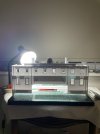
So on we go. Next the base of the building will need blocking in to prevent light bleed, then the additional stone decor can be tackled. Finally, the lights can be installed (better check I’ve sufficient make and female Jack plugs in stock).

Thanks for reading.

jonte

Edit: Since I took those photos, I’ve had a rethink: the existing building isn’t cutting it, so I’m going to cut my losses and put it to bed. Just need some more materials to build a replacement. jonte.

 
Last edited:

simond

Western Thunderer
Jon,

I know less about architecture than the king but from my perspective, even if the two facades are typical of different eras, the building does not jar - as you have observed, buildings are modified, sympathetically or less so - as time and progress demands and it’s entirely reasonable to reflect that in your model.

Rather than Meccano which is expensive, maybe some eg 10x10mm aluminium extrusion from a diy shed might offer the extra stiffening required?

Don’t be despondent!
Best
Simon
 

jonte

Western Thunderer
Jon,

I know less about architecture than the king but from my perspective, even if the two facades are typical of different eras, the building does not jar - as you have observed, buildings are modified, sympathetically or less so - as time and progress demands and it’s entirely reasonable to reflect that in your model.

Rather than Meccano which is expensive, maybe some eg 10x10mm aluminium extrusion from a diy shed might offer the extra stiffening required?

Don’t be despondent!
Best
Simon

I wish I shared your ingenuity and determination, Simon, but thank you for taking the time to share your considered thoughts and solutions.

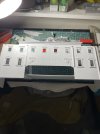
The problem with remedial work to address the ‘lean’ is that the model is ‘closed’ so to speak, although I suppose (restricted) access could be gained via the removable roof. But the issue is twofold: that bl**dy awful roof too!

By the time I sorted the leaning towers (to say nothing of the angst trying to work in such a narrow confined space), and built a new (third attempt) roof, I could have sourced the extra materials and finished a mirror image of the rear. I might even find a use for those balconies I abandoned :)

I think also the newer section looks a little more to scale.

I’m sure I can find a use for the big grey thang somewhere else on the layout, as it’s a big space to fill.

So, it’s back to wrestling with that thick styrene sheet in an attempt to cut out some more windows…….

Thanks again, Simon.

Jon
 
Top