Time once again has been of the essence of late, and so it will prove to be for the foreseeable, or at least the next fortnight or so.
Thankfully there’s temporary relief from the gloom when we enjoy the company of the children and grandchildren as we holiday together for the next few days, in the company of Father Christmas (when did this guy become Santa?).
Still it eats away at the time spent at the bench, so if I’m ever to finish this layout on time, I need to cut corners hence this brief post to show such an example.
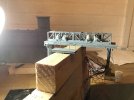
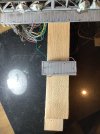
Those of you kind enough to follow will remember I was intending to face the next challenge of representing the wooden flooring on the crossmember of the gantry. Originally, I was intending to use some thin veneer for the purpose, contoured or grained (with a variety of graded papers), base painted then laid individually to represent the inevitable uneveness of wear and tear, further work applied to enhance once fitted. But there just wasn’t time, so it was yet another a case of plan ‘b’ in an attempt to achieve the best I could do in the shortest time, and I submit this in the hope that it might help another member (as I say, not the best effect, but it passes muster I feel).
So keeping with the embossed card, the best way I reckoned to start a wood effect - after priming - is to apply a base colour of say black/brown, white or - in this case - beige (more of a deck tan colour to be precise, which is an acrylic paint labelled as ‘Pearl’ which took my eye a couple of years ago whilst looking for something else in Hobbycraft)……or whatever colour wood you might be trying to emulate. As I say, I used acrylic paint, although enamel or oil is just as good - and great fir blending - but take longer to dry!
I noted on the real things that it was a musty dark colour with slightly nuanced shades of the same colour on individual planks. I didn’t fancy masking off so simply represented this by shading across the whole.
Next I gathered up powders of black, smoky grey and earth shades which I lathered on with a finger. Then to achieve the ‘shades’, I dipped a paintbrush into warm water containing a colour of drops of washing up liquid and washed off some of the powder along the length of each board, which removes - and ‘fixes’ - the powder. When dry, you’ll probably end up with tide marks, a hazard of this method, which can be blended and reduced with more water. If you take off too much, just apply more powder and repeat until you’re happy with the result.
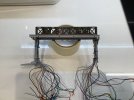
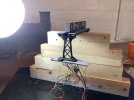
Here’s how it ended up: (tea bags for effect, but perhaps they could be washed onto the surface as a base

)
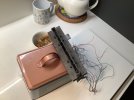
For a quick-effect, it was okay, but the real thing appeared darker than this and the embossed detail of individual planks is ‘lost’, so I proceeded to stage two.
This simply comprised of a knocking up a quick thin wash of black enamel paint in copious amounts of spirit which was washed over the surface. It dries quickly so you can decide to go further in the same sitting if you so wish - which I did.
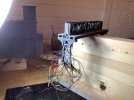
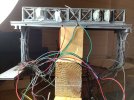
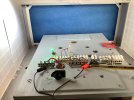
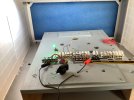
This provided the deeper shade I was seeking and highlighted the seams between the planks to give them their individuality:


(Note that that I’ve started to repaint the central part of the crossmember after a slip with the paint brush when laying in the base coat for the planks…………. darned wires don’t help with handling!).
It’s not perfect, and wasn’t how I’d intended to go about things, but it was good enough for the purpose of expediency.
Anyway, it’s done and I can at least holiday in the thought that yet another job is boxed.
Until next time, thanks for looking and I hope it may prove of worth to somebody.
jonte




 .
.