
You are using an out of date browser. It may not display this or other websites correctly.
You should upgrade or use an alternative browser.
You should upgrade or use an alternative browser.
Monks Ferry: a layout for the Grandchildren.
- Thread starter jonte
- Start date


jonte
Western Thunderer
I’m pleased to report that painting of the mainline track is now complete and appears as in the previous shots.
There will be no further embellishments; the black wash over the ballast will tone and blend and this will do in the interests of time, mindful of the nature of the layout too.
However, work has commenced on making the track in the station area a little more interesting and akin to how the lines appearin photos- or at least as near as I can make them without going overboard. But first, I laid down a thin wash tothe rails as mentioned in my last to tone things down:

Next I began mixing up dark and light greys with a brown added in different concentrations to warm things up, as well as adding a small amount of black occasionally to strike a slightly different shade:


It might be that the light provided by the small table lamp I use isn’t helping but the colour appears a little too……well, not as mixed which you can see on the pallet ringed in red in the third shot above.Mixed thinly with plenty of spirit added, it’s just dabbedon here and there and will all e blended in time. A couple of added washes of different shades will also be provided to add further interest although the base layer of sleepers in brown and black will also remain as most sleepers in the photos are of this nature.
This might all sound a little long-winded but in practice, it takes no time at all.
Thanks for looking.
jonte
There will be no further embellishments; the black wash over the ballast will tone and blend and this will do in the interests of time, mindful of the nature of the layout too.
However, work has commenced on making the track in the station area a little more interesting and akin to how the lines appearin photos- or at least as near as I can make them without going overboard. But first, I laid down a thin wash tothe rails as mentioned in my last to tone things down:
Next I began mixing up dark and light greys with a brown added in different concentrations to warm things up, as well as adding a small amount of black occasionally to strike a slightly different shade:
It might be that the light provided by the small table lamp I use isn’t helping but the colour appears a little too……well, not as mixed which you can see on the pallet ringed in red in the third shot above.Mixed thinly with plenty of spirit added, it’s just dabbedon here and there and will all e blended in time. A couple of added washes of different shades will also be provided to add further interest although the base layer of sleepers in brown and black will also remain as most sleepers in the photos are of this nature.
This might all sound a little long-winded but in practice, it takes no time at all.
Thanks for looking.
jonte
jonte
Western Thunderer
An early start saw me applying another thin wash to the sleepers in the station area.
The intention was to address the starkness of the yesterday’s (initial) wash where it was applied, and add a little warmth to the hue, although the lamplight under which it taken is anything but balanced. In reality,the colour is not as pronounced.
This was attempted with Humbrol 98 and Matt black:

I’m satisfied that the track in this area now has some bearing, so I’m going to leave it there save for perhaps a dusting of talc over the sleepers (the light still doesn’t show a true likeness but this will do for what we want).
All that’s needed now is to provide the track in the MPD (already prepared) with an overall weathered black (Phoenix) in its entirety and that will conclude track painting. I’ll spare you all that.
Then I’ll countersink the pin holes in each sleeper so that I can fill over and hide the pins once laid.
I think the next bulletin will concern the securing and cutting of rails where each board section meets for which I purchased one of those flexible drill accessories. Ive already tested it and it does work, and whilst I prefer the slighter gap provided by the use of a piercing saw, the construction of the joints I’m afraid precludes it.
Heigh Ho.
In the meantime, I’m off to see my computer expert of a nephew as my iPad is on its last lags (for instance, completing a post here seems to take longer than painting track!). Luckily I purchased a new one sometime ago when it began playing up, but it’s come to the point where my email page takes forever to load and sort, and I’ve given up trying to write an email with it……
Anyway, thanks for looking and your forbearance.
jonte
The intention was to address the starkness of the yesterday’s (initial) wash where it was applied, and add a little warmth to the hue, although the lamplight under which it taken is anything but balanced. In reality,the colour is not as pronounced.
This was attempted with Humbrol 98 and Matt black:
I’m satisfied that the track in this area now has some bearing, so I’m going to leave it there save for perhaps a dusting of talc over the sleepers (the light still doesn’t show a true likeness but this will do for what we want).
All that’s needed now is to provide the track in the MPD (already prepared) with an overall weathered black (Phoenix) in its entirety and that will conclude track painting. I’ll spare you all that.
Then I’ll countersink the pin holes in each sleeper so that I can fill over and hide the pins once laid.
I think the next bulletin will concern the securing and cutting of rails where each board section meets for which I purchased one of those flexible drill accessories. Ive already tested it and it does work, and whilst I prefer the slighter gap provided by the use of a piercing saw, the construction of the joints I’m afraid precludes it.
Heigh Ho.
In the meantime, I’m off to see my computer expert of a nephew as my iPad is on its last lags (for instance, completing a post here seems to take longer than painting track!). Luckily I purchased a new one sometime ago when it began playing up, but it’s come to the point where my email page takes forever to load and sort, and I’ve given up trying to write an email with it……
Anyway, thanks for looking and your forbearance.
jonte
jonte
Western Thunderer
Undertook a little more messing about with the sleepers of points and track from the station area, and reckon that - apart from a little dusting when in place, plus the overspill of a dark wash to the ballast- it offers a nod to Waterloo and other London termini:

The desk light still showing it lighter than in reality, so I placed another section in place on the board under the layout lighting to see if there was any difference:
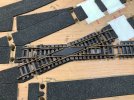
Not much, although I can assure you it really is a lot darker; in fact it’s almost lost against the dark underlay.
And yet another reference fir comparison:

Yeah, I know: must try harder.
Perhaps I will on my next layout…………but for now, it’s time to move on and lay it.
jonte
The desk light still showing it lighter than in reality, so I placed another section in place on the board under the layout lighting to see if there was any difference:
Not much, although I can assure you it really is a lot darker; in fact it’s almost lost against the dark underlay.
And yet another reference fir comparison:
Yeah, I know: must try harder.
Perhaps I will on my next layout…………but for now, it’s time to move on and lay it.
jonte

Roger Pound
Western Thunderer
Don't put yourself down, Jon, it is all coming together very nicely indeed. To paraphrase Young Mr Grace -"You're doing very well!"
Roger .
.
Roger
.
Yorkshire Dave
Western Thunderer
Hi Jonte
The track looks fine. Do you intend ballasting the track once laid?
If so I would use something like Woodland Scenics (or equivalent) buff colour ballast - I would avoid greys and pinks. By using buff colours it means you can apply a pale earth brown wash to tone it down and get closer to the colour seen in photos and films. On the approaches to SR termini it would mostly be brake dust from the electric units.
The track looks fine. Do you intend ballasting the track once laid?
If so I would use something like Woodland Scenics (or equivalent) buff colour ballast - I would avoid greys and pinks. By using buff colours it means you can apply a pale earth brown wash to tone it down and get closer to the colour seen in photos and films. On the approaches to SR termini it would mostly be brake dust from the electric units.
jonte
Western Thunderer
Don't put yourself down, Jon, it is all coming together very nicely indeed. To paraphrase Young Mr Grace -"You're doing very well!"
Roger

Thanks, Roger.
It may seem glacial, but for me the pace is anything but as I’ve always an eye to the time on this one.
Despite it being nothing more than a traditional train set, I know that if it doesn’t look quite right it’ll always fester, but in the end it’s a case of ‘onwards and upwards’. Now where’s that phrase from?
Cheers.
Jon
jonte
Western Thunderer
Hi Jonte
The track looks fine. Do you intend ballasting the track once laid?
If so I would use something like Woodland Scenics (or equivalent) buff colour ballast - I would avoid greys and pinks. By using buff colours it means you can apply a pale earth brown wash to tone it down and get closer to the colour seen in photos and films. On the approaches to SR termini it would mostly be brake dust from the electric units.
Hi Dave and thanks for the compliment.
The benefit of your knowledge is also appreciated so many thanks.
Yep, I’m going to ballast using an amalgam of sand and Ngauge (think it’s dark grey from memory) ballast in a ratio of 6 : 1 sand to ballast for two reasons. In the station area especially the ballast appears (from photos) quite fine, and in my humblest, many commercial ballasts seem to overwhelm the ‘under nourished’ - as I refer to them - sleepers of proprietary track. It’s also appears very dark which is why I’m going to ‘stain’ it with a black wash which tends to spill over and darken adjacent sleepers.
Here’s a couple of examples from a previous layout:
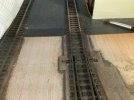
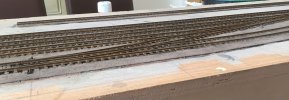
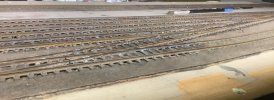
And hers a couple of the real thing:

I can see the ‘buff’ you mention in the second and I’ve several more references which also show this, so I’lltryand introduce that element if I can.
Also, I’m trying to blend the track in the station area with the ‘main’ as the mainline runs through the station throat, and also the station is immediately adjacent so I’m attempting to avoid the starkness in contrast if at all possible (the mainline tones an be seen in the second to last photo above).
Hope this helps to explain my approach and many thanks once again, Dave.
Jon
jonte
Western Thunderer
Well, having completed painting of the mainline track and MPD areas, I’d hoped to have started laying the track by now but the appearance of the trackage for the station area was bothering me.
This was because the application of additional enamel washes to the sleepers had stained the rails on each side, so whilst still wet, I’d washed them with a damp brush dipped in white spirit just to remove it. Unfortunately (as I discovered once it had dried), the wash had blended the piebald effect of the real thing I’d attempted with a darker wash, and merely created a single colour of a darker shade of what had been there before. I couldn’t live with it, so after much deliberation, I decided to repaint all the rails of the trackage in this area: points and plain track. But how to recreate the original effect without ending up with the previous disastrous result?
In the end, I decided to return to the salt technique but only for the plain track: having to apply the salt to only two faces of rail in a sitting before allowing it to dry was both a chore and time consuming. To add insult to injury, the damp climate in my workshop failed to dry out the rails without additional aid, so out would come the old hair dryer to carefully dry evrything out without disturbing the salt. A right pain. Now that (thankfully) the procedure is complete, the lengths of plain track concerned are ready for airbrushing with a suitable shade of acrylics, although this after a further process of masking off the sleepers.
With the sheer numbers of points involved I wasn’t repeating this protracted approach, with those or I’ll never finish before the year’s out, so decided to simply apply a drybrushed coat of a dark brown amd matt black enamel in a nod to the real thing.
Here’s an example, having just had the rails repainted as described (finger nails still encrusted with the salt applied to the plain track):

……and after dry brushing on some detail to the rail sides as described:


I’m going to run with that.
Thanks for your likes and interest, chaps.
jonte
This was because the application of additional enamel washes to the sleepers had stained the rails on each side, so whilst still wet, I’d washed them with a damp brush dipped in white spirit just to remove it. Unfortunately (as I discovered once it had dried), the wash had blended the piebald effect of the real thing I’d attempted with a darker wash, and merely created a single colour of a darker shade of what had been there before. I couldn’t live with it, so after much deliberation, I decided to repaint all the rails of the trackage in this area: points and plain track. But how to recreate the original effect without ending up with the previous disastrous result?
In the end, I decided to return to the salt technique but only for the plain track: having to apply the salt to only two faces of rail in a sitting before allowing it to dry was both a chore and time consuming. To add insult to injury, the damp climate in my workshop failed to dry out the rails without additional aid, so out would come the old hair dryer to carefully dry evrything out without disturbing the salt. A right pain. Now that (thankfully) the procedure is complete, the lengths of plain track concerned are ready for airbrushing with a suitable shade of acrylics, although this after a further process of masking off the sleepers.
With the sheer numbers of points involved I wasn’t repeating this protracted approach, with those or I’ll never finish before the year’s out, so decided to simply apply a drybrushed coat of a dark brown amd matt black enamel in a nod to the real thing.
Here’s an example, having just had the rails repainted as described (finger nails still encrusted with the salt applied to the plain track):
……and after dry brushing on some detail to the rail sides as described:
I’m going to run with that.
Thanks for your likes and interest, chaps.
jonte
jonte
Western Thunderer
Just while I await the arrival of my grandchildren, I thought I’d share this bit of trivia.
Whilst busy with the tedious process of painting over the last few days, I’ve also been doing a bit more mind modelling.
When this part of the build is through and the station building is finished, I’ve to start populating the rest of the ‘world’ with buildings and such, but what? One idea that’s persisted was borne whilst poring over old photos of Waterloo, and that is the erstwhile power station that seems to loom large in the background of many. Problem is, Battersea was huge (even in this scale) with its four towers replete with chimneys, to say nothing of the auxiliary stuff such as covered conveyers (I presume) for the coal. However, whilst browsing last week, I discovered that originally it was built with only two, the other two not being added until the fifties, which got me thinking that this might be achievable with its smaller footprint after all (credits attached):

This then led me to considering repurposing the two intended stock storage roads in the MPD as possible sidings for coal trucks feeding the covered conveyer belts for the coal to feed the station, the ends being covered by simple rectangular buildings so that there would be no requirement for modelling the equipment vital for the transfer of coal from the wagons. And, with its smaller footprint, I’m pretty sure I could make the power station fit in the lower area.
Hmmm……things were coming to fruition, sort of. The building itself is only a series of rectangular boxes with some sort of boxy shaped creations perched on the roof, and if I chose construction to be of concrete - like many other power stations - then it would save having to paint all those individual bricks and arrange them in patterns. But what about those chimneys ?
This seemed the shortfall, as I didn’t want to get into the lengthy business of messing with rolled up sections of card or plasticard.
Funnily enough, whilst staring at them one night when I awoke early, it dawned on me that they looked rather like Greek or Roman pillars without the tops. Swiftly, a search threw up these on Temu at quite a reasonable price, and at around six inches or so in height, in the right proportions:

Unfortunately, despite getting into my account, the verification code to my phone still hasnt arrived after several failed attempts over the last few days, so I might have to go elsewhere (Amazon do them also with free delivery on Prime, but at the full price of a tenner or so).
Still, at least, it offers a solution.
jonte
Whilst busy with the tedious process of painting over the last few days, I’ve also been doing a bit more mind modelling.
When this part of the build is through and the station building is finished, I’ve to start populating the rest of the ‘world’ with buildings and such, but what? One idea that’s persisted was borne whilst poring over old photos of Waterloo, and that is the erstwhile power station that seems to loom large in the background of many. Problem is, Battersea was huge (even in this scale) with its four towers replete with chimneys, to say nothing of the auxiliary stuff such as covered conveyers (I presume) for the coal. However, whilst browsing last week, I discovered that originally it was built with only two, the other two not being added until the fifties, which got me thinking that this might be achievable with its smaller footprint after all (credits attached):
This then led me to considering repurposing the two intended stock storage roads in the MPD as possible sidings for coal trucks feeding the covered conveyer belts for the coal to feed the station, the ends being covered by simple rectangular buildings so that there would be no requirement for modelling the equipment vital for the transfer of coal from the wagons. And, with its smaller footprint, I’m pretty sure I could make the power station fit in the lower area.
Hmmm……things were coming to fruition, sort of. The building itself is only a series of rectangular boxes with some sort of boxy shaped creations perched on the roof, and if I chose construction to be of concrete - like many other power stations - then it would save having to paint all those individual bricks and arrange them in patterns. But what about those chimneys ?
This seemed the shortfall, as I didn’t want to get into the lengthy business of messing with rolled up sections of card or plasticard.
Funnily enough, whilst staring at them one night when I awoke early, it dawned on me that they looked rather like Greek or Roman pillars without the tops. Swiftly, a search threw up these on Temu at quite a reasonable price, and at around six inches or so in height, in the right proportions:
Unfortunately, despite getting into my account, the verification code to my phone still hasnt arrived after several failed attempts over the last few days, so I might have to go elsewhere (Amazon do them also with free delivery on Prime, but at the full price of a tenner or so).
Still, at least, it offers a solution.
jonte
jonte
Western Thunderer
Jon,
The Bankside power station was not far downstream from Waterloo and is now the Tate Modern Gallery.
Hi Phil, and thanks for your valued interest as usual.
I wasn’t aware of Bankside so thank you. The chimney is certainly easier to model

Perhaps this with the accessories of Battersea as mentioned previously, this should be the way forward?
All the best,Phil.
Jon
Roger Pound
Western Thunderer
Jon,
You could try cleaning the painted rail top surface with a soft cloth dipped lightly in acetate (nail varnish remover). Solves the run off problem encountered with brush application and cleans efficiently but a note of caution is to ensure good ventilation and make sure your hands are protected. And before anyone says anything - it worked for me and has done for many a year. Mind you, one can get some funny looks asking for nail varnish remover at a chemist - supermarket anonimity is better..........
Roger
You could try cleaning the painted rail top surface with a soft cloth dipped lightly in acetate (nail varnish remover). Solves the run off problem encountered with brush application and cleans efficiently but a note of caution is to ensure good ventilation and make sure your hands are protected. And before anyone says anything - it worked for me and has done for many a year. Mind you, one can get some funny looks asking for nail varnish remover at a chemist - supermarket anonimity is better..........
Roger
Last edited:

simond
Western Thunderer
Acetone, not acetate.
Be wary as highly flammable and will degrease your hands!
be aware that nail varnish remover has other stuff in it, I know not what but likely lanolin or something similar to mitigate the effect of removing the natural grease from skin.
it also dissolves superglue.
Be wary as highly flammable and will degrease your hands!
be aware that nail varnish remover has other stuff in it, I know not what but likely lanolin or something similar to mitigate the effect of removing the natural grease from skin.
it also dissolves superglue.
jonte
Western Thunderer
I’m most discreet, Roger, so your penchant is quite safe with meJon,
You could try cleaning the painted rail top surface with a soft cloth dipped lightly in acetate (nail varnish remover). Solves the run off problem encountered with brush application and cleans efficiently but a note of caution is to ensure good ventilation and make sure your hands are protected. And before anyone says anything - it worked for me and has done for many a year. Mind you, one can get some funny looks asking for nail varnish remover at a chemist - suopermarket anonimity is better..........
Roger
Yep, cleaning the rail tops…….Debbie came back with a tin of cellulose from Halfords several weeks ago (which shows how long I’ve been intending to start this aspect
 ) which I’m intending to apply sparingly with a cocktail stick in places so as not to remove any paint from the tops of check rails etc.. The only drawback here is ensuring that there’s no run off down the rail web etc as this can affect the paint thereon.
Elsewhere, I will continue as you sagely direct: with a soft cloth.
I’ve also some lighter fluid available, however, bearing in mind some of the base costs and primer were first applied several months ago, I think it would prove somewhat of a damp squib!
Cheers,
Jon
jonte
Western Thunderer
Jon,
I learnt about Bankside as a teenager, a couple of mates and me took a river boat trip from Westminster Pier down to Greenwich and return, I think the skipper gave a running commentary on the shoreside sites, of which Bankside was one.
I’m glad you did, Phil.
Thanks for sharing.
Jon
jonte
Western Thunderer
I removed the salt from the rails of the plain track this afternoon having airbrushed over the rails with an acrylic mix on Christmas Eve.
A couple of lengths saw me removing the clumps of salt quite easily with an old toothbrush, but in the main it was necessary to generally soak them with water - to which had been added some washing up liquid - using a paint brush. A further, more focussed, cleaning was then undertaken to dissolve the more stubborn clumps.
Here’s an example cleaned with just a toothbrush but requiring a wash to remove the dusty residue:

The effect is quite subtle and I’m rather pleased with it.
Here are a couple more of the rails in the process of being cleaned with water:
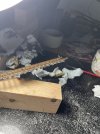

Again the effect is rather subtle and doesn’t show up particularly well with phone camera, but it is quite pleasing and more akin to what I was aiming for (rather than the first dabbed on version and the dry brushed technique used on the points):


Consequently, despite the protracted process it’s become, I’vedecided to adopt the same for the points in the station area.
The good thing about this is that I don’t need to mask off the sleepers first as the I’m using the finest nozzle and needle in the airbrush which ensures the bloom of paint remains no greater than rail height. I discovered this quite by accident after mixing the paint and setting up the airbrush and realising I’d forgotten to mask off………
jonte
A couple of lengths saw me removing the clumps of salt quite easily with an old toothbrush, but in the main it was necessary to generally soak them with water - to which had been added some washing up liquid - using a paint brush. A further, more focussed, cleaning was then undertaken to dissolve the more stubborn clumps.
Here’s an example cleaned with just a toothbrush but requiring a wash to remove the dusty residue:
The effect is quite subtle and I’m rather pleased with it.
Here are a couple more of the rails in the process of being cleaned with water:
Again the effect is rather subtle and doesn’t show up particularly well with phone camera, but it is quite pleasing and more akin to what I was aiming for (rather than the first dabbed on version and the dry brushed technique used on the points):
Consequently, despite the protracted process it’s become, I’vedecided to adopt the same for the points in the station area.
The good thing about this is that I don’t need to mask off the sleepers first as the I’m using the finest nozzle and needle in the airbrush which ensures the bloom of paint remains no greater than rail height. I discovered this quite by accident after mixing the paint and setting up the airbrush and realising I’d forgotten to mask off………
jonte

AdeMoore
Western Thunderer
Just caught up again Jon all going very well as in the finished results not the have to redo bits!
On cleaning your air brush have a look at Boomer Diorama's on You Tube he uses a lot of IPA to thin his paint and in the air brush never has to clean it he says! The videos are searchable to find a relevant one.
On cleaning rail tops I just use a piece of wood run along the painted tops might drag the odd bit of paint off but easy touching in.
Keep up the good work.
Happy New Year.
On cleaning your air brush have a look at Boomer Diorama's on You Tube he uses a lot of IPA to thin his paint and in the air brush never has to clean it he says! The videos are searchable to find a relevant one.
On cleaning rail tops I just use a piece of wood run along the painted tops might drag the odd bit of paint off but easy touching in.
Keep up the good work.
Happy New Year.