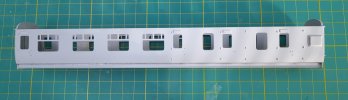
4mm B.S.L./Phoenix Coach Kits - A Retrospective.

Mike Trice

Western Thunderer
Positions mapped out with my gadget and unipin fine line pen:
20250723_095416.jpg

This time I used some Fablon Chrome Sticky Back Plastic cut into strips and applied. The Fablon seems less inclined to stretch and seems to stick quite well. Actually went on quite easily:
20250723_102817.jpg

Given a blast of white primer to help hold in place and assess the thickness of the bands. I think the will do (not easiest to photograph if I am honest):
20250723_104219.jpg
 

LarryG

Western Thunderer
Jeepers Mike ......Always test spray on something else before spraying. Re roof ribs, I never even attempted to fit them to my coaches after years of gluing down Derek's tape that had 'sprung'. Instead, I scribed the roofs with bands...........Permanent and nothing to go wrong later in life. Longnitudal rainstrips were a different matter and never came unstuck at the ends.

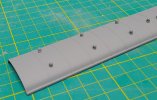
Roof vents. Pop them in holes, place a spare roof on top to hold them all in place while you invert the roof and run a touch of Evostik Impact round them to secure.

Evostik was the only glue Derek used when during assembly of BSL coaches....Ends, sides and roof. It must have been adequate seeing as many hundreds of his coaches are still about in one piece after half a Century.
 

Mike Trice

Western Thunderer
Considering the number of times I have fallen foul of that, you would have thought I would have learnt my lesson by now. Old habits die hard.

My recent Dave Studley painted Lawrence Gresley had a couple of windows that had come unstuck. It looks as if the glazing itself warped. Managed to prise the roof off by carefully inserting a scalpel at the ends which was enough to release the EvoStik. The sides were not glued.
 

LarryG

Western Thunderer
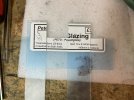
The glazing material Derek used shrank over time and I've also seen it yellowing. The man I obtained my glazing from passed away. It was great stuff that was thick enough to lie flat like glass, yet pliable. It came with a blue peel-off protective skin. I've forgotten where my last glazing came from.
 

Mike Trice

Western Thunderer
Interesting. I have a sheet of 0.5mm glazing I was going to use which coincidentally has a blue protective layer. I think it came from the 4D Model Shop as was.
 

Mike Trice

Western Thunderer
Guess what I have done!
20250724_104401.jpg

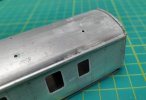
Yep, broken it down into its component parts again. Why? Well for some reason the roof was too narrow to comfortably fit over the sides.

Carefully filed the end rebates in the castings including underneath and this time thought "Lets use EvoStik". That actually went quite well for once.

The roof now fits correctly however the ends need filing down to allow it to overhang correctly. I have checked this against another kit which seems to have to same problem:
20250724_161335.jpg

I have reinforced some of the EvoStik joints with standard epoxy so tomorrow I will try and reprofile the ends. Meanwhile the roof has been shortened by 1.5mm in preparation.

I will NOT let this kit beat me.
 

simond

Western Thunderer
The name “Cobex” rings a bell, however, I have a jigsaw of these parts, unfortunately I do not have a complete label…

image.jpg
 

simond

Western Thunderer
PETG glazing here: I’m sure there are other suppliers.


Mike Trice

Western Thunderer
Based on the suggestion by @paulc earlier, I used masking tape this time. It was quite easy to use. As before roof had been presprayed with uPol Acid Etch:
20250726_103334.jpg

I did worry that the tape may not have been thick enough but after spraying with some Halfords' grey primer (testing the spray before I did it for real) I was quite happy with the result:
20250726_105527.jpg

As can be seen the roof does now fit:
20250726_105233.jpg
 

Mike Trice

Western Thunderer
I have started looking at the bogie kit for this vehicle. As designed and supplied these castings were for use with the early non-pinpoint type of Jackson wheel. Most people constructed them without bearings and as a result they were not terribly free running. I felt it would be good to use more modern wheelsets with brass bearings.

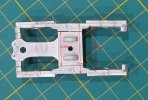
These are the main dimensions of the bogie (a lot of straightening still required):
20250728_214142.jpg

The supplied (aluminium?) wheelsets have axles 23.8mm long. Modern pinpoint wheelsets have axles 26mm over the points. Tophat type bearings are designed to fit a 23.5mm to 24mm "gap". Clearly 19.93mm is not going to cut it. The overall width of 25mm is not far off scale so how to proceed? I could simply use some form of internal etched bogie and then thin the sideframes and add them but these would probably be too wide. I could use alternative bogies such as those from Bachmann, MJT or Wizard but my philosophy throughout has been to try and keep things in the spirit of the original kits. Of course I could ignore using pin points altogether.

I think what I will do is rebate the new bearings into the castings to give me the required depth. It looks as if there is sufficient whitemetal to allow this.

Has anyone done this before?
 

76043

Western Thunderer
I've found Peco round end bearings with round end axles are surprisingly free running. No need for lubricant either. Peco still make them, product code is R-30.

They have the advantage that they don't jog along like pin points do, but roll with a consistency that pin points can never do.
Tony
 

Mike Trice

Western Thunderer
Tony, I like the sound of using the Peco R30 bearings as they should involve minimum modification. I should also be able to use normal pin-point axles with them. It is not beyond the realms of possibility that they were also used by original kit builders. Thank you.
 

Mike Trice

Western Thunderer
Still waiting for the bearings to arrive which is very frustrating.

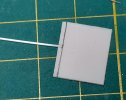
Meanwhile I decided to attempt redoing the door hinges. Door hinges are cut as 1mm lengths of 0.5mm styrene rod. I decided I could improve the cutting of these and made a simple jig from 20thou styrene:
20250731_160456.jpg

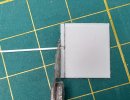
The rod is placed in the jig slot up to the stop:
20250731_160527.jpg

A knife is used to cut the small rod section off. Now this is obviously a posed photograph. I found I can hold the jig still with two fingers of one hand, then hold the rod in place with the little finger of the other hand and still manage to hold the knife. Doing this and holding the camera was a step too far:
20250731_160545.jpg

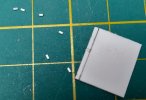
Usefully the cut rod is less likely to ping away onto the carpet (that comes later so cut more than you need):
20250731_160827.jpg

I tried gluing the hinges in place using JB Kwik Weld but it was not a very strong joint. In the end I decided to use superglue applied with a plastic toothpick. The toothpicks are available from branches of Savers for £1 per 100. A small amount of superglue is applied to the foil then the toothpick tip dipped in and a small globule applied to the model. A scalpel is used to carefully pick up one of the hinges (often pinging away in the process) and applied to the side:
20250802_100217.jpg

I have tried to stick (pun not intended) to materials available to builders of these kits when they were first introduced. A lot of people did not bother with the hinges but they do add some much needed detail. I can remember being introduced to Superglue during my time at Hobbytime so feel it is appropriate to use if here.
 

Mike Trice

Western Thunderer
The Peco bearing cups arrived yesterday. They are quoted as 2.5mm outside diameter but on measuring are 2.57mm so I have now had to order some 2.6mm drills :mad:
 

Mike Trice

Western Thunderer
Something I have commented on earlier with this LMS kit is the mention in the instructions of fitting duckets, however no duckets appear to have been provided. I ended up opening another Stanier kit which also showed duckets but once again no duckets were provided. Odd.

So I have had to resort to making them.

First off two rectangles were cut from 20thou styrene to the overall size then two strips of 40thou 1.5mm wide glued to the backs:
20250803_200727.jpg

The excess lengths of the side pieces is trimmed and the outer face marked with a 1mm inset:
20250803_201357.jpg

A bevel was crudely shaved off with a scalpel:
20250803_201529.jpg

Careful sanding brings it to size (the apparent sag has since been filed back):
20250803_201939.jpg

The correct position was marked on the sides and the duckets superglued in place. You can see here how much the hinge detail adds to the model:
20250804_083856.jpg

Having sprayed the duckets I can see I still have some minor filing to do to square them up!

The full body:
20250804_083848.jpg
 
Top