And so the first step on the long road of track laying, wiring, ballasting and weathering was taken by laying out the station throat cum junction on a couple of 4mm foamboard sections.
You see (and this is not a criticism of other modellers), whilst it’s difficult to make proprietary track resemble anything even remotely approaching the real thing, the sight of twin roads or more with the continuous spread of ballast from the nearest to furthest sleepers just doesn’t sit right with me; the girder like rails are accentuated and the undernourished sleepers barely visible alongside the boulder-like stones. So how to make it a little more palatable? Not sure I can really, but this is how I intend to ‘address’ it. I hope you can bear with me.
As an aside, it was late Autumn when I last considered the layout ‘plan’. This had been adjusted - or at least the station throat - to allow arriving and departing trains to access all platforms, something the original plan didn’t cater for as this was just intended to be an oval with a couple of sidings off for a platform or two and an engine shed. But as the idea grew, the desire to access all areas became a must, which then (as always, much wants more) led to the ideal of two trains arriving and departing the station at the same time. As things stood, this was not possible as both roads leading to and from the mainline joined on the ‘down’, a problem of a small layout where the throat forms part of the mainline. As baseboard building became the priority, this was put on the back burner; until today; when the track was laid out on the bench as described; what could be done?
Here’s a reminder of how the throat/junction was planned originally and illustrated whilst marking out for baseboard cutting:
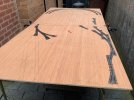
And after some careful head scratching, it occurred to me that this could potentially be achieved by placing a left handed and right handed crossing respectively, either side of the first crossing (on the inside track) of the above picture as follows:
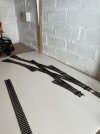
So how to join?
As the points have a radius of - I believe - 2nd radius, it occurred to me to dig out a curve of this radius and place it over the two track sections to see if flowed, which it didn’t. However, a piece if 3rd radius placed similarly seemed a better fit:
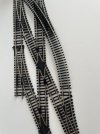
The only problem, I assumed, was that curves of different directions placed so close together - despite the centre section being of ‘less harsh’ radius - could prove problematic.
There was only on way to find out, so I dug out a couple of Bachmann coaches and began to cut up a Hornby 3rd radius double curve (it’s all I had) to fit which thankfully it did:


I will cut a new section to replace this from the remainder of the double curve, as I need the rails to be a little shorter to allow for expansion.
So, on with the testing:

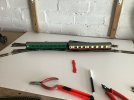
Well, they didn’t come off (those tiny Bachmann couplings might have to be addressed as they look a little too close together for a train set), so I’ll consider it a success. Whether I’ll achieve the same success with the odd long wheelbase kettle remains to be seen, but I’m sure the EMU in my possession and the odd diesel should be fine……..
So back to track laying and the foamboard.
The idea here is to use the foamboard as a ‘cess’ (which I believe is the correct term for the area between the rails) and as a frame to the outside in which the ballast (a mixture of sand and fine ballast) is contained. As the underlay is of 3mm thickness, the ballast laid level with the top of foamboard will see it rest just below the sleeper tops. It is in this way I hope to address the ‘orrible ballast spread described earlier.
And so to marking out:
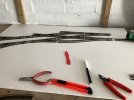
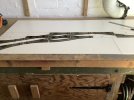

The islands between the tracks, which will be cut out and painted as mentioned, were drawn round with a flexible length of boat building hardwood to ensure that the foamboard cess is a millimetre or two short to allow for underlay spread and excess ballast. The ‘frames’ for the outside were marked out similarly.
So the next visit to the bench will see me cutting out the marked sections of cess etc., and marking out and cutting other sections of track in similar fashion for such things as crossovers.
Thanks for looking.
jonte





 .)
.)




 .
.