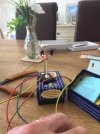
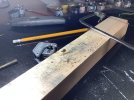
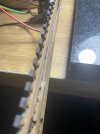
With an odd hour or so spare since my recent last, I subjected the points to a couple more washes. This time, upside down to give a more even hue over the height of the rail. A repeat of the leather was applied only this time stippled in an attempt to replicate the piebald appearance of the weathering to the rails, especially in Waterloo. This was repeated, only on this occasion, I reached for a cream colour added 2:1 to the leather (Humbrol 121, i recall, but any yellowish colour will do). This was because I’ve saved another photo from an online vid which shows a paler shade of ochre. Anyway, where it is currently:


As mentioned previously, this will all be toned with washes of a black brown colour similar to that of the sleeper wash.
Unusually, I had a free modelling day today, although I was reluctant to start. Why? Well, I thought it about time to make a start on the signals now that the materials were to hand. However, whilst I had given much thought to the direction construction would take in the absence of doing any modelling whilst away from home, now that I’m back, I’m just not in the mood.
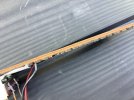
So, I just gave the track (above) another wash.
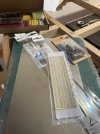
But during lunch, aware that time at the bench is restricted more than ever at present and perhaps so for some time to come, if I’m to complete anywhere near my set time, I dragged myself out to the workshop and picked up the nickel silver sheet which I thought was a good place to start.
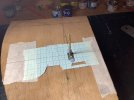
To assist with cutting and marking out, I stuck a length of masking tape to one end and drew a line approximately the width of a BR(S) canopy (slightly larger dimensions than the plastic one I was intending to use and which was under scale at HO) and then made several passes with a Stanley knife:

Then I bent it steadily downwards along the line using the table edge until it broke off:

Then I cut tthe strip into sections, one for each canopy of six using a small square to keep things as straight as possible :
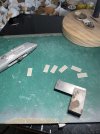
They were elongated at the base unlike the American based plastic ones I’d intended to use, and more in fitting with the SR type, but essentially to satisfy an idea for locating the e canopy and lights in the main stanchion for easy removal (I found out later this was a bum steer). Also shown is some brass tubing I had which I intend to use for the lens covers, and which fits the thin part of the led like a glove:

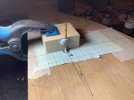
They were elongated sections cleaned up and placed one on top of the other for shaping and drilling, held together by a washing peg clamp to solder each side together:
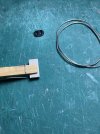
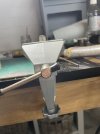
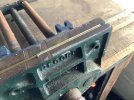
The joined sections in a modelling vice for shaping with a variety of files and drilling:
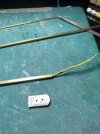
Whilst searching for my bigger files, I discovered another piece of brass tubing which handily is wide enough in diameter to allow the wider section at the base of the led to fit through, which means I can locate the whole length of led inside the lens covers. The section of tube intended for the lens cover and which is also a snug fit for the body of the led is shown (telescpoically) inside it:

Also shown, are the two sections of square tubing, the wider one of which will form the main stanchion. My idea hatched whilst away, was to solder the canopy to this inner section to allow its easy removal from the stanchions should a bulb fail. However, try as I might, I couldn’t get the two wires inside, so that was that idea out of the window. I’ll just have to run with the single wider stanchion which easily accommodates the wires:
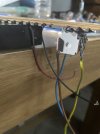
I’ve decided that the cathodes for each led can be solder to the rear of the canopy fir each signal, a wire then soldered to the base of the stanchion to which a resistor can be attached (as long as the lights don’t illuminate at the same time a single resistor can be used).
The light canopies after using a wider drill fir the leds (they will be opened up with a reamer when the time comes):
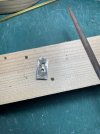
………and finally separated and cleaned up:

Ah well, not a bad start considering My lacklustre mood.
I was going to add something else, but I’m afraid it’s gone……..
Until next time.
jonte


















 !
!